India Women’s National Cricket Team vs New Zealand Women’s National Cricket Team Match Scorecard: IND-W Clinch Thriller by 53 Runs
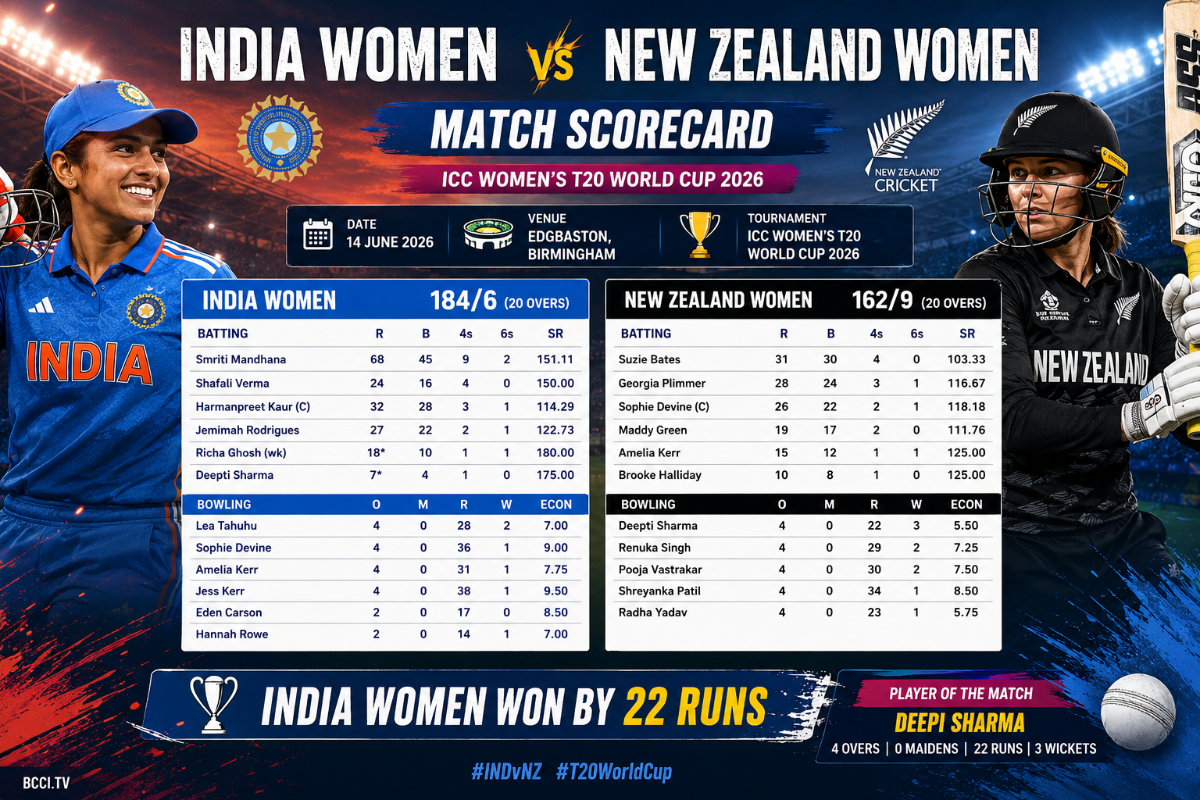
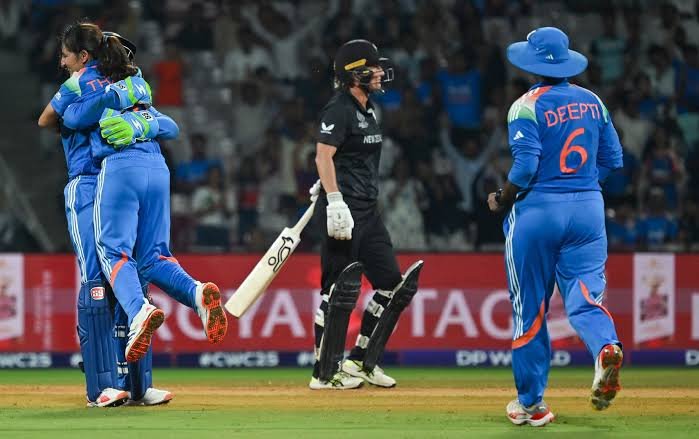
India Women’s National Cricket Team defeated New Zealand Women’s National Cricket Team by 53 runs under the DLS method in a high-scoring World Cup encounter at Dr. DY Patil Sports Academy, Navi Mumbai, with India posting a commanding 340/3 before restricting the Kiwis to 271/8 in a rain-shortened chase. This India Women’s National Cricket Team vs New Zealand Women’s National Cricket Team match scorecard breaks down every batting stat, bowling figure, partnership, and turning point that decided the contest, giving fans, fantasy players, and stats enthusiasts a complete resource in one place. Cricket rarely offers a cleaner example of how a single dropped catch, one blistering opening stand, and a well-timed Power play strike can combine to decide a 340-run contest. This match had all three, and understanding why matters more than simply knowing the final score.
Match Result Summary
India Women’s National Cricket Team beat New Zealand Women’s National Cricket Team by 53 runs (DLS method), with the result built on a record-breaking opening stand and a disciplined bowling effort in the second innings that never allowed New Zealand’s chase to gain real traction. India Women’s National Cricket Team vs New Zealand Women’s National Cricket Team match scorecard. In the match New Zealand won the toss and chose to field first, a decision that looked reasonable on paper given the historical tendency of Powerplay pitches at this venue to offer some early movement. It backfired almost entirely once India’s top order settled in on a genuinely batting-friendly surface. By the time the ball started coming onto the bat, New Zealand’s bowlers had already lost the initiative, and India’s batters made them pay for every loose delivery.
Smriti Mandhana was named Player of the Match for her commanding century, an innings built on patience early and calculated aggression later. Clear weather conditions prevailed for most of the contest, though intermittent rain later forced the DLS method into play during New Zealand’s chase, altering the target and ultimately shaping how the final margin reads on the scorecard.
Key Match Facts
- Result: India Women’s National Cricket Team won by 53 runs (DLS method)
- Venue: Dr. DY Patil Sports Academy, Navi Mumbai
- Toss: New Zealand Women’s National Cricket Team won, elected to field
- Player of the Match: Smriti Mandhana
- India Women’s total: 340/3 in 49 overs
- New Zealand Women’s total: 271/8 in a revised 44-over chase
- Match format: ICC Women’s Cricket World Cup fixture
- Weather impact: Rain interruption forced a DLS recalculation during the chase
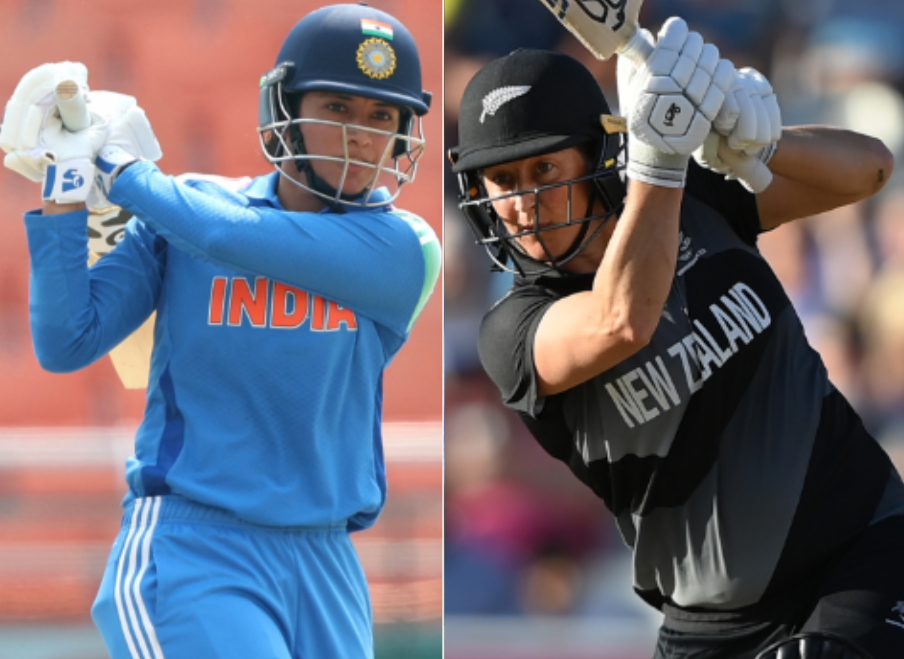
This combination of factors-a flat batting surface, a lopsided toss decision, and weather intervention-created a match that looked straightforward on the surface but carried several layers of tactical nuance underneath.
India Women’s Batting Scorecard: 340/3 in 49 Overs
India Women’s National Cricket Team posted 340/3, built almost entirely on a 212-run opening partnership between Smriti Mandhana and Pratika Rawal, followed by a rapid finish from Jemimah Rodrigues that pushed the total from merely strong to genuinely intimidating. The opening pair batted with contrasting styles that complemented each other perfectly. Mandhana anchored the innings with calculated aggression, picking her moments to attack rather than forcing the pace artificially, while Rawal rotated strike constantly and picked gaps in the field with real precision. This kind of ODI batting depth, where the top three combine control with acceleration at different phases, is exactly what separates dominant totals from merely competitive ones in modern women’s cricket.
Read More: West Indies Cricket Team vs Scotland National Cricket Team Match Scorecard
Batting Card
| Batter | Runs | Balls | 4s | 6s | Strike Rate |
| Smriti Mandhana | 122 | 134 | 13 | 2 | 91.04 |
| Pratika Rawal | 109 | 95 | 10 | 4 | 114.73 |
| Jemimah Rodrigues | 76 | 55 | 7 | 0 | 138.18 |
| Harmanpreet Kaur (c) | 10 | 11 | 1 | 0 | 90.90 |
| Richa Ghosh (wk) | 4* | 1 | 1 | 0 | 400.00 |
Why the Opening Stand Mattered
A 212-run opening partnership in women’s ODI cricket is a match-defining event rather than an incidental stat buried in a scorecard. Once Mandhana and Rawal blunted New Zealand’s new-ball attack through the Powerplay overs, the middle order-Harmanpreet Kaur and Jemimah Rodrigues-batted with total freedom, knowing wickets in hand allowed them to attack from the very first ball they faced. Rodrigues’ unbeaten cameo of 76 off just 55 deliveries turned a strong total into an imposing one, striking at nearly 138 in the closing overs when the required acceleration mattered most. Her innings included clever use of the crease, stepping out to spin and manipulating field placements to find boundary options that weren’t obviously available. This is the kind of situational batting intelligence that stats alone rarely capture, but it directly explains why India’s final total ballooned rather than plateaued.
The Middle-Order Cameo That Sealed the Total
Harmanpreet Kaur’s brief innings of 10 off 11 balls might look unremarkable on paper, but it came at a stage where India needed quick runs without risking a batting collapse. Her dismissal-caught brilliantly by a diving Eden Carson at backward point-was a rare moment where New Zealand’s fielding matched the intensity the situation demanded. Richa Ghosh’s unbeaten 4 off just 1 ball, including a streaky edge that raced to the boundary, summed up how fortune tilted India’s way in the closing stages of the innings.
New Zealand Women’s Batting Scorecard: 271/8 in 44 Overs
New Zealand Women’s National Cricket Team fell 53 runs short, managing 271/8 despite twin fifties from Brooke Halliday and Izzy Gaze, as regular wickets in the middle overs disrupted their chase momentum at exactly the wrong moments.
Unlike India’s clean top-order platform, New Zealand’s innings was interrupted repeatedly by early breakthroughs, forcing their middle order into constant rebuilding mode rather than the free-flowing acceleration a 340-plus target demands. Chasing a total of this magnitude requires either a rapid start or sustained partnerships through the middle overs, and New Zealand managed neither consistently enough.
Batting Card
| Batter | Runs | Balls | 4s | 6s | Strike Rate |
| Brooke Halliday | 81 | 84 | 9 | 1 | 96.42 |
| Izzy Gaze (wk) | 65 | 51 | 10 | 0 | 127.45 |
| Georgia Plimmer | 30 | – | – | – | – |
| Amelia Kerr | 22 | – | – | – | – |
| Jess Kerr | 18 | 13 | 1 | 1 | 138.46 |
| Rosemary Mair | 1 | 3 | 0 | 0 | 33.33 |
Halliday-Gaze Partnership: Too Little, Too Late
Halliday and Gaze combined for a rebuilding partnership after New Zealand lost early wickets, but the required run rate had already climbed well beyond a comfortable chase rate by the time they got going. Both fifties came at a strike rate that kept New Zealand in theoretical contention on paper, but the asking rate outpaced their acceleration curve, and neither batter could convert their promising start into the match-defining century that a chase of this size demanded. Gaze’s innings, in particular, deserves recognition for its intent-she mixed calculated risk-taking, including a scoop over short fine leg for four, with genuine situational awareness, rotating strike relentlessly to prevent the required rate from spiraling out of control. Halliday’s approach was more conventional, relying on classical stroke play through the covers and consistent running between the wickets, but both fell short as partners around them struggled to stay in.
Why New Zealand’s Middle Order Struggled
The core issue for New Zealand wasn’t a lack of individual quality-it was the absence of a partnership beyond 39 runs anywhere in the innings after the early wickets fell. In a chase this large, batting sides typically need at least one stand in excess of 60-70 runs to keep the required rate manageable. New Zealand never found that stand, and by the time Halliday and Gaze were dismissed, the tail simply didn’t have enough overs or wickets in hand to complete an improbable finish.
Bowling Performance: Deepti Sharma’s Consistency Stands Out
Deepti Sharma extended her tournament-long streak of taking at least one wicket in every match, finishing the innings by removing Rosemary Mair, while Renuka Singh Thakur provided the crucial early breakthroughs that dented New Zealand’s chase before it ever gathered momentum.
India’s Bowling Figures
| Bowler | Overs | Runs | Wickets | Economy |
| Deepti Sharma | 8 | 57 | 1 | 7.12 |
| Kranti Gaud | 9 | 48 | 2 | 5.33 |
| Renuka Singh Thakur | – | – | 2 | – |
| Sneh Rana | – | – | 1 | – |
Deepti Sharma’s economy of 7.12 might look expensive on the surface, but context matters here-she bowled through the phase when New Zealand were attempting to accelerate, absorbing pressure while still striking at the right moment to remove Mair and seal the innings. Kranti Gaud’s figures of 2 for 48 across nine overs reflect a bowler who mixed variations effectively, drawing false shots that eventually led to dismissals in the middle overs.
The Powerplay Breakthroughs That Changed the Chase
India Women’s National Cricket Team vs New Zealand Women’s National Cricket Team match scorecard, Renuka Singh Thakur‘s twin strikes inside the Power play-removing Georgia Plimmer and captain Sophie Devine in successive overs-reduced New Zealand to 59/3 and forced an immediate change in approach from the chasing side. Instead of chasing at a controlled, measured rate, Halliday and Gaze were pushed into rebuild mode from roughly the tenth over onward, a tactical setback New Zealand never fully recovered from for the remainder of the innings. This is precisely the kind of new-ball impact that shifts a match’s entire complexion. When a chasing team loses its captain and an in-form top-order batter inside the first ten overs of a 340-plus chase, the pressure compounds rapidly-not just in terms of the required run rate, but in the psychological weight it places on the remaining batters to both rebuild and accelerate simultaneously.
Fall of Wickets: New Zealand’s Innings Breakdown
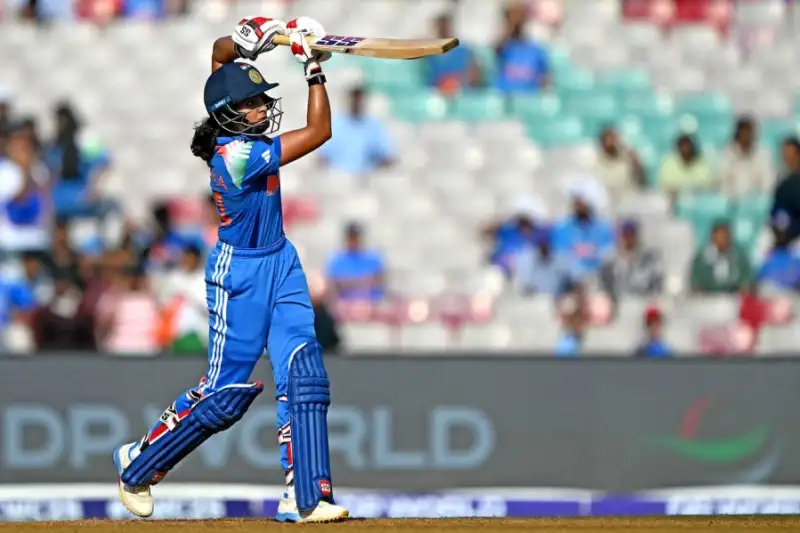
New Zealand lost wickets at 1-9, 59-3, 154-5, 261-6, and 271-8, with the middle-overs period between the 20th and 35th over proving the most costly stretch of their entire chase.
Wicket-by-Wicket Timeline
- 1st wicket (9 runs): Suzie Bates caught early off Renuka Singh Thakur inside the Powerplay, setting an uneasy tone from the outset
- 3rd wicket (59 runs): Georgia Plimmer and Sophie Devine both dismissed in successive overs, effectively ending New Zealand’s hopes of a controlled chase
- 5th wicket (154 runs): Falling after a 39-run stand between Halliday and Maddy Green, the best partnership New Zealand managed all innings
- 6th wicket (261 runs): Jess Kerr departs for a brisk 18 off 13, caught brilliantly by Mandhana off Kranti Gaud at point
- 8th wicket (271 runs): Rosemary Mair caught off Deepti Sharma, sealing the result and confirming India’s 53-run win
Turning Point of the India Women’s National Cricket Team vs New Zealand Women’s National Cricket Team match scorecard
The single biggest moment came in the 48th over of India’s innings, when Maddy Green dropped Jemimah Rodrigues on 71 at long off-a missed chance that directly enabled India’s late surge past 320 toward the eventual 340.
In high-scoring women’s ODI cricket, an extra 20 runs at the death doesn’t just pad the scoreboard statistically-it materially shifts win probability by giving the bowling side less margin for error and handing the batting side a genuine psychological cushion heading into the field. Had that catch stuck, New Zealand would have chased a target closer to 310-320, a considerably more gettable number given the platform Halliday and Gaze eventually built through the middle overs. This single moment illustrates why fielding standards in modern women’s cricket have become such a decisive factor in close contests. Bowling and batting get the headlines, but a dropped catch at a critical juncture can single-handedly swing a match’s eventual margin by 20-30 runs, exactly as it did here.
Why the DLS Method Was Used
Rain interruptions reduced New Zealand’s chase from a full 50 overs to 44, meaning the eventual 53-run margin was calculated using the DLS (Duckworth-Lewis-Stern) formula rather than a direct run comparison between two completed innings.
The DLS method recalculates a fair target based on overs and wickets remaining at the point of interruption, weighing resource loss on both sides of the ledger rather than simply comparing final totals. Because only New Zealand’s innings was affected by the reduction in this instance, the revised target and resulting margin reflect resource-adjusted par scores rather than a straightforward 340-versus-271 comparison that casual observers might assume from the scorecard alone. Understanding DLS matters for fans following T20 and ODI cricket generally, since rain-affected matches are common across most cricketing nations, and the method directly influences both the chasing target and how a final margin should be interpreted.
Tournament and Head-to-Head Impact
This win strengthened India Women’s National Cricket Team’s push toward the semifinal stage of the tournament, building on a campaign defined by top-order consistency and Deepti Sharma’s reliability with the ball across multiple fixtures. New Zealand’s campaign, meanwhile, now faces mounting pressure after a batting effort that produced two individual fifties but no substantial partnership beyond 39 runs-a pattern that has repeatedly cost them in tight chases this tournament. Historically, both sides have traded dominant performances in ODI cricket over the years, with matches between India and New Zealand often decided by which top order fires first. India’s depth through the top four-Mandhana, Rawal, Rodrigues, and Harmanpreet Kaur-has increasingly proven the difference in recent encounters between these two nations, and this match reinforced that trend once again.
Key Stats and Records Worth Noting
- 212-run opening stand between Mandhana and Rawal ranks among the highest opening partnerships recorded between these two nations in ODI cricket
- Deepti Sharma’s wicket-per-match streak continues unbroken through the tournament, underlining her value as a frontline spin option
- Jemimah Rodrigues’ strike rate of 138.18 was the highest among all batters in the match, reflecting her impact in the death overs
- Izzy Gaze’s 10 fours were the most boundaries struck by any individual batter in the game, despite finishing on the losing side
- Renuka Singh Thakur’s two early wickets proved the difference between a controlled and a rushed New Zealand chase
Frequently Asked Questions:
Who won the India Women’s National Cricket Team vs New Zealand Women’s National Cricket Team match?
India Women’s National Cricket Team won by 53 runs under the DLS method after posting 340/3 against New Zealand’s 271/8.
What was the full match scorecard result?
India Women’s National Cricket Team scored 340/3 in 49 overs, New Zealand Women’s National Cricket Team responded with 271/8 in a revised 44-over chase.
Who was named Player of the Match?
Smriti Mandhana won Player of the Match for her 122 off 134 balls in India’s 212-run opening partnership with Pratika Rawal.
Why was the DLS method applied in this match?
Rain interruptions shortened New Zealand’s chase to 44 overs, requiring the DLS method to calculate a fair, resource-adjusted target.
What was the highest individual score in the match?
Smriti Mandhana’s 122 was the highest individual score, followed closely by Pratika Rawal’s 109 in the same opening partnership.
How many runs did the opening partnership produce?
Mandhana and Rawal added 212 runs for the first wicket, forming the backbone of India’s imposing total.
Which bowler took the most wickets in the match?
Kranti Gaud and Renuka Singh Thakur each took two wickets, sharing the bowling workload effectively across the innings.
What was the turning point of the match?
A dropped catch of Jemimah Rodrigues in the 48th over allowed India to push their total from around 320 toward 340, widening the eventual margin.
Who scored a fifty for the New Zealand Women’s National Cricket Team?
Brooke Halliday (81) and Izzy Gaze (65) both scored fifties, but neither could convert their start into a match-winning innings for their side.
Where was this match played?
The India Women’s National Cricket Team vs New Zealand Women’s National Cricket Team match was played at Dr. DY Patil Sports Academy in Navi Mumbai.

Related Posts
Profilbau Victoria United vs Powergen Penal SC Match Scorecard: PPS Win by 4 Runs
India Legends vs West Indies Legends Match Scorecard: Binny 50, Pollard 74 Decide WCL 2025 Thriller