Pakistan National Cricket Team vs West Indies Cricket Team Timeline: Complete Head-to-Head History, Records, and Rivalry Breakdown
The Pakistan National Cricket Team vs West Indies Cricket Team Timeline stretches back to 1958, when a dominant Caribbean side put a young Pakistan through the wringer in Test cricket’s early days. Nearly seven decades later, the rivalry has flipped on its head -Pakistan now holds the historical edge across Tests and T20Is, while the West Indies have quietly built a lead in the ODI format. This isn’t a rivalry defined by constant intensity like Pakistan vs India, but it has produced some of the most tactically fascinating cricket of the modern era, shaped by fast-bowling duels, unpredictable batting collapses, and a current series (July-August 2026) that’s reigniting interest in this fixture. What makes this rivalry genuinely interesting for modern fans isn’t just the numbers -it’s the way the balance of power has shifted across generations. In the 1950s and 1960s, West Indies were essentially unbeatable. By the 2010s, Pakistan had turned the tables completely in white-ball cricket. And now, in 2026, there are early signs that West Indies’ pace bowling resurgence could tilt the rivalry again, at least in the Test arena. Understanding this back-and-forth is essential to understanding why the current series carries more weight than a typical two-Test tour.
Who Leads the Pakistan vs West Indies Head-to-Head?
Pakistan leads the all-time head-to-head record against West Indies, having won 103 of 220 international matches across Tests, ODIs, and T20Is combined, compared to West Indies’ 96 wins, with the remainder drawn, tied, or ending without a result. Pakistan’s advantage is driven almost entirely by their dominance in the shortest format, where they’ve won 17 of 24 T20I meetings, while West Indies still hold a narrow lead in ODIs. This overall lead is worth pausing on because it isn’t uniform. If you isolate any single format, the story changes dramatically. Pakistan’s Test record is close but favorable, their ODI record is actually a losing one, and their T20I record is one of the most dominant format-specific head-to-heads in modern cricket. That variance is the real story of this rivalry -it’s not one team simply being better than the other, it’s two teams that have specialized in different disciplines against each other.
Combined Head-to-Head Record (All Formats)
| Format | Matches | Pakistan Won | West Indies Won | Drawn/Tied/NR | First Played | Last Played |
| Test | 56 | 22 | 19 | 15 (draws) | 1958 | 2026 |
| ODI | 140 | 64 | 73 | 3 (tied) | 1975 | 2022 |
| T20I | 24 | 17 | 4 | 3 (no result) | 2011 | 2025 |
| Total | 220 | 103 | 96 | 21 | 1958 | 2026 |
Historical Context: How the Rivalry Began
Pakistan’s first-ever Test against West Indies came in the 1957-58 series, where a West Indies side featuring Garfield Sobers and Everton Weekes crushed Pakistan 3-1 across five Tests, a score line that set the tone for a lopsided early rivalry. West Indies cricket in that era was near-untouchable, and Pakistan -still building its Test-playing identity barely a decade after Partition -struggled to compete with the Caribbean pace and power that would soon terrorize teams across the world. It’s worth remembering the broader context of world cricket at the time. West Indies in the late 1950s were assembling the foundation of what would eventually become one of the most feared teams in the sport’s history. Pakistan, by contrast, had only earned Test status in 1952 and was still finding its footing on the international stage. A 3-1 series loss against that calibre of opposition wasn’t a surprising result -it was, in many ways, an expected outcome given the gulf in experience and depth between the two programs at that stage.
Read More: Scotland National Cricket Team vs Italy National Cricket Team Match Scorecard
What Most Fans Miss About the Early Years
The common narrative treats this rivalry as one-sided from the start, but Pakistan’s batting lineups in the 1970s and 1980s -led by Zaheer Abbas, Javed Miandad, and later Inzamam-ul-Haq -actually built a competitive Test record against West Indies well before the Caribbean side’s decline in the 2000s. Pakistan’s 22-19 Test lead didn’t happen by accident during the “weak West Indies” era alone, it reflects genuine head-to-head competitiveness across multiple generations of players. This is a crucial correction to a lazy assumption many casual fans make. It’s tempting to assume Pakistan’s overall Test lead is simply a product of beating up on a weaker West Indies side after their golden generation retired in the mid-1990s. The reality is more nuanced -Pakistan’s batting depth, particularly through the Miandad and Inzamam eras, was genuinely equipped to handle Caribbean pace even when West Indies still had strong bowling attacks. This matters for understanding the current 2026 series too: Pakistan’s struggles against Seales and company aren’t unprecedented, but they also aren’t guaranteed by history -Pakistan has previously found ways to counter West Indian pace when their batting order is well-organized.
Format-by-Format Breakdown: Test Cricket: Pakistan’s Slight Edge
Pakistan holds a narrow 22-19 lead in Test matches, with 15 matches drawn, out of 56 played since 1958. This format has produced the most draws of any format between these two sides, reflecting a pattern where flat pitches and defensive batting have often neutralized attacking bowling attacks on both ends. The high draw rate in this fixture is itself a notable statistical quirk. Nearly 27 percent of all Test matches between these two sides have ended without a result, a figure that’s higher than many other bilateral Test rivalries in the modern game. This suggests that even in an era of more aggressive, result-oriented Test cricket, Pakistan-West Indies Tests have often been decided by marginal moments rather than overwhelming dominance from either side.
Key Test series moments:
- The 1957-58 series remains West Indies’ most dominant series win (3-1) against Pakistan.
- Pakistan’s most recent bilateral Test series against West Indies in Pakistan (2024-25) ended 1-1, with each side winning one Test.
- The ongoing 2026 tour has seen West Indies win the opening Test in Tarouba, Trinidad, with pace bowler Jayden Seales playing a decisive role in restricting Pakistan’s chase.
Beyond these headline results, the pattern of Test cricket between these two nations has generally favored the home team, which is unsurprising given how much conditions vary between the subcontinent and the Caribbean. Pakistan’s pitches tend to be slower and more spin-friendly, while West Indian surfaces -particularly in Trinidad and Antigua -offer more bounce and carry for fast bowlers. This home-conditions bias is one of the most underappreciated factors in predicting outcomes in this fixture, and it’s exactly what’s playing out in the current 2026 series.
ODI Cricket: West Indies’ Narrow Lead
In the 50-over format, West Indies actually lead Pakistan 73-64 across 140 matches, with 3 ties, making this the one format where the Caribbean side holds a historical advantage. West Indies won all of their first seven ODI meetings against Pakistan after the format’s introduction in 1975, building an early lead that Pakistan has never fully closed. This early dominance is largely explained by the same factor driving West Indies’ Test success in that period -their fast bowling attack, at the time featuring some of the most feared quicks in cricket history, was simply too much for most batting lineups to handle regularly, regardless of format. Pakistan’s ODI record against West Indies has improved considerably in more recent decades, but the historical deficit built up in the 1970s and 1980s has proven difficult to fully erase given how large that head start was. It’s also worth noting that ODI cricket between these two sides has become far less frequent in the 21st century as bilateral scheduling has shifted toward Tests and T20Is, meaning West Indies’ lead in this format is somewhat “frozen” -there simply aren’t as many opportunities left for Pakistan to close the gap through this format alone.
T20I Cricket: Pakistan’s Dominant Format
This is where Pakistan has built a commanding lead. Of 24 T20I meetings since 2011, Pakistan has won 17 compared to West Indies’ 4, with 3 matches ending without a result. West Indies actually won the very first T20I between the two sides in 2011 by seven runs, but Pakistan has dominated nearly every meeting since, including a 3-0 sweep in the UAE in 2016-17 and consecutive series wins through 2021. Pakistan’s white-ball bowling attack -built around variations and death-over control -has consistently troubled West Indies’ aggressive, power-hitting batting approach in T20 cricket, a tactical mismatch that hasn’t shown up the same way in ODIs or Tests. This gap deserves closer tactical examination. West Indies’ T20I approach has traditionally relied on explosive top-order hitting to set up totals or chase quickly, banking on their batters’ power over technique. Pakistan’s bowling strategy against this style has been to use variation-heavy spin and cutters in the middle overs specifically to disrupt timing rather than simply bowling fast and straight. This approach has proven remarkably effective against West Indies’ batting depth, which -whilst capable of explosive periods -has often struggled to sustain momentum against bowlers who change pace rather than bowlers who simply attack the stumps.
Full Series Timeline: Pakistan National Cricket Team vs West Indies Cricket Team Timeline
| Year | Series | Format | Result | Location |
| 1957-58 | Pakistan tour of West Indies | Test | West Indies won 3-1 | West Indies |
| 1975 | First ODI meeting | ODI | West Indies won | Neutral/WI |
| 1987-88 | Pakistan tour of West Indies | ODI | West Indies won 5-0 | West Indies |
| 2011 | First T20I meeting | T20I | West Indies won | Multi-format tour |
| 2013 | Pakistan tour of West Indies | T20I | Pakistan won 2-0 | West Indies |
| 2016-17 | Series in UAE | T20I | Pakistan won 3-0 | UAE |
| 2017 | Pakistan tour of West Indies | T20I | Pakistan won 3-1 | West Indies |
| 2018 | West Indies tour of Pakistan | T20I | Pakistan won 3-0 | Pakistan |
| 2021 (Dec) | West Indies tour of Pakistan | T20I | Pakistan won 3-0 | Pakistan |
| 2024-25 | West Indies tour of Pakistan | Test | Series drawn 1-1 | Pakistan |
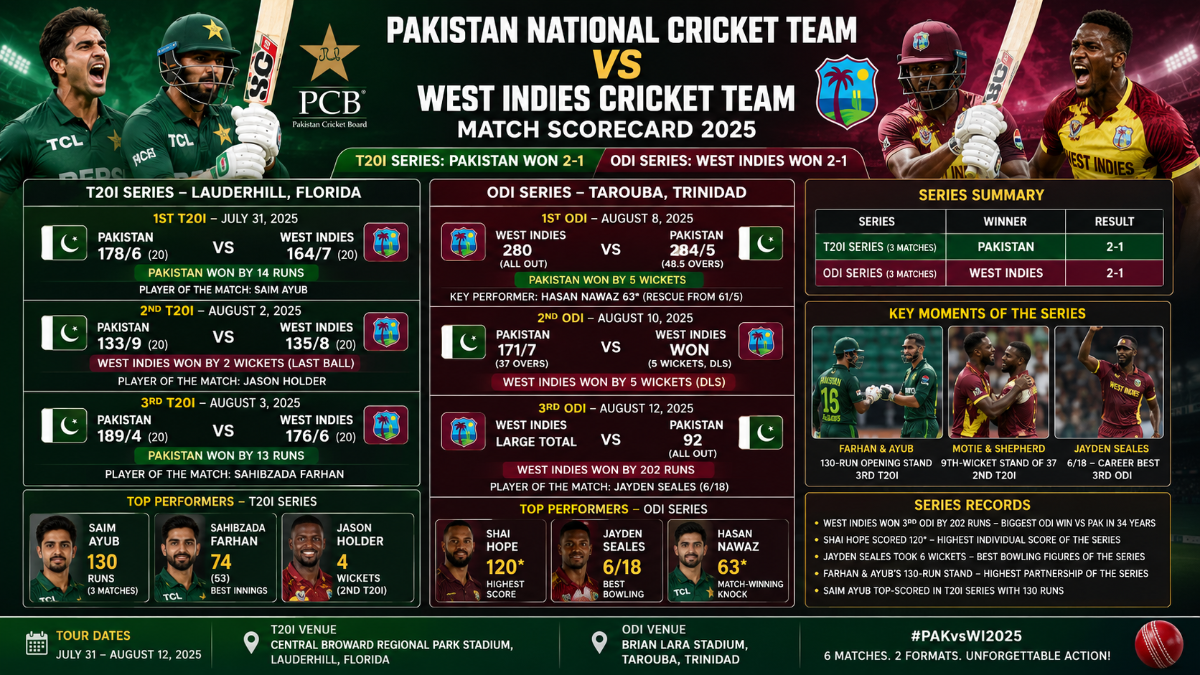
| 2025 (Aug) | Pakistan tour of West Indies | T20I | Series shared | West Indies |
| 2026 (Jul-Aug) | Pakistan tour of West Indies | Test (2-match) | In progress -WI lead 1-0 | West Indies |
This timeline illustrates a clear structural shift over roughly seven decades. The early period (1958 through the mid-1980s) belonged almost entirely to the West Indies. The middle period (late 1980s through the 2000s) saw the rivalry become genuinely competitive, particularly in Test cricket. And the most recent period, especially the 2010s onward, has been defined by Pakistan’s near-total dominance in the shortest format while West Indies has occasionally found footing in home Tests, as the current 2026 series demonstrates.
Current Series: What’s Happening Right Now (July-August 2026)
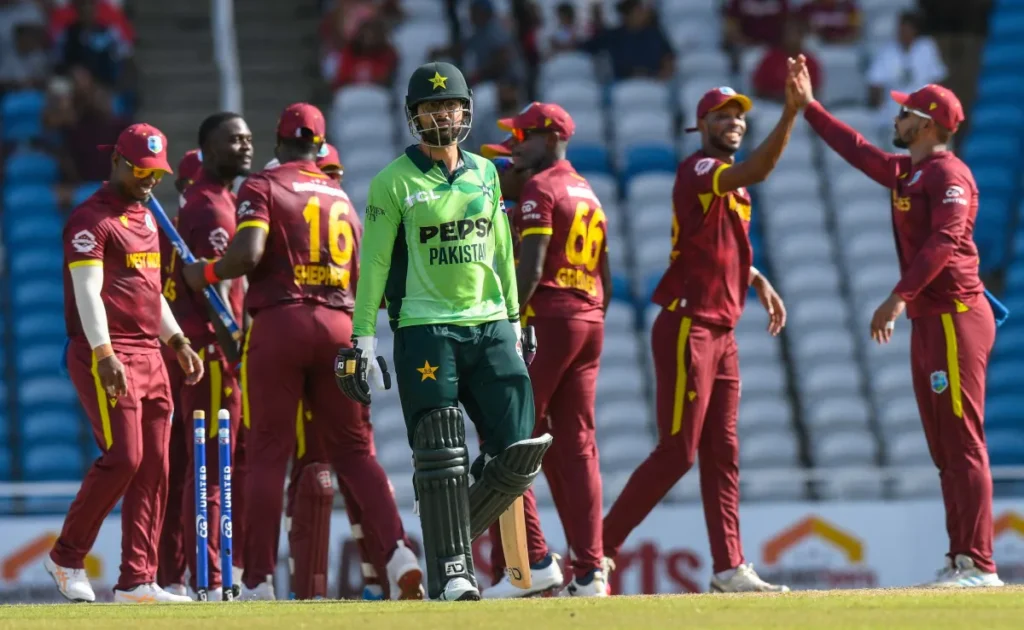
Pakistan’s tour of the West Indies is currently underway, featuring a two-match Test series running from July 18 to August 6, 2026. The opening Test at the Brian Lara Cricket Academy in Tarouba, Trinidad went decisively in West Indies’ favor, with fast bowler Jayden Seales spearheading a pace attack that restricted Pakistan’s fourth-innings chase. Pakistan, chasing 211 for victory, fell well short of the target, handing West Indies a psychological edge heading into the series-deciding second Test.
Snippet Summary: 2026 Series Status
Pakistan currently trail West Indies 1-0 in their ongoing two-Test series after losing the first Test in Tarouba during the third week of July 2026, with the deciding Test scheduled to begin August 2, 2026. The manner of Pakistan’s defeat in the first Test is significant beyond just the scoreline. According to match reporting, Pakistan were still 98 runs short of their target when the innings collapsed under sustained pace pressure, suggesting the batting lineup lost composure rather than being outclassed from the outset. This kind of pressure-moment failure -where a chase looks achievable before unraveling -is often more revealing of a team’s mental fragility than a straightforward heavy defeat would be. For Pakistan’s team management, the second Test now carries series-defining weight. A loss would mean a first bilateral Test series defeat to West Indies on Caribbean soil in recent memory, while a win would level the series and preserve Pakistan’s overall head-to-head Test lead. The pressure squarely sits on Pakistan’s top order to adapt more effectively to Trinidad’s bounce and carry than they managed in the series opener.
Also Read: West Indies Cricket Team vs Italy National Cricket Team Match Scorecard
Tactical Analysis: Why This Rivalry Has Shifted
The biggest tactical story of the modern era is the role reversal in pace bowling. Through the 1980s, West Indies terrorized Pakistan with fast bowling depth few teams could match. In 2026, that dynamic has partially returned -West Indies’ younger pace unit, led by Seales, has started troubling Pakistan’s top order in home conditions, while Pakistan’s own new-look attack featuring Mohammad Ali is still finding its rhythm on unfamiliar Caribbean pitches.
What captains are managing differently now:
- West Indies captains increasingly rely on short bowling spells from a rotating pace attack rather than a single dominant strike bowler
- Pakistan’s team management has experimented with batting depth, exposing new players like Awais and testing them against genuine pace before the senior Test series
- Both boards now schedule tour matches before Test series specifically to acclimatize batters to unfamiliar conditions, a practice that wasn’t standard in earlier decades,
This shift in captaincy philosophy reflects broader trends across modern Test cricket. Workload management for fast bowlers has become a central concern for every Test-playing nation, and West Indies’ rotation-heavy approach with their pace unit is consistent with strategies used by teams like Australia and England in recent years. Rather than relying on a single spearhead bowling long spells, teams now prefer distributing overs across three or four quacks who can consistently bowl at high pace in short, sharp bursts. For Pakistan, the tour-match strategy before the Test series represents a lesson learned from previous tours where batters arrived undercooked against unfamiliar bounce and were exposed immediately in the first innings of a series. Whether this preparation proves sufficient will become clearer as the second Test unfolds, but the early signs from the first Test suggest more adaptation is still needed against genuine Caribbean pace.
Records and Standout Performances
While comprehensive all-time individual batting and bowling leaders across the full 220-match history require deeper archival verification, the most frequently cited standout performer in this fixture historically has been West Indies’ Desmond Haynes, who accumulated significant runs against Pakistan across formats during the 1980s and early 1990s. On the Pakistan side, Javed Miandad and Inzamam-ul-Haq are widely regarded as the most consistent run-scorers against West Indies bowling attacks through the 1980s and 1990s. Haynes’ record against Pakistan is particularly notable because it spans an era when Pakistan’s own bowling attack -featuring legends like Imran Khan and Wasim Akram in different periods -was genuinely world-class. Scoring consistently against that level of bowling talent over an extended career underscores just how significant a player Haynes was during his prime, and why his name still surfaces prominently in head-to-head statistical discussions decades later.
Why This Rivalry Matters Beyond the Numbers
Cricket rivalries are often judged purely on win-loss columns, but the Pakistan-West Indies fixture carries additional context worth understanding. Both nations have experienced periods of significant transition in their cricketing structures -Pakistan through repeated changes in team management and administrative turnover, and West Indies through the broader challenges facing Caribbean cricket’s talent pipeline as many top athletes increasingly pursue T20 franchise careers over international commitments. This backdrop makes bilateral series between these two teams somewhat unpredictable compared to fixtures involving more stable cricketing structures like Australia or England. Form can fluctuate significantly between series, and neither side can be considered a reliable favorite purely based on historical head-to-head numbers, particularly in Test cricket where the format’s demands often expose whichever team has less recent match practice together as a unit.
What Comes Next in This Rivalry
With West Indies leading the ongoing 2026 series 1-0, the second Test starting August 2 will decide whether Pakistan can level the series or whether West Indies extends their recent home advantage. Given Pakistan’s historical strength in white-ball cricket against this opponent, a poor Test series result is unlikely to significantly dent Pakistan’s overall head-to-head lead, but it would extend a concerning pattern of Pakistan struggling on fast, bouncy Caribbean pitches -a tactical weakness their team management will need to address before any future ICC World Test Championship fixtures against West Indies. Looking further ahead, both boards will likely continue scheduling white-ball series between these teams more frequently than Tests, given how commercially valuable T20I cricket has become and how dominant Pakistan has proven in that format specifically against West Indies. Whether that scheduling pattern changes depends partly on how competitive the current Test series ultimately becomes -a genuinely close, hard-fought series could reignite interest in longer-format cricket between these two nations for years to come.
Frequently Asked Questions:
Who has won more matches between Pakistan and West Indies overall?
Pakistan leads the all-time head-to-head record with 103 wins compared to West Indies’ 96 wins across 220 total matches in Tests, ODIs, and T20Is combined.
When did Pakistan and West Indies play their first Test match?
Pakistan and West Indies played their first Test series in 1957-58, with West Indies winning 3-1 across five matches.
What is the head-to-head record in T20Is specifically?
Pakistan dominates the T20I format with 17 wins from 24 matches against West Indies, compared to West Indies’ 4 wins, with 3 matches ending in no result.
Does the West Indies lead Pakistan in any format?
Yes, West Indies hold a narrow lead in One Day Internationals, having won 73 of 140 matches compared to Pakistan’s 64 wins.
What happened in the most recent Test series between the two teams?
The 2024-25 Test series in Pakistan ended 1-1, with each team winning one match. The current 2026 series in the West Indies is ongoing, with West Indies leading 1-0 after the first Test.
Who are the key players to watch in the current 2026 series?
West Indies pace bowler Jayden Seals has been the standout performer so far, while Pakistan’s new-look pace attack featuring Mohammad Ali is being closely watched as the series progresses.
Where is the 2026 Pakistan vs West Indies Test series being played?
The series is being held in the West Indies, with the first Test played at the Brian Lara Cricket Academy in Troupe, Trinidad.
How many times have Pakistan and West Indies played each other in total?
The two teams have met 220 times across all three international formats since 1958.
Has Pakistan ever won a Test series in the West Indies?
Pakistan has recorded Test series wins on West Indian soil in past decades, though their overall away Test record against West Indies remains competitive rather than dominant, reflecting the difficulty of touring Caribbean conditions.
When does the 2026 Pakistan vs West Indies series conclude?
The second and final Test of the current series is scheduled to begin August 2, 2026, in the West Indies.

Related Posts
Bangladesh Women vs Australia Women’s National Cricket Team Timeline: Every Match, Every Record
Oman National Cricket Team vs Namibia National Cricket Team Timeline: Complete Head-to-Head History, Stats & Records (2019-2026)