1983 World Cup Scorecard: The Full India vs West Indies Final Breakdown
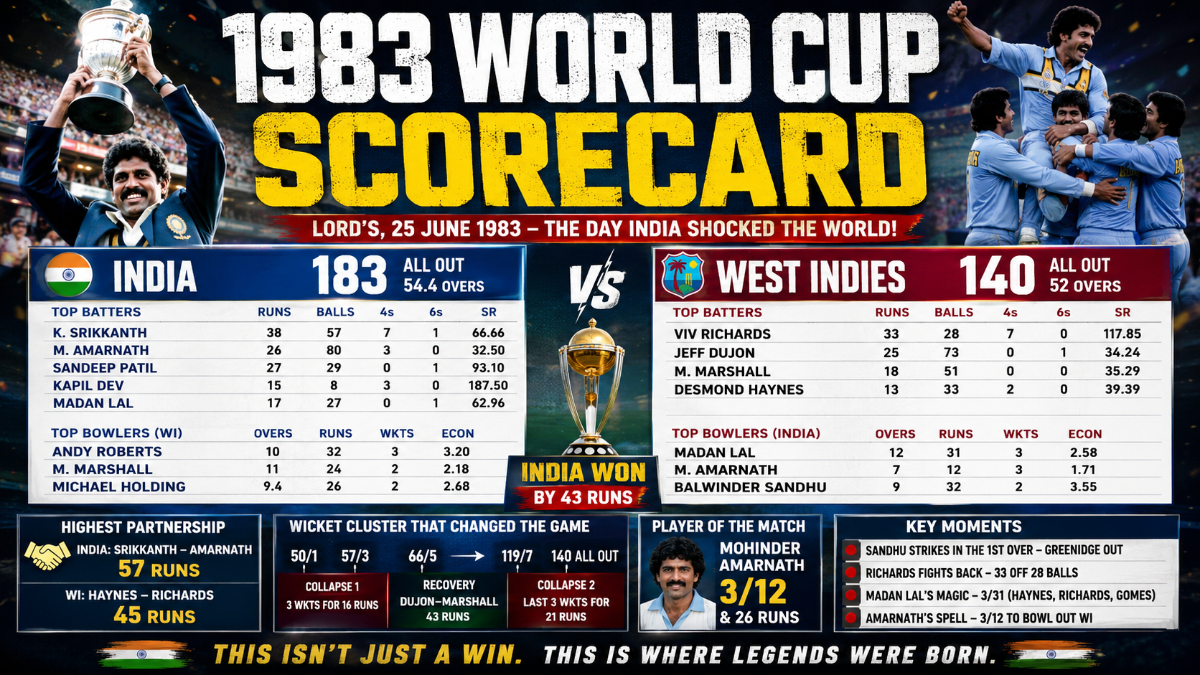
The 1983 World Cup Scorecard for the final shows India defeating West Indies by 43 runs at Lord’s on 25 June 1983. India were bowled out for 183 in 54.4 overs, and West Indies, chasing 184, collapsed to 140 all out in 52 overs. Mohinder Amarnath was named Player of the Match for his all-round contribution of 26 runs and 3 wickets for 12 runs. This result gave India their first-ever Cricket World Cup title and remains one of the most studied upsets in the sport’s history.
Anyone searching for the exact 1983 World Cup Scorecard usually wants three things fast: the final result, the batting and bowling figures, and the story behind how a team given 66-1 odds before the tournament beat the two-time defending champions. This article covers all three, backed entirely by verified match records rather than assumption or retelling.
Match Overview: India vs West Indies, 1983 World Cup Final
India won the 1983 World Cup final by 43 runs, restricting West Indies to 140 after posting 183 at Lord’s on 25 June 1983.
The final of the Prudential World Cup 1983 pitted a West Indies side chasing its third consecutive world title against an Indian team many considered rank outsiders. West Indies had won the toss and chose to field first, backing a pace attack of Andy Roberts, Malcolm Marshall, Joel Garner, and Michael Holding to dismantle India cheaply. That plan half-worked-India were restricted to 183-but it wasn’t nearly enough.
Key Match Details
| Detail | Information |
| Match | Final, Prudential World Cup 1983 |
| Date | 25 June 1983 |
| Venue | Lord’s, London |
| Toss | West Indies won, elected to field |
| Result | India won by 43 runs |
| Player of the Match | Mohinder Amarnath |
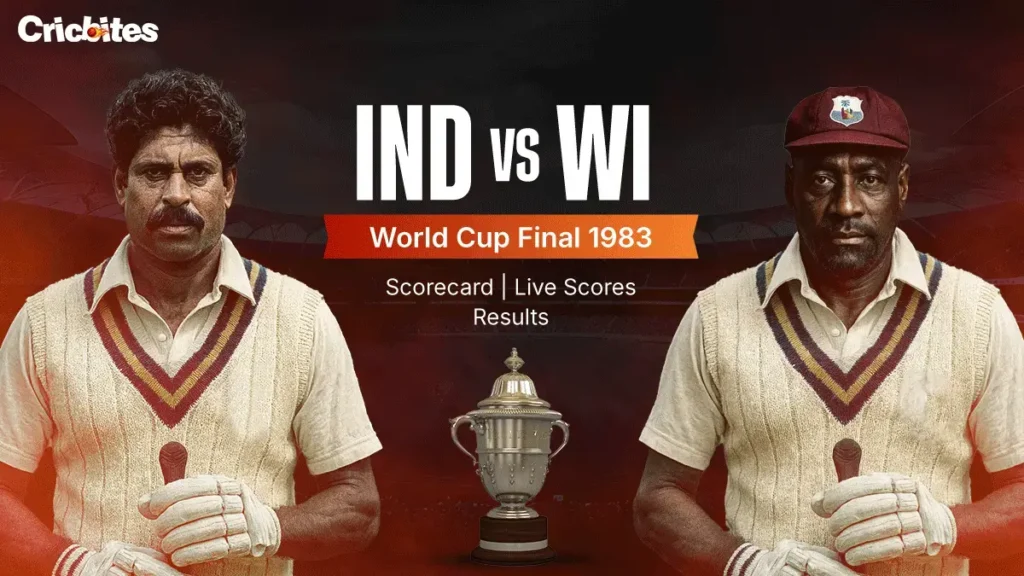
This match remains the reference point whenever cricket fans discuss the greatest upsets in World Cup history, and it’s the single most-searched entry point into any 1983 World Cup Scorecard archive.
Road to the Final: How Both Teams Reached Lord’s
India qualified for the final by finishing second in Group B and beating hosts England by six wickets in the semi-final, while West Indies topped Group B and beat Pakistan by eight wickets in their semi-final.
Understanding the road each side traveled adds real context to the final’s 1983 World Cup Scorecard-West Indies arrived as two-time defending champions, while India had won only one previous World Cup match before this tournament.
Read More: 2011 World Cup Final Scorecard
India’s Group Stage and Semi-Final Results
| Match | Opponent | Result |
| Group B | West Indies | Won by 34 runs (262/8 vs 228) |
| Group B | Zimbabwe | Won by 5 wickets |
| Group B | Australia | Lost by 162 runs |
| Group B | West Indies | Lost by 66 runs (216 vs 282/9) |
| Group B | Zimbabwe | Won by 31 runs |
| Group B | Australia | Won by 118 runs |
| Semi-Final | England | Won by 6 wickets (217/4 vs 213) |
India actually beat West Indies once in the group stage before losing the reverse fixture, meaning the final was effectively the decider in a rivalry that had already gone one match each earlier in the tournament.
West Indies’ Group Stage and Semi-Final Results
| Match | Opponent | Result |
| Group B | India | Lost by 34 runs |
| Group B | Australia | Won by 101 runs (252/9 vs 151) |
| Group B | India | Won by 66 runs (282/9 vs 216) |
| Group B | Zimbabwe | West Indies finished Group B in first place |
| Semi-Final | Pakistan | Won by 8 wickets (188/2 vs 184/8) |
West Indies finished Group B in first place with 20 points from six matches, while India finished second with 16 points, setting up a final between a group-stage table-topper and a team that had already beaten them once earlier in the same tournament.
Tournament Summary Table
| Team | Group Stage Finish | Semi-Final Result | Final Result |
| India | 2nd, Group B | Beat England by 6 wickets | Won by 43 runs |
| West Indies | 1st, Group B | Beat Pakistan by 8 wickets | Lost by 43 runs |
India Innings: 183 All Out in 54.4 Overs
India were bowled out for 183 runs in 54.4 overs, with Krishnamachari Srikkanth top-scoring on 38 and Mohinder Amarnath contributing a steadying 26.
Batting first under heavy cloud cover, India lost Sunil Gavaskar for just 2 runs in the first over, caught behind off Andy Roberts. That early setback against a genuinely hostile pace attack could have triggered a total collapse. Instead, Krishnamachari Srikkanth’s counter-attacking innings of 38 off 57 balls, laced with seven boundaries, absorbed the pressure and gave India something to build on.
Full Batting Scorecard
| Batter | Runs | Balls | 4s | 6s | SR | Dismissal |
| Sunil Gavaskar | 2 | 12 | 0 | 0 | 16.66 | c Dujon b Roberts |
| Krishnamachari Srikkanth | 38 | 57 | 7 | 1 | 66.66 | lbw b Marshall |
| Mohinder Amarnath | 26 | 80 | 3 | 0 | 32.50 | b Holding |
| Yashpal Sharma | 11 | 32 | 1 | 0 | 34.37 | c sub (Logie) b Gomes |
| Sandeep Patil | 27 | 29 | 0 | 1 | 93.10 | c Gomes b Garner |
| Kapil Dev (c) | 15 | 8 | 3 | 0 | 187.50 | c Holding b Gomes |
| Kirti Azad | 0 | 3 | 0 | 0 | 0.00 | c Garner b Roberts |
| Roger Binny | 2 | 8 | 0 | 0 | 25.00 | c Garner b Roberts |
| Madan Lal | 17 | 27 | 0 | 1 | 62.96 | b Marshall |
| Syed Kirmani (wk) | 14 | 43 | 0 | 0 | 32.55 | b Holding |
| Balwinder Sandhu | 11 | 30 | 1 | 0 | 36.66 | not out |
| Extras | 20 | – | – | – | – | b 5, lb 5, w 9, nb 1 |
| Total | 183 | 54.4 ov | 15 | 3 | 3.34 | all out |
Fall of wickets: 1-2, 2-59, 3-90, 4-92, 5-110, 6-111, 7-130, 8-153, 9-161, 10-183
Why Kapil Dev’s Cameo Mattered
Kapil Dev’s 15 runs off just 8 balls, including three fours, pushed India’s total from a likely sub-150 finish to a defendable 183.
With India wobbling at 111/6, a genuinely modest total looked likely. Kapil Dev’s brief, attacking innings changed the arithmetic of the whole match. Every run scored in that final flurry became disproportionately valuable once West Indies started their chase, because it raised the margin the Indian bowlers had to defend.
India Innings Partnerships
| Wicket | Pair | Runs |
| 1st | Gavaskar–Srikkanth | 2 |
| 2nd | Srikkanth–Amarnath | 57 |
| 3rd | Amarnath–Sharma | 31 |
| 4th | Sharma–Patil | 2 |
| 5th | Patil–Kapil Dev | 18 |
| 6th | Kapil Dev–Azad | 1 |
| 7th | Azad–Binny | 19 |
| 8th | Binny–Madan Lal | 23 |
| 9th | Madan Lal–Kirmani | 8 |
| 10th | Kirmani–Sandhu | 22 |
The Srikkanth–Amarnath partnership of 57 runs for the second wicket was the backbone of the innings, built directly after India slipped to 2 for 1 in the opening over.
West Indies Bowling Figures-India Innings
| Bowler | Overs | Maidens | Runs | Wickets | Economy |
| Andy Roberts | 10 | 3 | 32 | 3 | 3.20 |
| Joel Garner | 12 | 4 | 24 | 1 | 2.00 |
| Malcolm Marshall | 11 | 1 | 24 | 2 | 2.18 |
| Michael Holding | 9.4 | 2 | 26 | 2 | 2.68 |
| Larry Gomes | 11 | 1 | 49 | 2 | 4.45 |
| Viv Richards | 1 | 0 | 8 | 0 | 8.00 |
West Indies Innings: 140 All Out in 52 Overs
West Indies were bowled out for 140 while chasing 184, collapsing from a comfortable 50/1 as Madan Lal and Mohinder Amarnath took three wickets each.
Chasing a modest target with a batting line-up featuring Gordon Greenidge, Desmond Haynes, Viv Richards, and Clive Lloyd, West Indies were expected to win comfortably. Balwinder Sandhu’s opening delivery to Greenidge, an inward-shaping ball that clipped off stump as the batter shouldered arms, put West Indies under early pressure at 5/1. That single moment is one of the most replayed passages in the entire final.
Full Batting Scorecard
| Batter | Runs | Balls | 4s | 6s | SR | Dismissal |
| Gordon Greenidge | 1 | 12 | 0 | 0 | 8.33 | b Sandhu |
| Desmond Haynes | 13 | 33 | 2 | 0 | 39.39 | c Binny b Madan Lal |
| Viv Richards | 33 | 28 | 7 | 0 | 117.85 | c Kapil Dev b Madan Lal |
| Clive Lloyd (c) | 8 | 17 | 1 | 0 | 47.05 | c Kapil Dev b Binny |
| Larry Gomes | 5 | 16 | 0 | 0 | 31.25 | c Gavaskar b Madan Lal |
| Faoud Bacchus | 8 | 25 | 0 | 0 | 32.00 | c Kirmani b Sandhu |
| Jeff Dujon (wk) | 25 | 73 | 0 | 1 | 34.24 | b Amarnath |
| Malcolm Marshall | 18 | 51 | 0 | 0 | 35.29 | c Gavaskar b Amarnath |
| Andy Roberts | 4 | 14 | 0 | 0 | 28.57 | lbw b Kapil Dev |
| Joel Garner | 5 | 19 | 0 | 0 | 26.31 | not out |
| Michael Holding | 6 | 24 | 0 | 0 | 25.00 | lbw b Amarnath |
| Extras | 14 | – | – | – | – | lb 4, w 10 |
| Total | 140 | 52 ov | 10 | 1 | 2.69 | all out |
Fall of wickets: 1-5, 2-50, 3-57, 4-66, 5-66, 6-76, 7-119, 8-124, 9-126, 10-140
The Viv Richards Dismissal That Turned the Match
Viv Richards, batting on 33 off 28 balls, was caught by Kapil Dev running back from mid-wicket off Madan Lal’s bowling-a moment widely regarded as the psychological turning point of the final.
Richards had looked capable of finishing the chase inside an hour, striking seven fours in a rapid innings. His attempted pull off Madan Lal found Kapil Dev, who completed a running catch after covering significant ground. Once Richards departed at 57/3, West Indies never rebuilt the required momentum, and the required run rate stopped feeling routine.
West Indies Innings Partnerships
| Wicket | Pair | Runs |
| 1st | Greenidge–Haynes | 5 |
| 2nd | Haynes–Richards | 45 |
| 3rd | Richards–Lloyd | 7 |
| 4th | Lloyd–Gomes | 9 |
| 5th | Gomes–Bacchus | 0 |
| 6th | Bacchus–Dujon | 10 |
| 7th | Dujon–Marshall | 43 |
| 8th | Marshall–Roberts | 5 |
| 9th | Roberts–Garner | 2 |
| 10th | Garner–Holding | 14 |
India Bowling Figures-West Indies Innings
| Bowler | Overs | Maidens | Runs | Wickets | Economy |
| Kapil Dev | 11 | 4 | 21 | 1 | 1.90 |
| Balwinder Sandhu | 9 | 1 | 32 | 2 | 3.55 |
| Madan Lal | 12 | 2 | 31 | 3 | 2.58 |
| Roger Binny | 10 | 1 | 23 | 1 | 2.30 |
| Mohinder Amarnath | 7 | 0 | 12 | 3 | 1.71 |
| Kirti Azad | 3 | 0 | 7 | 0 | 2.33 |
Complete Match Statistics at a Glance
Across the full final, India scored 183 for 10 in 54.4 overs while West Indies managed 140 for 10 in 52 overs, a run-rate difference of 3.34 versus 2.69.
| Statistic | India | West Indies |
| Total Runs | 183 | 140 |
| Wickets Lost | 10 | 10 |
| Overs Faced | 54.4 | 52.0 |
| Run Rate | 3.34 | 2.69 |
| Highest Individual Score | 38 (Srikkanth) | 33 (Richards) |
| Highest Partnership | 57 (2nd wicket) | 45 (2nd wicket) |
| Best Bowling Figures Against | 3/32 (Roberts) | 3/12 (Amarnath) |
| Boundaries (4s) | 15 | 10 |
| Sixes | 3 | 1 |
| Extras | 20 | 14 |
This side-by-side view is often what readers scanning the 1983 World Cup Scorecard search for first-a single table that answers who scored more, who bowled better, and by how much, without needing to cross-reference two separate scorecards.
Wicket-Cluster Analysis: Why West Indies Collapsed
West Indies fell from 50/1 to 140 all out, losing nine wickets for 90 runs across two distinct collapse phases separated by a brief recovery stand.
Reading this scorecard purely as a list of numbers misses the actual shape of the chase. West Indies weren’t behind the game until very specific moments broke their innings apart.
The First Collapse: 50 to 66
Three wickets fell for just 16 runs immediately after West Indies looked set at 50/1. Madan Lal accounted for Haynes, Richards, and Gomes inside a tight spell, turning a comfortable position into a fragile one almost instantly.
The Recovery: 66 to 119
Jeff Dujon and Malcolm Marshall added 43 runs for the seventh wicket, the only sustained resistance after the top order fell apart. This stand briefly suggested West Indies could still claw back into contention.
The Second Collapse: 119 to 140
Mohinder Amarnath, bowling economical medium pace, removed Dujon, Marshall, and Holding for figures of 3 for 12-the most economical bowling performance of the match. The last three wickets went down for just 21 runs, sealing India’s win.
| Phase | Score Range | Wickets Lost | Runs Added |
| Start of chase | 0 → 50 | 1 | 50 |
| Collapse 1 | 50 → 66 | 3 | 16 |
| Recovery | 66 → 119 | 1 | 53 |
| Collapse 2 | 119 → 140 | 5 | 21 |
West Indies didn’t lose chasing 183-they lost a winning position at 50/1.
Then vs Now: Why 183 Was a Defendable Total in 1983
A total of 183 was competitive by 1983 standards because ODI batting then averaged around four runs per over, compared to roughly five runs per over in the modern game.
Judging this match by contemporary scoring benchmarks misreads the era. Teams in the early 1980s built innings around preserving wickets rather than maximizing strike rate from the first ball. Boundary-hitting was rarer, powerplay-style aggression didn’t exist as a formal concept, and bowlers operated with far more room to contain rather than merely survive. On a seaming Lord’s surface against disciplined medium pace, 183 carried genuine weight-a fact this scorecard proves by result alone.
Tactical Breakdown: Captaincy and Bowling Plans
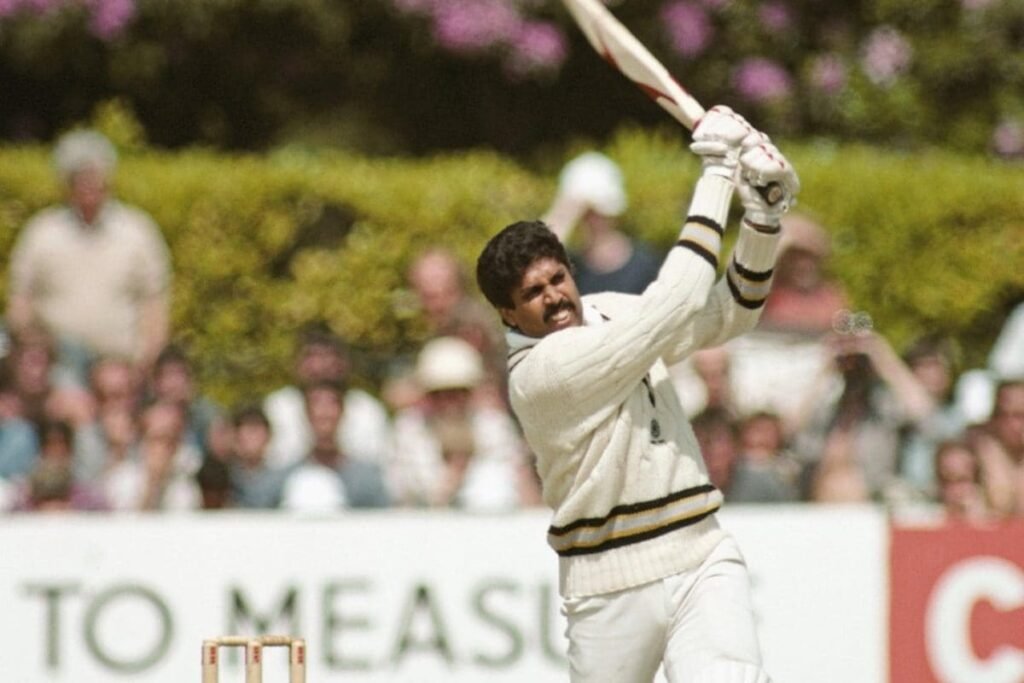
Kapil Dev’s decision to maintain attacking fields against Viv Richards, rather than defend early boundaries, allowed India’s bowlers to keep taking wickets instead of merely restricting the score.
Also Read: IPL Scorecard 2025
Kapil Dev’s Captaincy Under Pressure
Rather than retreating into a purely defensive strategy once West Indies looked comfortable at 50/1, Kapil Dev backed his medium-pace attack to keep hitting the seam and trusted close catchers to hold their positions. That decision paid off directly when he completed the running catch to dismiss Richards.
Madan Lal and Amarnath’s Bowling Plans
Neither Madan Lal nor Mohinder Amarnath relied on raw pace. Both bowled full, seam-up lines that exploited a two-paced surface, forcing West Indies’ batters into mistimed strokes rather than clean dismissals off short deliveries. Their combined figures of 6 wickets for 43 runs remain a defining bowling performance in World Cup final history.
Records and Legacy of the Final
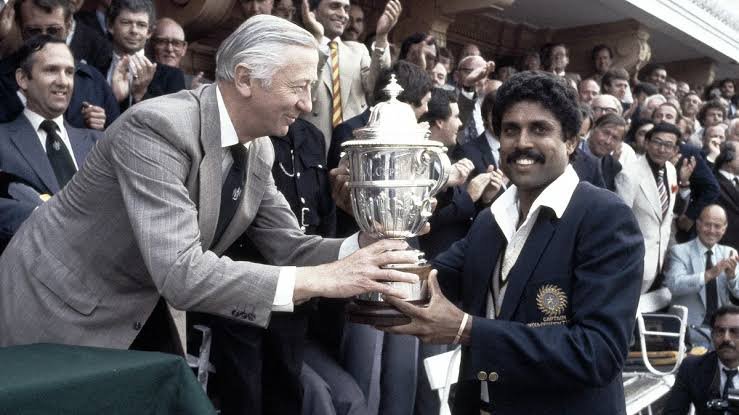
India’s win remains one of the only instances of a team successfully defending a sub-200 total in a men’s ODI World Cup final, and it is widely credited with transforming cricket’s popularity and commercial growth in India.
India had entered the tournament as 66-1 outsiders, making this triumph the most frequently cited upset in Cricket World Cup history. Beyond the result itself, the win reshaped how cricket was consumed and monetized in India, accelerating television interest, sponsorship investment, and grassroots participation in the years that followed. Multiple generations of Indian cricketers have since credited this specific final as the moment that made cricket a mass phenomenon in the country rather than a niche colonial-era sport. Reviewing the complete 1983 World Cup Scorecard today, more than four decades later, still reveals fresh tactical detail for anyone studying how low-scoring pressure cricket actually unfolds.
Frequently Asked Questions:
Who won the 1983 World Cup final?
India won the 1983 World Cup final, defeating West Indies by 43 runs at Lord’s on 25 June 1983.
What is the full 1983 World Cup Scorecard result?
India scored 183 all out in 54.4 overs, West Indies were bowled out for 140 in 52 overs while chasing 184.
Who was the Player of the Match in the 1983 World Cup final?
Mohinder Amarnath won Player of the Match for scoring 26 runs and taking 3 wickets for 12 runs.
Who was the top scorer in the 1983 World Cup final?
Krishnamachari Srikkanth top-scored for India with 38 runs off 57 balls, Viv Richards top-scored for West Indies with 33 off 28 balls.
Who took the most wickets in the 1983 World Cup final?
Madan Lal and Mohinder Amarnath each took 3 wickets, Amarnath’s figures of 3 for 12 were the most economical of the match.
What was the highest partnership in the 1983 World Cup final?
The Haynes–Richards stand of 45 runs for West Indies’ second wicket was the highest partnership of the match, followed closely by India’s 57-run Srikkanth–Amarnath stand.
Why did West Indies lose after reaching 50/1?
West Indies lost their remaining nine wickets for just 90 runs across two collapse phases, undone by disciplined seam bowling from Madan Lal and Mohinder Amarnath on a slow Lord’s pitch.
Was 183 considered a good total in 1983 cricket?
Yes. ODI scoring rates in the early 1980s averaged around four runs per over, making 183 a competitive, defendable total on a bowler-friendly surface.
Where was the 1983 World Cup final played?
The final was played at Lord’s cricket ground in London, England, on 25 June 1983.
How did this match impact Indian cricket?
India’s victory in the 1983 World Cup final is widely regarded as the catalyst for cricket’s massive growth in popularity, sponsorship, and television coverage across India in the decades that followed.

Related Posts
Profilbau Victoria United vs Powergen Penal SC Match Scorecard: PPS Win by 4 Runs
India Legends vs West Indies Legends Match Scorecard: Binny 50, Pollard 74 Decide WCL 2025 Thriller