Australia Women’s National Cricket Team vs India Women’s National Cricket Team Timeline: The Complete Cricket Rivalry (1978–2026)
The Australia Women’s National Cricket Team vs India Women’s National Cricket Team Timeline is one of the longest, most evolving rivalries in women’s sport. It spans nearly five decades, three formats, and a transformation so dramatic that the team which could not win a single ODI against Australia before 1999 chased down 339 in a World Cup semi-final in 2025. This is the complete record of that journey -every era, every turning point, every number that matters, and the structural reasons behind India’s rise from consistent loser to World Cup champion.
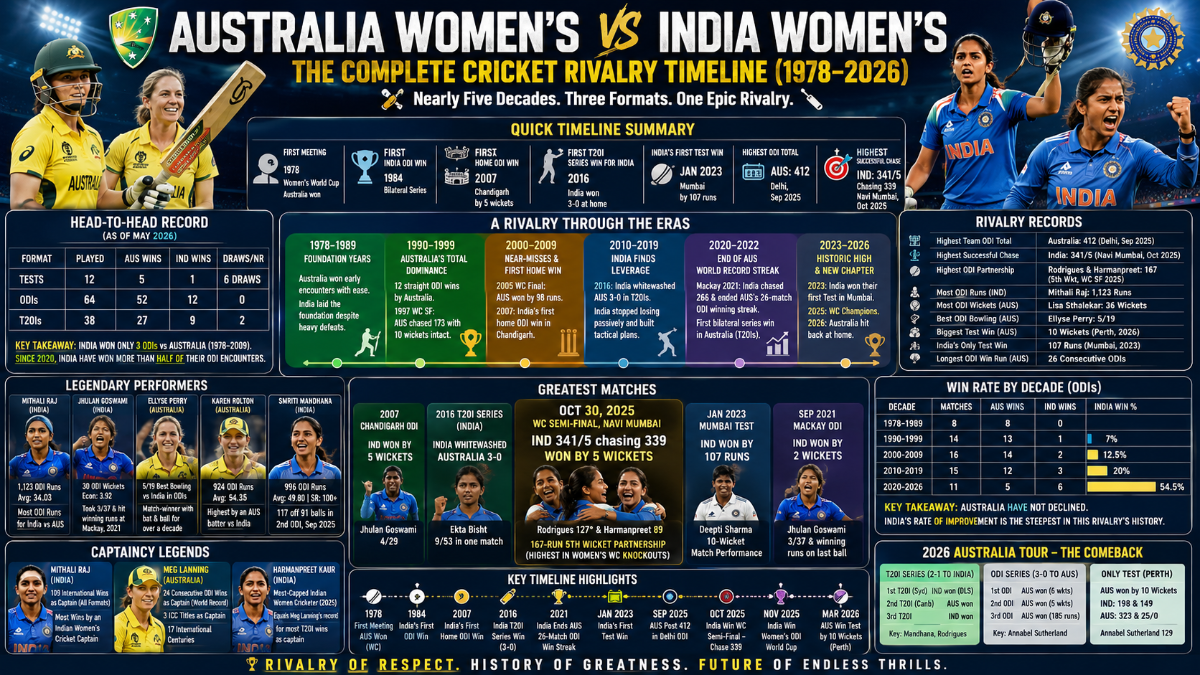
Quick Timeline Summary
| Milestone | Details |
| First Meeting | 1978 Women’s World Cup -Australia won |
| First India ODI Win vs AUS | 1984 bilateral series |
| First India Home ODI Win | 2007, Chandigarh -by 5 wickets |
| First T20I Series Win for India | 2016 -India won 3-0 at home |
| India’s First Test Win vs AUS | January 2023, Mumbai -by 107 runs |
| Highest ODI Total in Rivalry | Australia: 412 (Delhi, September 2025) |
| Highest Successful Chase | India: 341/5 chasing 339 (Navi Mumbai, Oct 2025) |
| ODI Head-to-Head | Australia lead 52–12 |
| T20I Head-to-Head | Australia lead 27–9 |
| Test Head-to-Head | Australia lead 5–1 (6 drawn) |
| Latest Test Result | Australia won by 10 wickets, Perth, March 2026 |
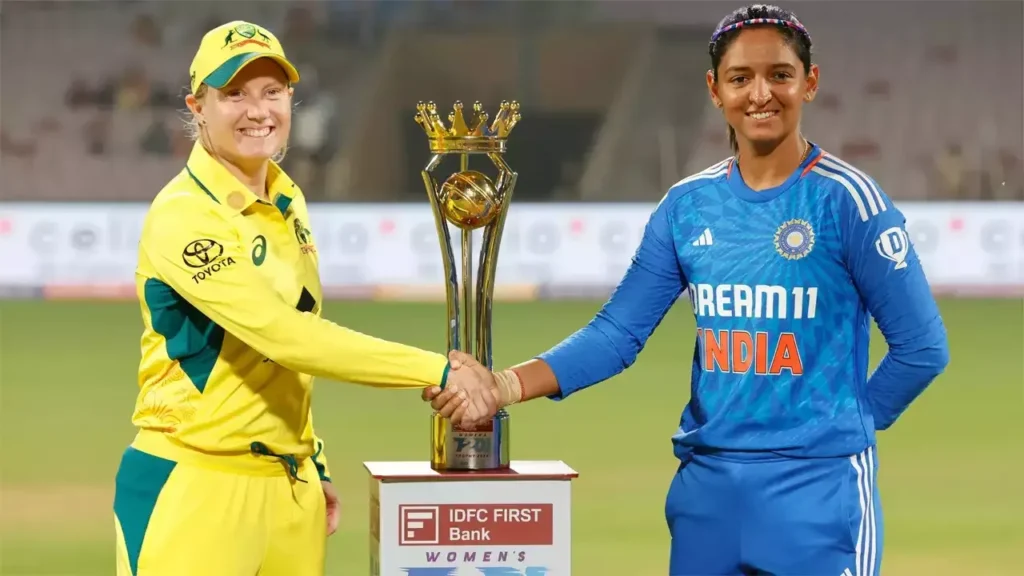
Head-to-Head Record (All Formats, As of May 2026)
Read More: Pakistan national cricket team vs Afghanistan national cricket team timeline
The overall Australia Women’s National Cricket Team vs India Women’s National Cricket Team Timeline head-to-head record across all formats remains heavily in Australia’s favor -but the recent trend tells a different story.
| Format | Played | Australia Wins | India Wins | Draws/NR |
| Tests | 12 | 5 | 1 | 6 draws |
| ODIs | 64 | 52 | 12 | 0 |
| T20Is | 38 | 27 | 9 | 2 |
India won only 3 ODIs against Australia across the entire period from 1978 to 2009. Since 2020, India have won more than half of their ODI encounters against Australia.
Rivalry Records at a Glance
| Record | Detail |
| Highest team ODI total | Australia: 412 (Delhi, Sep 2025) |
| Highest successful ODI chase | India: 341/5 in 48.3 overs (Navi Mumbai, Oct 2025) |
| Highest ODI partnership | Rodrigues & Harmanpreet: 167 (5th wkt, WC SF 2025) |
| Most ODI runs in rivalry | Mithali Raj: 1,123 runs at avg 34.03 (India) |
| Most ODI wickets in rivalry | Lisa Sthalekar: 36 wickets (Australia) |
| Best ODI bowling figures | Ellyse Perry: 5/19 (Australia) |
| Biggest Test win margin | Australia: 10 wickets (Perth, 2026) |
| India’s only Test win margin | 107 runs (Mumbai, 2023) |
| Longest ODI winning run (AUS) | 26 consecutive ODIs (ended Mackay, 2021) |
The 1978–1989 Era: Foundation Years
The Australia Women’s National Cricket Team vs India Women’s National Cricket Team Timeline begins in 1978, when the two sides met at the Women’s World Cup hosted in India. Australia, already a professionally organized side, won with ease.
How Dominant Was Australia Early On?
The 1984 bilateral series in India ended 4-0 to Australia. India failed to reach 150 in three of those four games. Australia were operating with structured domestic competition, professional coaching support, and multi-format experience. India were essentially learning the game at the highest level simultaneously. What the raw scorelines do not show: India’s Diana Edulji was already troubling Australian top-orders with sharp off-spin. The structural gap was real -but the craft foundations were being laid in every losing match.
The 1990–1999 Era: Australia’s Total Dominance
Australia won 12 consecutive ODIs against India between 1991 and 1999. The 1997 Women’s World Cup semi-final -played on Indian soil -ended with Australia chasing 173 with 10 wickets intact. Belinda Clark was unbeaten on 64. The bilateral series of 1991-92 (4-0) and 1997-98 (3-0) reinforced the gap.
India’s First Signs of Resistance
In a 1999 tri-series ODI, India chased 220 -their highest successful chase against Australia to that point -driven by Anjum Chopra’s 75. India won just two ODIs against Australia in the entire decade. Both victories were treated as landmark results. The hunger those wins produced became the engine of the next generation.
The 2000–2009 Era: Finals, Near-Misses, and India’s First Home Win
The 2005 ICC Women’s World Cup Final in Johannesburg remains one of the clearest pictures of where this rivalry stood at that point. Australia posted 215. India were bowled out for 117 –a 98-run defeat in the final. A young Mithali Raj’s composure in a difficult chase hinted at what was to come, but the result was not close.
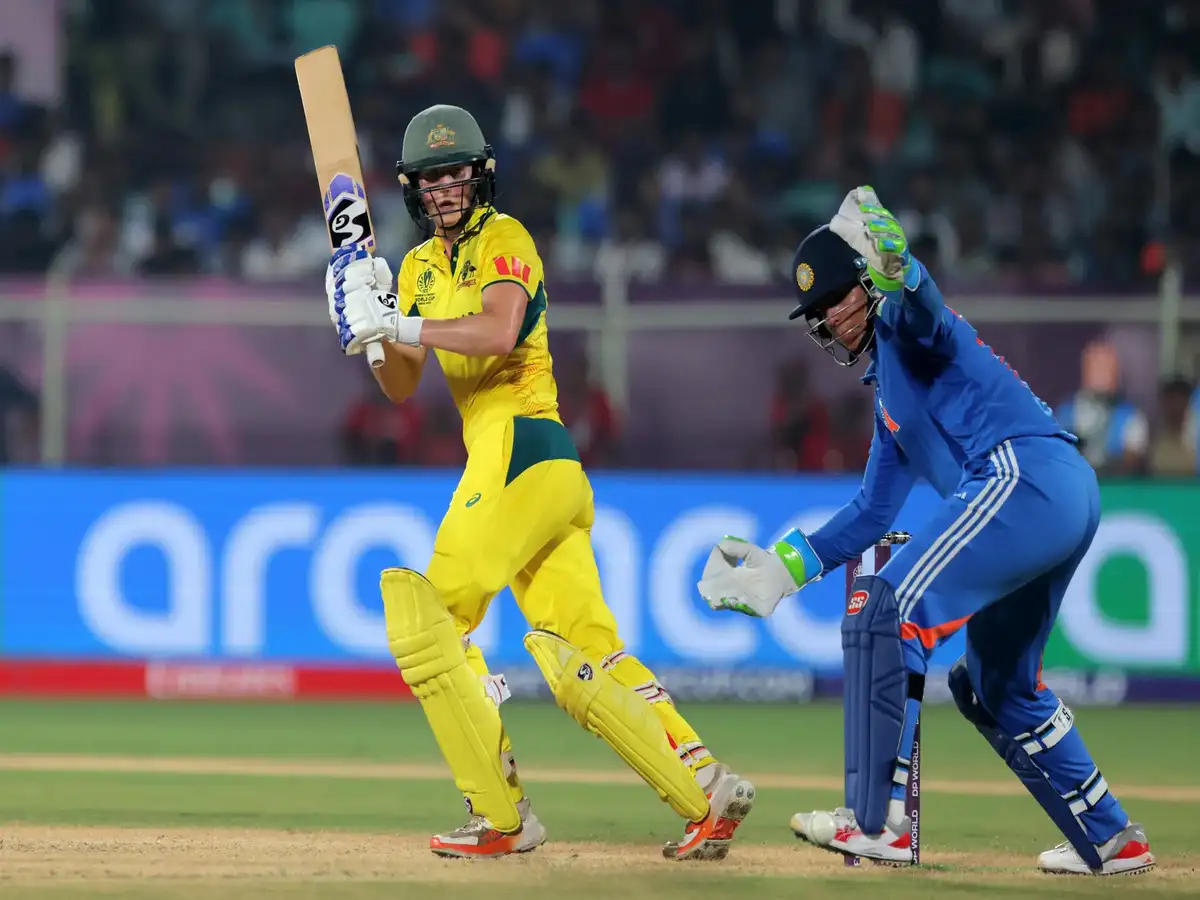
2007: India’s First Home ODI Win Against Australia
In Chandigarh in 2007, India beat Australia by 5 wickets in a bilateral ODI -their first-ever home ODI win against Australia. Jhulan Goswami took 4/29, exploiting subcontinental swing conditions with line discipline that Australian batters had not prepared for. The result demonstrated that India could win against Australia when conditions aligned with their strongest weapons. The first women’s T20 World Cup clash in 2008 saw Australia win by 74 runs. But T20 cricket had arrived -and it would prove to be India’s most productive format for closing the competitive gap.
The 2010–2019 Era: India Finds Format-Specific Leverage
This decade marks a clear shift in the Australia Women’s National Cricket Team vs India Women’s National Cricket Team Timeline -not because India started winning consistently, but because they stopped losing passively.
Read More: West Indies cricket team vs India national cricket team timeline
The 2016 T20I Whitewash
India won the 2016 T20I series 3-0 at home -their first-ever complete series win over Australia in any format. Left-arm spinner Ekta Bisht took 9/53 in one match of that series. Australia’s batting lineup, which included Alyssa Healy, Meg Lanning, and Ellyse Perry, had no answers to Bisht’s trajectory into right-handers on turning surfaces. This was India’s first proof that a deliberate tactical plan -not just favorable conditions -could produce a series result against Australia.
Decade Results Summary
| Year | Format | Result | Key Performer |
| 2016 | T20I series (India) | India 3-0 | Ekta Bisht 9/53 in one match |
| 2017 | ODI World Cup SF | Australia won by 8 wkts | Ellyse Perry 46* |
| 2018 | Only Test (Australia) | Australia won by 8 wkts | Perry all-round |
| 2018-19 | T20I series | Australia 2-1 | Harmanpreet Kaur 46* |
| 2019 | ODI series (India) | Australia 3-0 | Meg Lanning 86 |
The 2020–2022 Era: India Ends Australia’s World Record Streak
The 2020 Women’s T20 World Cup semi-final ended in a 5-wicket win for Australia. Alyssa Healy’s 75* anchored the chase. Australia proceeded to win the tournament. But the 2021-22 bilateral tour to Australia produced the most competitive bilateral results India had managed on Australian soil.
Mackay 2021: The Match That Changed the Narrative
India chased 266 in the third ODI at Mackay -their highest successful chase against Australia in an ODI at that time. The result ended Australia’s world-record 26-match consecutive ODI winning streak. Jhulan Goswami took 3/37 and then hit the winning runs off the final delivery of the match, aged 38. India also won the T20I series 2-1 on Australian soil -their first bilateral T20I series win in Australia. This marked India’s first bilateral series win on Australian territory in any format.
2023–2024: India’s First Test Win Against Australia: Mumbai, January 2023
India beat Australia by 107 runs in the only Test of the 2023 series -their first-ever Women’s Test win against Australia, ending a winless record in Tests against them going back to their very first meeting. Deepti Sharma produced a 10-wicket match performance with the ball, and Richa Ghosh’s counter-attacking batting in India’s second innings broke Australian momentum at a critical stage. The result was historic. India had played 11 Tests against Australia before January 2023 without winning once. Australia responded clinically. The 2023-24 ODI series in India ended 3-0 to Australia. Annabel Sutherland accumulated over 200 runs across the series, exploiting seam movement even on Indian pitches. Australia’s ability to execute their pace game in subcontinental conditions remained a structural advantage.
2025: The Year India Rewrote the Record Books
No single year in the Australia Women’s National Cricket Team vs India Women’s National Cricket Team Timeline produced more significant results than 2025.
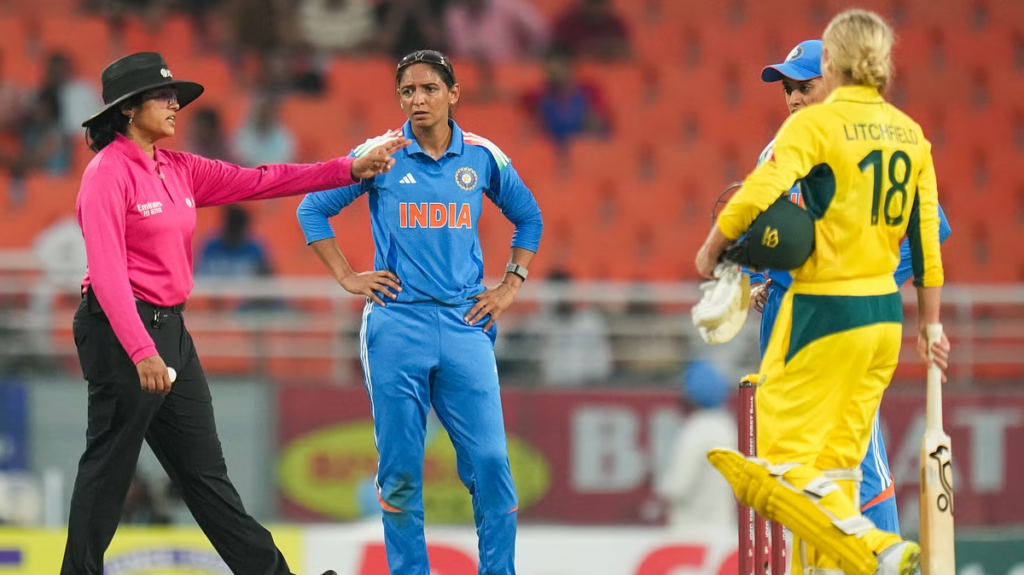
September 2025: Bilateral ODI Series
The three-match ODI series in India produced some of the highest combined scores in women’s bilateral ODI history.
| Match | Venue | Score | Result | Key Performer |
| 1st ODI | Mullanpur | AUS 218/8, IND 174 | Australia won | Litchfield 119 |
| 2nd ODI | Mullanpur | IND 284/6, AUS 182 | India won by 102 runs | Mandhana 117 off 91 balls |
| 3rd ODI | Delhi | AUS 412, IND 369 | Australia won by 43 runs | Mooney 138 |
Australia posted 412 in the Delhi ODI -their highest total against India in bilateral women’s cricket. The combined 781 runs in that game set a women’s bilateral ODI record.
October 2025: ICC Women’s World Cup Semi-Final
This is the defining match of the modern Australia Women’s National Cricket Team vs India Women’s National Cricket Team Timeline.
| Detail | Fact |
| Date | October 30, 2025 |
| Venue | Dr DY Patil Sports Academy, Navi Mumbai |
| Australia innings | 338 all out -Phoebe Litchfield 119 |
| India innings | 341/5 in 48.3 overs |
| Result | India won by 5 wickets |
| Match-defining partnership | Rodrigues (127*) & Harmanpreet (89) -167 runs for 5th wicket |
| Historical significance | Highest successful chase in Women’s World Cup knockout history |
India were 88/4 when Rodrigues and Harmanpreet came together. The unbeaten 167-run partnership was the highest for any wicket in a Women’s World Cup knockout match. The win ended Australia’s 15-match unbeaten ODI World Cup streak. India went on to beat South Africa by 52 runs in the final on November 2, 2025 -winning their first ICC Women’s ODI World Cup.
2026: Australia Hits Back on Home Soil
India’s World Cup triumph was followed by a full multi-format tour of Australia in January–March 2026 -three T20Is, three ODIs, and one Test.
T20I Series (January–February 2026)
- 1st T20I, Sydney: India won by 21 runs (DLS method)
- 2nd T20I, Canberra: Australia won by 19 runs -Georgia Voll and Beth Mooney added a 128-run opening stand, India collapsed from 128/4 to 133/9
- 3rd T20I: India won by 17 runs –Smriti Mandhana and Jemimah Rodrigues rebuilt the chase
India won the T20I series 2-1, taking a 4-2 lead in the multi-format series.
ODI Series (February–March 2026)
| Match | Venue | Result |
| 1st ODI | – | Australia won by 6 wickets |
| 2nd ODI | – | Australia won by 5 wickets |
| 3rd ODI | Hobart | Australia won by 185 runs |
Australia won the ODI series 3-0. India’s batting failed to fire consistently on Australian pace-friendly surfaces. The 185-run defeat in Hobart was India’s heaviest ODI loss against Australia since 2019.
Only Test, Perth (March 2026)
Australia won by 10 wickets. India were bowled out for 198 in their first innings. Annabel Sutherland scored 129 in Australia’s first-innings 323. India set only 25 to win in their second innings -Australia chased it without loss. Sutherland was named Player of the Series.
Win Rate by Decade (ODIs)
| Decade | Matches | AUS Wins | IND Wins | India Win % |
| 1978–1989 | 8 | 8 | 0 | 0% |
| 1990–1999 | 14 | 13 | 1 | 7% |
| 2000–2009 | 16 | 14 | 2 | 12.5% |
| 2010–2019 | 15 | 12 | 3 | 20% |
| 2020–2026 | 11 | 5 | 6 | 54.5% |
Australia has not declined. India’s rate of improvement across the last six years is the steepest in this rivalry’s history. These are two different facts -and only one predicts the future of this contest.
Venue-Wise Performance: India as Host
India’s three biggest wins against Australia -the 2016 T20I whitewash, the 2023 Mumbai Test, and the 2025 World Cup semi-final -all came in Indian conditions or on neutral ground. Spin-friendly pitches, subcontinental humidity, and tailored bowling attacks have consistently given India their best chance against Australia.
Australia as Host
India have won just four bilateral ODIs on Australian soil across the entire history of this rivalry. Pace-friendly surfaces, early swing, and bounce have consistently troubled India’s top-order. The 2026 ODI series (3-0 to Australia including a 185-run win in Hobart) confirmed that Indian batting still finds Australian conditions difficult in 50-over cricket.
Greatest Players in This Rivalry: Mithali Raj -India’s All-Time Leading Scorer
Mithali Raj remains the highest run-scorer in women’s ODI cricket history, finishing with 7,805 runs. Against Australia, she accumulated 1,123 ODI runs at an average of 34.03 across 37 matches -the most for any India batter in this head-to-head. She captained India in 155 ODIs overall, winning 89 -the most wins as ODI captain in women’s cricket history.
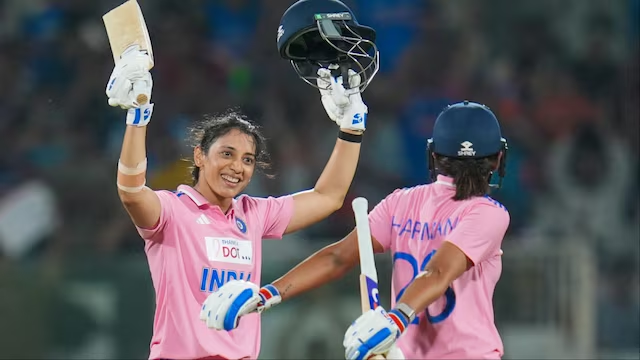
Jhulan Goswami -India’s Greatest Wicket-Taker Against Australia
Jhulan Goswami, India’s highest ODI wicket-taker in women’s cricket, claimed 30 wickets against Australia at an economy rate of 3.92 across 33 ODIs. At Mackay in September 2021, she took 3/37 and hit the winning runs off the final ball to end Australia’s 26-match world-record ODI winning streak.
Ellyse Perry -Australia’s Most Dangerous Performer
Perry’s best bowling figures against India stand at 5/19 in ODIs. She has contributed with bat and ball across more than a decade of this rivalry -remaining Australia’s most complete performer against India regardless of conditions.
Karen Rolton -Australia’s Highest ODI Run-Scorer in This Rivalry
Karen Rolton accumulated 924 runs at 54.35 against India in ODIs -the highest average among all batters with more than 500 runs in this head-to-head. Her consistency in the 2000s gave Australia a batting foundation that India’s bowling had no consistent answer for.
Smriti Mandhana -India’s Most Productive Active Batter vs Australia
Smriti Mandhana has scored 996 ODI runs at 49.80 in this rivalry, with a strike rate exceeding 100. Her 117 off 91 balls in the September 2025 second ODI at Mullanpur -the innings that won India that game -showed her capacity to dominate Australian bowling on subcontinental pitches.
Captaincy Records in This Rivalry ( Mithali Raj (India, 1999–2022)
Raj holds 109 wins as captain across all formats -third-most in women’s international history behind Charlotte Edwards (142) and Meg Lanning (128). She scored 6,546 runs while captaining India -the most by any Indian women’s cricket captain.
Meg Lanning (Australia, 2014–2024)
Lanning won 24 consecutive ODIs as captain between 2018 and 2021 -the longest winning streak for any ODI captain in cricket history, across men’s and women’s formats. She won three ICC titles as captain, including the 2020 T20 World Cup and the 2022 ODI World Cup. She scored 17 international centuries -more than any other woman in cricket history.
Harmanpreet Kaur (India, 2022–present)
Harmanpreet became India’s most-capped female cricketer in 2025, surpassing Mithali Raj. She equalled Meg Lanning’s record for most wins as captain in women’s T20Is. Her 89 in the 2025 World Cup semi-final -batting at No. 6 when India were 88/4 -was the decisive innings alongside Rodrigues’ century that turned the result.
Why India Became Competitive After 2016
Three structural shifts -not individual performances -explain the transformation in the Australia Women’s National Cricket Team vs India Women’s National Cricket Team Timeline head-to-head record.
1. Spin Matchup Exploitation
India deliberately built T20I and ODI attacks around multiple left-arm spinners to target right-handed Australian top-orders. Ekta Bisht’s 2016 T20I whitewash was the first large-scale demonstration of this working in practice. India won that series without needing batting firepower -they won it with field placement, flight, and patience.
2. Aggressive Middle-Order Intent
The post-Raj batting era introduced Harmanpreet Kaur and Jemimah Rodrigues as players built to accelerate in the final 15 overs rather than manage scoreboards. The 2025 World Cup semi-final -167 runs added from 88/4, ultimately winning -was the defining expression of this tactical evolution.
3. Women’s Premier League (WPL) Exposure
From 2023, the WPL placed Indian players in daily professional competition alongside and against Australian internationals. Players developed counter-attacking techniques against pace bowling that India’s domestic circuit had not previously replicated at scale. The improvement in India’s batting against quality pace between 2022 and 2026 correlates directly with this exposure.
Complete Master Timeline Table (Tests)
| Date | Venue | Result | Margin | Key Performer |
| 1977-78 | Australia | Australia won | – | – |
| 1983-84 | India | Drawn | – | – |
| 1990-91 | Australia | Australia won | – | – |
| 2005-06 | India | Drawn | – | – |
| 2012-13 | Australia | Australia won | – | Ellyse Perry |
| 2014-15 | India | Drawn | – | Mithali Raj |
| 2016 | England (WC) | Drawn | – | – |
| 2018-19 | Australia | Australia won | 8 wkts | Perry all-round |
| 2021-22 | Australia | Australia won | – | – |
| Jan 2023 | Mumbai, India | India won | 107 runs | Deepti Sharma 10-wkt match |
| Mar 2026 | Perth, Australia | Australia won | 10 wkts | Annabel Sutherland 129 |
ODI Key Results
| Date | Venue | Result | Margin | Key Performer |
| 1984 series | India | Australia won | 4-0 | – |
| 1997 WC SF | India | Australia won | 10 wkts | Belinda Clark 64* |
| 2005 WC Final | Johannesburg | Australia won | 98 runs | – |
| 2007 | Chandigarh | India won | 5 wkts | Goswami 4/29 |
| 2017 WC SF | — | Australia won | 8 wkts | Perry 46* |
| Sep 2021 (Mackay) | Australia | India won | 2 wkts | Goswami 3/37 + winning runs |
| Sep 2025, 2nd ODI | Mullanpur | India won | 102 runs | Mandhana 117 |
| Sep 2025, 3rd ODI | Delhi | Australia won | 43 runs | Mooney 138 |
| Oct 2025, WC SF | Navi Mumbai | India won | 5 wkts | Rodrigues 127*, Harmanpreet 89 |
| Mar 2026, 1st ODI | Hobart | Australia won | 185 runs | – |
| Mar 2026 (series) | Australia | Australia won | 3-0 | Sutherland |
T20I Key Results
| Date | Venue | Result | Key Performer |
| 2008 WT20 | – | Australia won by 74 runs | – |
| 2016 series | India | India won 3-0 | Ekta Bisht 9/53 |
| 2020 WT20 SF | Australia | Australia won by 5 wkts | Healy 75* |
| 2021-22 series | Australia | India won 2-1 | Shafali Verma |
| Feb 2026, 1st T20I | Sydney | India won by 21 runs (DLS) | – |
| Feb 2026, 2nd T20I | Canberra | Australia won by 19 runs | Voll/Mooney 128-run stand |
| Feb 2026, 3rd T20I | – | India won by 17 runs | Mandhana, Rodrigues |
Frequently Asked Questions:
Q1. When did the Australia Women’s National Cricket Team vs India Women’s National Cricket Team Timeline rivalry begin?
A1. The rivalry began at the 1978 ICC Women’s World Cup, hosted in India. Australia won that first encounter. The two sides have since played more than 100 international matches across Tests, ODIs, and T20Is.
Q2. What is the overall head-to-head record between Australia Women and India Women?
A2. As of May 2026, Australia lead 52-12 in ODIs, 27-9 in T20Is, and 5-1 in Tests (6 Tests were drawn). Australia has dominated this rivalry historically, but India’s win rate has improved sharply since 2020.
Q3. Has India ever beaten Australia in a Women’s Test match?
A3. Yes –once. India beat Australia by 107 runs in Mumbai in January 2023 -their first-ever Women’s Test win against Australia. Deepti Sharma took a 10-wicket match performance. It ended a winless run in Tests against Australia going back to their first-ever meeting.
Q4. What happened in the 2025 Women’s World Cup semi-final between India and Australia?
A4. India chased 339 in 48.3 overs, winning by 5 wickets. Jemimah Rodrigues scored 127 not out and Harmanpreet Kaur scored 89. Their unbeaten fifth-wicket stand of 167 was the highest partnership for any wicket in Women’s World Cup knockout history. India went on to win the 2025 Women’s ODI World Cup.
Q5. Who has scored the most ODI runs in the Australia Women vs India Women rivalry?
A5. Mithali Raj leads for India with 1,123 runs at an average of 34.03 across 37 ODIs. Australia’s Karen Rolton leads for her side with 924 runs at 54.35. Mithali Raj also remains the highest run-scorer in women’s ODI cricket history overall with 7,805 runs.
Q6. Who has taken the most wickets in the Australia Women vs India Women rivalry?
A6. Lisa Sthalekar leads all bowlers with 36 ODI wickets in this rivalry. India’s Jhulan Goswami leads for India with 30 wickets across 33 ODIs at an economy of 3.92.
Q7. What was the result of the 2026 Women’s Test in Perth?
A7. Australia won by 10 wickets. India were bowled out for 198 in their first innings and 149 in their second. Annabel Sutherland scored 129 and was named Player of the Series.
Q8. What is Australia’s highest ODI total against India?
A8. Australia posted 412 at the Arun Jaitley Stadium, Delhi, in September 2025. Beth Mooney scored 138 in that innings.
Q9. What was India’s best bowling performance against Australia in women’s cricket?
A9. Ekta Bisht took 9/53 in one T20I match during India’s 3-0 series win in 2016 -the first complete series victory India had achieved over Australia in any format. Deepti Sharma’s 10-wicket performance in the 2023 Mumbai Test is the best all-match bowling figure for India against Australia.
Q10. Who has captained India and Australia the most in this rivalry?
A10. Mithali Raj captained India the most -winning 109 internationals overall as captain. Meg Lanning captained Australia across the rivalry’s most dominant modern phase, winning 24 consecutive ODIs as captain and three ICC titles, including matches against India.

Related Posts
Bangladesh Women vs Australia Women’s National Cricket Team Timeline: Every Match, Every Record
Oman National Cricket Team vs Namibia National Cricket Team Timeline: Complete Head-to-Head History, Stats & Records (2019-2026)