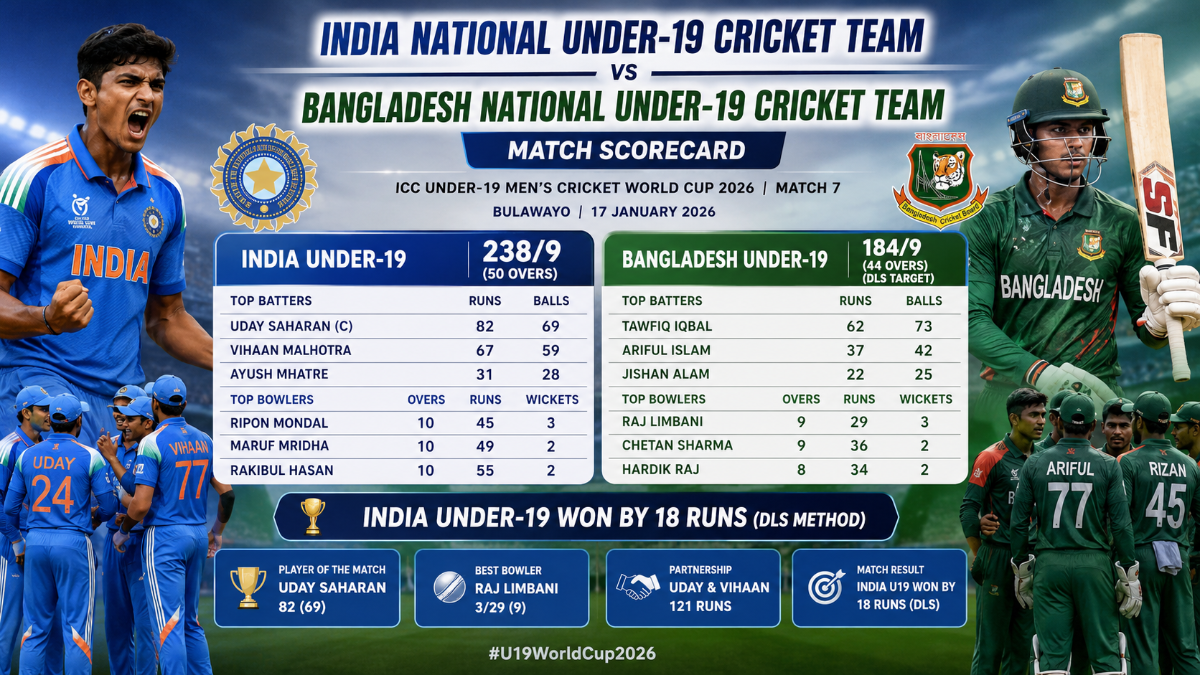
India National Under-19 Cricket Team vs Bangladesh National Under-19 Cricket Team Match Scorecard: India Win by 18 Runs (DLS)
The India National Under-19 Cricket Team vs Bangladesh National Under-19 Cricket Team match scorecard from the ICC Under-19 Men’s Cricket World Cup 2026 captures one of the tightest contests of the group stage-a game India won by 18 runs under the DLS method after Bangladesh’s rain-hit chase fell apart in the final overs. Played at Queens Sports Club, Bulawayo, on January 17, 2026, the match swung on two individual performances: Abhigyan Kundu’s anchoring 80 for India and Al Fahad’s five-wicket haul for Bangladesh. This detailed breakdown covers the complete batting and bowling cards, match timeline, turning points, squad context, and what the result meant for both sides in the race toward the Super Six stage.
Quick Match Summary
India Under-19 won by 18 runs (DLS method) after posting 238 all out in 48.4 overs, with Bangladesh Under-19 bowled out for 146 in 28.3 overs while chasing a rain-revised target of 165 off 29 overs. This youth ODI clash, part of Group B at the ICC Under-19 Cricket World Cup 2026, turned into a contest of contrasts-a disciplined Indian middle order against Bangladesh’s one standout bowling performer, with the weather ultimately tilting the balance toward India.
| Detail | Info |
| Result | India Under-19 won by 18 runs (DLS method) |
| Venue | Queens Sports Club, Bulawayo, Zimbabwe |
| Toss | India Under-19 won, elected to bat first |
| India Under-19 | 238 all out (48.4 overs), run rate 4.89 |
| Bangladesh Under-19 | 146 all out (28.3 overs), revised target 165 off 29 overs |
| Tournament | ICC Under-19 Men’s Cricket World Cup 2026, Group B |
| Format | Youth ODI (50-over format) |
| Match number | 7th match of the tournament |
Why This Fixture Carried Extra Stakes
Beyond the numbers, this match mattered because Bangladesh Under-19 had beaten India Under-19 by 59 runs in the previous ACC Under-19 Asia Cup final just weeks earlier. That result meant this World Cup meeting was effectively a rematch with a psychological edge on the line, and India’s bowling turnaround here reversed the momentum heading into the knockout rounds of the global event.
Read More: England Cricket Team vs Italy National Cricket Team Match Scorecard
Tournament Context: Where This Match Fit In
The 2026 edition of the ICC Under-19 Men’s Cricket World Cup was jointly hosted by Zimbabwe and Namibia, running from January 15 to February 6, with sixteen teams split across four groups of four. India, the most successful team in the tournament’s history with five previous titles, was placed in Group B alongside Bangladesh, New Zealand, and the USA, with all three of their group matches scheduled at Queens Sports Club, Bulawayo.
The Format Explained
Understanding the stakes of this India National Under-19 Cricket Team vs Bangladesh National Under-19 Cricket Team match scorecard requires understanding the tournament’s structure. The top three teams from each group advanced to the Super Six stage, where twelve qualified sides were reorganized into two groups of six, carrying forward their points and net run rate from matches against sides that progressed alongside them. From there, the top two teams in each Super Six group advanced to the semi-finals, with the final played at Harare Sports Club on February 6.
| Stage | Structure | Progression |
| Group Stage | 4 groups of 4 teams | Top 3 from each group advance |
| Super Six | 2 groups of 6 teams | Top 2 from each group advance |
| Semi-Finals | 2 matches | Winners advance to final |
| Final | Single match, Harare | Determines champion |
This structure meant that every group-stage result-including the India National Under-19 Cricket Team vs Bangladesh National Under-19 Cricket Team match scorecard clash-carried direct weight on net run rate calculations that would follow teams into the Super Six phase.
India Under-19 Squad and Leadership
India’s campaign was led by Ayush Mhatre as captain, with Vihaan Malhotra serving as vice-captain. The squad blended aggressive young talents with more experienced domestic performers, reflecting the depth Indian youth cricket has developed in recent seasons.
| Role | Player |
| Captain | Ayush Mhatre |
| Vice-Captain | Vihaan Malhotra |
| Key batter | Vaibhav Sooryavanshi |
| Wicketkeeper-batter | Abhigyan Kundu |
| All-rounder | Kanishk Chouhan |
| Seam bowling option | R.S. Ambrish |
Notably, Mhatre and Malhotra were both managing recovery from wrist injuries heading into the tournament, which added an extra layer of scrutiny to India’s bowling and batting balance in these early fixtures.
Pitch and Conditions at Queens Sports Club, Bulawayo
Queens Sports Club in Bulawayo hosted the bulk of Group B’s matches, and its surface behavior directly shaped how this contest unfolded. The pitch typically offers a hint of seam movement for fast bowlers with the new ball early in an innings, before flattening out as the game progresses-a pattern that explains why Al Fahad’s new-ball burst proved so damaging to India’s top order, and why India’s own bowlers targeted the same conditions during Bangladesh’s chase. Across the tournament, teams batting first at this venue won a similar number of matches to those chasing, indicating a genuinely balanced surface rather than one heavily loaded in either direction. Weather conditions in Bulawayo in mid-January typically bring warm temperatures with occasional rain interruptions-exactly the scenario that reshaped this particular run chase.
India Under-19 Batting Card: Full Breakdown
India’s innings followed a pattern increasingly familiar in modern youth cricket-an aggressive opening burst, a middle-order wobble, and one anchoring innings holding the total together against a hostile new-ball spell.
Read Also: West Indies Cricket Team vs Scotland National Cricket Team Match Scorecard
| Batter | Runs | Balls | 4s | 6s | Dismissal |
| Ayush Mhatre | 6 | 12 | 0 | 0 | c Siddiki b Al Fahad |
| Vaibhav Sooryavanshi | 72 | 67 | 6 | 3 | c Al Fahad b Iqbal Hossain Emon |
| Vedant Trivedi | 0 | 1 | 0 | 0 | c Rifat Beg b Al Fahad |
| Vihaan Malhotra | 7 | 24 | 0 | 0 | c Zawad Abrar b Azizul Hakim Tamim |
| Abhigyan Kundu (wk) | 80 | 112 | 4 | 3 | c Farid Hasan Faysal b Al Fahad |
| Harvansh Pangalia | 2 | 7 | 0 | 0 | c Rifat Beg b Iqbal Hossain Emon |
| Kanishk Chouhan | 28 | 26 | 4 | 0 | c (sub) Md Abdullah b Azizul Hakim Tamim |
| RS Ambrish | 5 | 12 | 0 | 0 | c Farid Hasan Faysal b Sheikh Paevez Jibon |
| Khilan Patel | 8 | 15 | 1 | 0 | c Farid Hasan Faysal b Al Fahad |
| Deepesh Devendran | 11 | 6 | 1 | 0 | c Md Rizan Hossan b Al Fahad |
| Extras | 12 | (10 wides, 2 no-balls) | |||
| Total | 238 | 48.4 overs | all out |
Sooryavanshi’s Fast Start Set the Tone
Vaibhav Sooryavanshi struck 72 off just 67 balls, hitting six fours and three sixes to give India rapid early tempo against the new ball. His strike rate of over 107 gave India a platform that looked capable of pushing toward 280 or beyond-but his dismissal to Iqbal Hossain Emon triggered a wobble that Bangladesh’s bowlers immediately exploited, with three wickets falling in quick succession.
Kundu’s Anchoring Innings Held the Total Together
Abhigyan Kundu’s 80 off 112 balls stands as the defining knock of this innings. His approach was low-risk and patient, absorbing pressure while wickets tumbled at the other end. Without Kundu’s application through the middle overs, India’s total likely finishes closer to 180 or 190, given how comprehensively Al Fahad dismantled the rest of the batting order. His partnership-building through the innings-first with Sooryavanshi, then with the lower order-was the single biggest factor keeping India’s total competitive.
The Lower-Order Contribution That Mattered
Kanishk Chouhan’s 28 off 26 balls provided a crucial late push, hitting four boundaries to lift India past 230 when the innings threatened to stall in the final ten overs. This late-innings contribution proved decisive in the context of the eventual 18-run winning margin-without it, the match could easily have swung the other way.
Bangladesh Under-19 Bowling Card
Bangladesh’s bowling effort was carried almost entirely by one standout performer, with support wickets arriving at crucial intervals to maintain pressure on India’s middle and lower order.
| Bowler | Wickets | Key Figures |
| Al Fahad | 5 | 5/38 in 9.2 overs |
| Iqbal Hossain Emon | 2 | Removed Sooryavanshi and Pangalia |
| Azizul Hakim Tamim | 2 | Removed Malhotra and Chouhan |
| Sheikh Paevez Jibon | 1 | Removed Ambrish |
Al Fahad’s Five-Wicket Haul Kept Bangladesh Alive
Al Fahad’s figures of 5 for 38 in 9.2 overs kept Bangladesh firmly in contention despite conceding 238 runs overall. This spell single-handedly altered the complexion of the match-without it, India’s total likely balloons past 260 or 270, rendering Bangladesh’s chase all but irrelevant rather than the genuinely tense pursuit it became. Al Fahad‘s ability to strip out India’s middle order, dismissing four separate batters through catches in the deep and behind the stumps, demonstrated exactly the kind of disciplined length bowling that troubled India throughout the innings.
Key Match Stats
The highest score belonged to Abhigyan Kundu (80), the best bowling figures went to Al Fahad (5/38), and India ultimately sealed victory by an 18-run margin under the DLS method.
| Stat | Detail |
| Highest score | Abhigyan Kundu-80 (112) |
| Best strike rate (fifty-plus score) | Vaibhav Sooryavanshi-107.46 |
| Best bowling figures | Al Fahad-5/38 |
| Most wickets, India Under-19 | Vihaan Malhotra-4 wickets |
| Winning margin | 18 runs (DLS method) |
| India’s boundaries (4s + 6s) | Sooryavanshi (9), Kundu (7), Chouhan (4) |
Bangladesh’s individual batting breakdown beyond their team total of 146 all out was not fully available at the time of writing, readers seeking that specific ball-by-ball detail should check the official scorecard directly for confirmation.
Match Timeline: How the Game Unfolded
India batted first, built a total on the back of contributions from Sooryavanshi and Kundu, survived Al Fahad’s five-wicket burst, and then bowled Bangladesh out under DLS pressure to secure an 18-run win.
- India won the toss and chose to bat first at Queens Sports Club, Bulawayo.
- Sooryavanshi gave India a fast start, striking at over 107 before falling for 72.
- Kundu anchored the innings, batting through to 80 off 112 balls as wickets fell around him.
- Al Fahad tore through the middle order, eventually finishing with figures of 5/38.
- Chouhan’s late 28 off 26 balls lifted India past 230 in the closing overs.
- India were bowled out for 238 in 48.4 overs.
- Rain interrupted Bangladesh’s chase midway through their innings.
- The target was revised to 165 runs off 29 overs under the DLS method.
- Malhotra struck twice in the compressed middle overs to derail the chase.
- Bangladesh were bowled out for 146 in 28.3 overs.
- India won the match by 18 runs under the DLS calculation.
The Rain Break That Reshaped the Chase
Weather intervention rarely just shortens a match-it fundamentally changes the psychology of a run chase. Once Bangladesh’s target was reset to 165 off 29 overs, their batters were forced into hurried scoring decisions far earlier than a full 50-over pursuit would demand. That artificial urgency played directly into the hands of India’s seam bowlers, who could attack the stumps knowing Bangladesh had little margin for cautious accumulation.
Turning Point: The Malhotra Burst After Rain
The decisive phase arrived immediately after the DLS revision, when Vihaan Malhotra removed two Bangladesh batters within three overs, effectively ending any realistic hope of Bangladesh reaching the revised target. The compressed equation forced Bangladesh’s middle order to accelerate before they had settled at the crease, and India’s bowling attack responded by attacking the stumps rather than bowling defensively for containment. Malhotra’s four-wicket spell, as vice-captain leading from the front with the ball, arrived at precisely the moment when a rushed chase either stabilized or collapsed entirely-and Bangladesh never recovered the platform needed to threaten 165.
Why the DLS Method Was Used
Rain interrupted Bangladesh’s innings partway through their chase, cutting the available overs to 29 and revising the target to 165 runs under the Duckworth-Lewis-Stern method-a mathematical system designed to set fair, proportional targets whenever overs are lost to weather. Bangladesh ultimately finished 18 runs short of that revised target, sealing India’s second win of the group stage. The DLS system accounts for both overs remaining and wickets in hand, meaning Bangladesh’s collapse-losing wickets steadily through the chase-worsened their position under the calculation beyond what a simple run-rate comparison would suggest.
Group B Standings After This Result
This result carried direct implications for the Group B qualification race at the ICC Under-19 World Cup 2026, where only the top three of four teams would advance to the Super Six stage.
| Team | Played | Won | Lost | Points | NRR |
| India Under-19 | 2 | 2 | 0 | 4 | +2.025 |
| Bangladesh Under-19 | 1 | 0 | 1 | 0 | -0.621 |
| New Zealand Under-19 | – | – | – | – | – |
| USA Under-19 | – | – | – | – | – |
India moved to the top of Group B with four points from two matches and a healthy net run rate, putting them close to Super Six qualification with one group game-against New Zealand-still to come. Bangladesh, despite the setback, retained a realistic path forward through their remaining fixtures against New Zealand and the USA.
What Happened Next in the Tournament
Both sides carried different pressures into their following assignments. India needed only a solid performance against New Zealand to lock in Super Six qualification with points to spare, while Bangladesh required consistent wins in their remaining group games to keep their net run rate competitive enough for a Super Six berth. As the group stage concluded, twelve of sixteen teams progressed to the Super Six phase, with India and Bangladesh both ultimately advancing before India carried momentum into the Super Six Group 2 phase alongside England, Pakistan, New Zealand, and Zimbabwe.
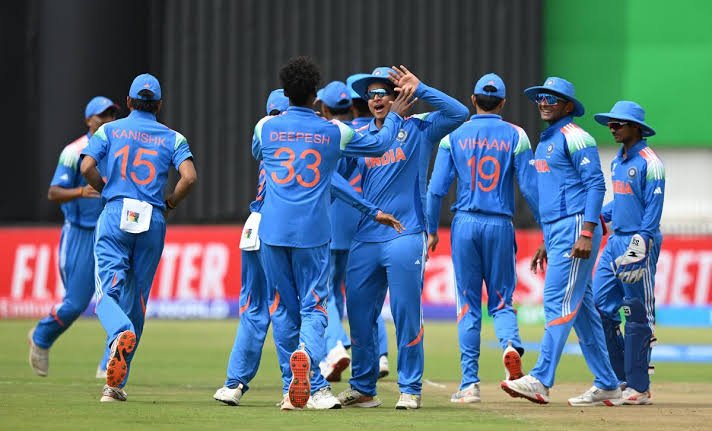
What This Result Means for Both Teams
The India National Under-19 Cricket Team vs Bangladesh National Under-19 Cricket Team match scorecard ultimately reflects a contest decided by two contrasting factors: one standout Indian batting partnership built around patience, and one standout Bangladeshi bowling spell built around new-ball hostility, with India’s greater bowling depth proving the difference in the closing stages.
For India, this was their second win in as many matches, building growing belief in a middle order that had now twice rescued the team from testing early positions. The victory also reinforced India’s tactical approach under Ayush Mhatre’s captaincy-trusting Kundu to bat through pressure rather than chasing quick runs, and deploying Malhotra’s disciplined seam bowling at the precise moment Bangladesh’s chase became vulnerable.
For Bangladesh, the loss came despite arguably the best individual bowling performance of the entire match from Al Fahad, whose five-wicket haul deserved a different result. It also reversed the outcome of the two sides’ previous meeting in the Asia Cup final, where Bangladesh had won comfortably by 59 runs-a reminder that ODI-format World Cup cricket, with its longer format and DLS complexities, punishes batting collapses far more severely than shorter tournament formats typically do.
Frequently Asked Questions:
Who won the India U19 vs Bangladesh U19 match?
India Under-19 defeated Bangladesh Under-19 by 18 runs under the DLS method after defending 238. Rain reduced Bangladesh’s chase to 29 overs, revising the target to 165, but India dismissed them for 146.
What was India U19’s total, and who scored the most runs?
India scored 238 all out in 48.4 overs. Abhigyan Kundu top-scored with 80 off 112 balls, and Vaibhav Sooryavanshi made 72 off 67 balls.
Who took the most wickets in the match?
Al Fahad took 5 wickets for 38 runs for Bangladesh, the best figures of the match. Vihaan Malhotra took 4 wickets for India.
Why was the DLS method used in this match?
Rain interrupted Bangladesh’s innings, cutting their chase to 29 overs and resetting the target to 165 runs under the Duckworth-Lewis-Stern method.
What was the winning margin between India U19 and Bangladesh U19?
India Under-19 won by 18 runs according to the DLS calculation after Bangladesh was bowled out for 146.
Where did the India U19 vs Bangladesh U19 match take place?
The match was played at Queens Sports Club, Bulawayo, Zimbabwe, as part of the ICC Under-19 Men’s Cricket World Cup 2026 Group B stage.
How many overs did Bangladesh U19 face in their run chase?
Bangladesh faced a rain-reduced chase of 29 overs after the DLS method revised their target to 165 runs.
What is India U19’s position in Group B after this win?
India Under-19 sat on top of Group B with four points from two matches and a net run rate of +2.025, nearing Super Six qualification.
Did Bangladesh U19 beat India U19 in their previous meeting?
Yes, Bangladesh Under-19 defeated India Under-19 by 59 runs in the previous ACC Under-19 Asia Cup final, making this World Cup result a reversal of that outcome.
Who captained India Under-19 in this match?
Ayush Mhatre captained India Under-19, with Vihaan Malhotra serving as vice-captain and also contributing four wickets with the ball in this match.

Related Posts
Profilbau Victoria United vs Powergen Penal SC Match Scorecard: PPS Win by 4 Runs
India Legends vs West Indies Legends Match Scorecard: Binny 50, Pollard 74 Decide WCL 2025 Thriller