Delhi Cricket Team vs Gujarat Cricket Club Match Scorecard: The Complete Story of a 7-Run Thriller
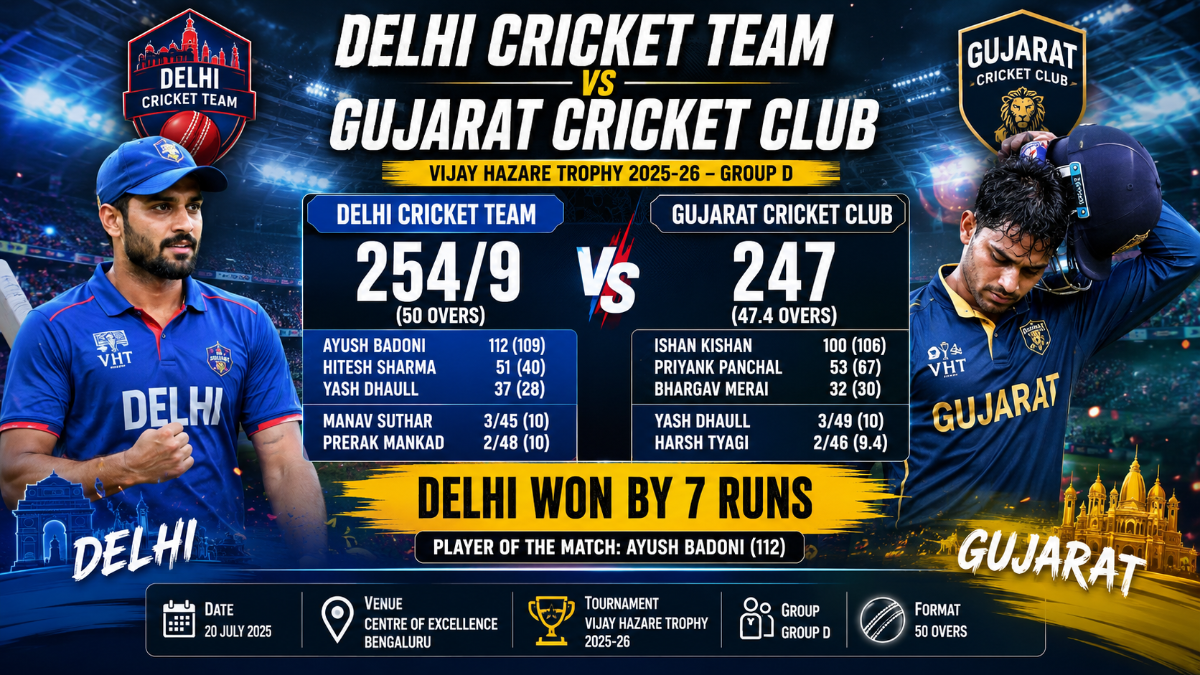
Delhi Cricket Team edged out Gujarat Cricket Club by seven runs in a gripping Vijay Hazare Trophy Elite Group D contest, with a Virat Kohli-Rishabh Pant partnership setting up a total that Delhi’s bowlers just about defended in a match that swung on the final ten overs of both innings. If you’re looking for the complete Delhi Cricket Team vs Gujarat Cricket Club Match Scorecard, here’s the headline answer before we go deeper: Delhi posted 254/9 in 50 overs batting first, and Gujarat Cricket Club came desperately close in the chase, falling to 247 all out in 47.4 overs. What makes this scorecard worth dissecting isn’t just the margin-it’s how both teams got there, and why a seven-run finish in a 50-over match tells you more about squad depth and death-overs execution than almost any other statistic in the game.
Match Summary: Delhi Cricket Team vs Gujarat Cricket Club Match Scorecard
Delhi Cricket Team scored 254/9 in their full 50 overs batting first, and Gujarat Cricket Club was bowled out for 247 in 47.4 overs while chasing, handing Delhi a seven-run win and four points in Group D of the Vijay Hazare Trophy Elite 2025-26. Domestic 50-over cricket in India rarely gets the spotlight reserved for the IPL, but the Vijay Hazare Trophy carries genuine weight for players fighting for national selection, and for teams chasing knockout qualification. Group D positioning in this tournament format directly decides who advances past the group stage, which means every run scored and every over bowled in matches like this one carries consequences well beyond the score line.
Key Match Facts
| Detail | Information |
| Result | Delhi Cricket Team won by 7 runs |
| Delhi Score | 254/9 in 50 overs |
| Gujarat Score | 247 all out in 47.4 overs |
| Match Format | List A, 50 overs per side |
| Competition | Vijay Hazare Trophy Elite, Group D, 2025-26 |
| Points Earned | Delhi 4, Gujarat 0 |
| Margin | 7 runs |
This wasn’t a routine group-stage tie that either side could afford to treat casually. Delhi had already shown strong early-season form, and this fixture against Gujarat represented a test of whether that form could hold up against a chasing side determined to disrupt momentum in the middle overs.
Understanding the Vijay Hazare Trophy Format
Before breaking down the individual performances, it helps to understand exactly what’s at stake in a match like this. The Vijay Hazare Trophy is India’s premier domestic List A tournament, structured around 50-over matches split into multiple groups, with the top teams from each group progressing to the knockout stages.
Read More: Oman National Cricket Team vs Namibia National Cricket Team Timeline
Why Group D Points Matter
In the Vijay Hazare Trophy’s group-stage format, teams accumulate points based on wins, with net run rate acting as the tiebreaker when standings are close-making every individual result, including this Delhi Cricket Team vs Gujarat Cricket Club Match Scorecard contest, mathematically significant for knockout qualification. A win doesn’t just add two points to the table, it also shapes a team’s net run rate, which becomes the decisive factor when multiple teams finish the group stage with identical win totals. This is precisely why Delhi’s disciplined defense of 254 mattered as much for their net run rate as it did for the two points themselves.
How Delhi Cricket Team Built Their Total
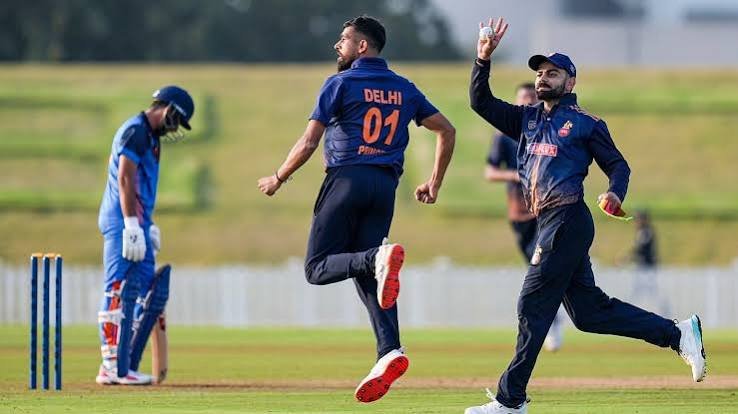
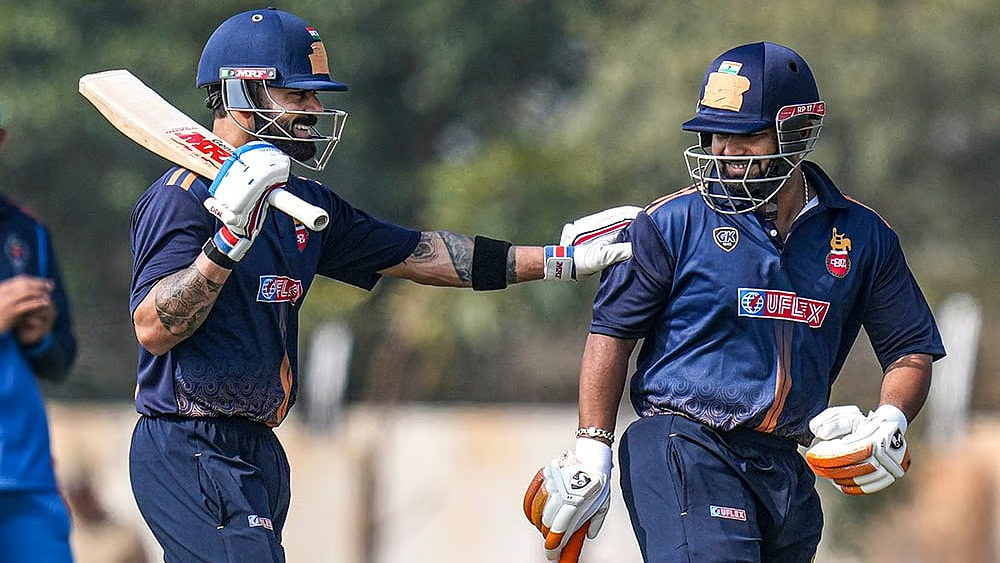
Delhi Cricket Team recovered from an early setback-losing opener Priyansh Arya in the very first over-through a crucial middle-order partnership between Virat Kohli (77 off 61) and captain Rishabh Pant (70 off 79), which formed the backbone of their 254-run total. Batting first against a Gujarat attack that opened with genuine pace, Delhi’s innings started about as poorly as it could. Priyansh Arya was dismissed inside the first over, immediately putting the middle order under pressure before the innings had even settled into a rhythm. In 50-over cricket, an early wicket like this often forces a batting unit into a choice: play defensively to rebuild, or counter-attack to nullify the shock. Delhi chose the former initially, and it paid off.
Delhi’s Batting Card
| Batter | Runs | Balls | Notes |
| Priyansh Arya | 1 | – | Dismissed in the 1st over |
| Arpit Rana | 10 | 31 | Anchored the innings after the early setback |
| Virat Kohli | 77 | 61 | 8 fours, 2 sixes, stumped off Vishal Jayswal |
| Rishabh Pant (c) | 70 | 79 | 8 fours, 2 sixes, captain’s innings |
| Harsh Tyagi | 40 | 47 | Crucial late-overs contribution |
Note: Complete ball-by-ball figures for every Delhi batter, along with total extras, were not consistently available across verified sources, so only confirmed entries are listed here rather than estimated figures.
Arpit Rana’s Rebuilding Role
Arpit Rana’s contribution of 10 off 31 balls won’t grab headlines, and it wasn’t meant to. His job following the loss of Priyansh Arya was pure containment-absorb the new-ball threat, see off the initial swing, and give the batters coming in behind him a platform with fewer overs of pressure remaining. It’s the kind of innings that rarely shows up in highlight reels but consistently shows up in winning totals.
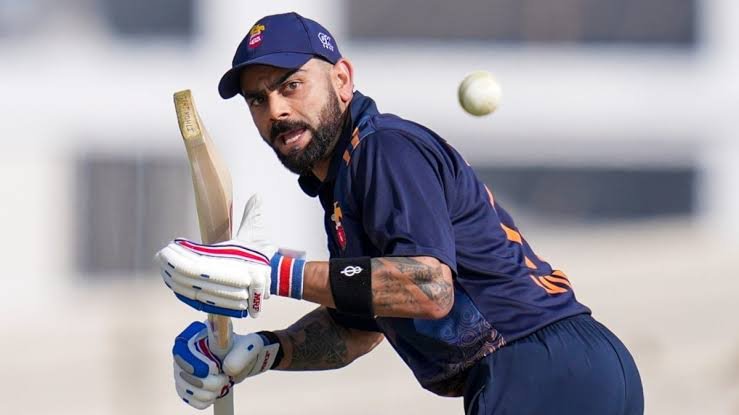
Virat Kohli’s Innings: The Turning Point
Kohli‘s 77 off 61 balls, laced with 8 fours and 2 sixes, was the innings that changed the complexion of Delhi’s total. Coming in once the platform had been set, Kohli accelerated through the middle overs with the kind of range-hitting and rotation of strike that has defined his List A returns throughout this domestic season. His dismissal-stumped off left-arm spinner Vishal Jayswal-arrived at a stage where the damage had already been done, Delhi had crossed the 100-run mark comfortably and had wickets in hand to push for a total well beyond 230. This particular innings matters beyond just the scorecard. Kohli’s continued domestic appearances have drawn significant attention from fans and selectors alike, especially given his form earlier in the same tournament. In Delhi’s opening match against Andhra, Kohli had already produced a match-defining hundred-131 off 101 balls-while chasing 299, forming a 160-run stand alongside Nitish Rana. Two substantial contributions in consecutive matches against quality domestic attacks reinforce why every Kohli innings in the Vijay Hazare Trophy is scrutinized so closely.
Rishabh Pant’s Captaincy Innings
Pant’s 70 off 79 balls, with 8 fours and 2 sixes, wasn’t built for spectacle-it was built for control. As Delhi’s captain and designated finisher-anchor, Pant paced his innings deliberately, prioritizing wicket preservation over an aggressive strike rate, which ensured Delhi crossed 250 without risking a late-innings collapse. This is a subtle but important captaincy decision. Many captains in Pant’s position would push the scoring rate artificially in the final ten overs to chase a higher total, risking a batting collapse in the process. Instead, Pant’s approach banked on Delhi’s lower order-specifically Harsh Tyagi-to provide the acceleration once the platform was secure.
Read Also: Nepal National Cricket Team vs Italy National Cricket Team Match Scorecard
Harsh Tyagi’s Late-Overs Impact
Tyagi’s 40 off 47 balls in the closing stages added the extra depth that separated a defendable total from a below-par one. In 50-over cricket, the difference between a total of 230 and a total of 254 often comes down to exactly this kind of late-innings contribution-not a blistering strike rate, but a steady accumulation of boundaries once the fielding restrictions loosen and bowlers are forced to defend specific areas of the ground.
Gujarat Cricket Club’s Chase: Where It Went Wrong
Gujarat Cricket Club needed just 59 runs from the final 60 balls with wickets in hand, but a batting collapse in the death overs saw them bowled out for 247, seven runs short of Delhi’s target of 255. Chasing 255 in a 50-over match is rarely just about the size of the target-it’s about how a batting order navigates specific pressure windows across the innings, and Gujarat’s chase offers a textbook case study in exactly that dynamic. For the first 40 overs, Gujarat looked genuinely competitive, keeping pace with the required run rate and giving themselves multiple platforms to accelerate from.
Gujarat’s Batting Performance
| Batter | Runs | Balls | Notes |
| Saurav Chauhan | 49 | – | Unbeaten, top scorer for Gujarat |
| Vishal Jayswal | 18 | 15 | Contributed in the lower order |
Note: A complete batting card for Gujarat’s remaining batters wasn’t consistently verifiable across accessed sources, so this table lists only confirmed contributions rather than a full estimated lineup.
The 196/5 Platform
At 196 for 5 after 40 overs, needing 59 runs off 60 balls, Gujarat Cricket Club was in a position that most 50-over teams would consider winning territory. A required rate of under 6 runs per over with five wickets still in hand is, statistically, a chase that favors the batting side more often than not in domestic List A cricket.
The Death-Overs Collapse
What followed instead was a sequence of dot balls and increasingly rushed shot selection that let Delhi’s bowling attack apply sustained pressure without needing to take unnecessary risks of their own. This is arguably the most common pattern behind close finishes in List A cricket-chasing teams rarely lose to a single unplayable delivery, they lose to an accumulated string of dot balls that inflates the required run rate until panic sets in. Saurav Chauhan’s unbeaten 49 kept Gujarat’s hopes alive until the very end, but the wickets falling around him in the closing overs meant there simply wasn’t enough support to finish the job. Gujarat’s innings folded in the 48th over, seven runs short of the target-closing out one of the tighter finishes of this Vijay Hazare Trophy season and highlighting exactly how thin the margin can be between a winning chase and a heartbreaking near-miss.
Key Turning Points That Decided the Match
Understanding a seven-run result requires looking beyond the final scoreline and identifying the specific moments where momentum actually shifted.
- Priyansh Arya’s first-over dismissal forced Delhi’s middle order into early repair mode rather than settled batting.
- The Kohli-Pant partnership converted a shaky start into a genuinely competitive total in the middle overs.
- Harsh Tyagi’s late-innings 40 added the extra depth Delhi needed to push past 250.
- Gujarat’s platform at 196/5 with 60 balls remaining should have been a winning position by most conventional benchmarks.
- A death-overs collapse turned what looked like a routine chase into a seven-run defeat.
Each of these moments, taken individually, might seem minor. Stacked together, they explain precisely how a 254-run total held up against a chasing side that had every statistical reason to expect victory at the 40-over mark.
Statistical Comparison: Delhi vs Gujarat
| Metric | Delhi Cricket Team | Gujarat Cricket Club |
| Final Score | 254/9 (50 ov) | 247 all out (47.4 ov) |
| Result | Won | Lost by 7 runs |
| Top Scorer | Virat Kohli-77 (61) | Saurav Chauhan-49* |
| Points Gained | 4 | 0 |
| Key Partnership | Kohli-Pant middle-order stand | No partnership large enough to close the gap |
The numbers make clear that this wasn’t a mismatch decided by a dominant individual performance on either side-it was decided by depth and composure in the specific pressure windows of each innings.
Why This Match Matters for Group D Standings
The win takes Delhi Cricket Team to four points in Group D of the Vijay Hazare Trophy Elite, strengthening their knockout qualification chances, while Gujarat Cricket Club remains winless from this fixture and will need results elsewhere in the group stage to stay competitive. Group-stage points in the Vijay Hazare Trophy don’t just sit on a table for show-net run rate and cumulative wins across the entire group stage decide which teams progress to the knockouts. A seven-run margin might look narrow on paper, but it carries the same two points as a hundred-run thrashing, which is exactly why Delhi’s disciplined finish with the ball mattered as much as their batting effort.
What This Means for Delhi Cricket Team
For the Delhi Cricket Team, this result adds to an already strong start to their campaign, following an earlier match-winning performance against Andhra that also featured a Kohli century. Back-to-back competitive performances from the top order suggest a batting unit that’s settling into a rhythm-a promising sign heading into the business end of the group stage, where net run rate battles often decide final standings.
What This Means for Gujarat Cricket Club
For Gujarat Cricket Club, the defeat serves as a clear reminder that death-overs execution-both with the bat while chasing and with the ball while defending-remains the single biggest differentiator between competing in a match and actually closing it out. A team that reaches 196/5 needing 59 off 60 balls has done the hard work of a chase, converting that platform into a win is a separate skill entirely, and this scorecard shows exactly where that conversion broke down.
Player Spotlight: Virat Kohli’s Domestic Return
Kohli’s decision to feature in domestic cricket has been closely watched throughout this Vijay Hazare Trophy season, and his output across these two matches-a century against Andhra followed by a 77 against Gujarat-reflects a batter using the tournament to sharpen match fitness and rhythm ahead of future assignments. For a player of his profile, every domestic innings gets outsized attention, and consistent contributions like these two performances reinforce both his current form and his continued value to Delhi’s batting lineup.
Player Spotlight: Rishabh Pant’s Captaincy
Pant’s approach in this match-pacing his own innings rather than forcing an artificially high strike rate-reflects broader captaincy trends among wicketkeeper-batters who double as leaders. Balancing personal batting responsibilities with tactical decision-making is one of the hardest jobs in limited-overs cricket, and Pant’s 70 off 79 balls, paired with a bowling unit that defended 59 runs in the final ten overs of Gujarat’s chase, points to a captain managing both roles effectively in this fixture.
Frequently Asked Questions:
Who won the Delhi Cricket Team vs Gujarat Cricket Club Match Scorecard?
Delhi Cricket Team won by 7 runs, defending a total of 254/9 against Gujarat’s 247 all out.
What was Delhi’s final score in this match?
Delhi Cricket Team posted 254/9 in their full 50 overs.
What was Gujarat’s final score in the chase?
Gujarat Cricket Club was bowled out for 247 in 47.4 overs while chasing a target of 255.
What did Virat Kohli score in this match?
Virat Kohli scored 77 off 61 balls, including 8 fours and 2 sixes.
How much did Rishabh Pant contribute with the bat?
Rishabh Pant scored 70 off 79 balls, with 8 fours and 2 sixes, as Delhi’s captain and top-order anchor.
Who was Gujarat’s top scorer in the chase?
Saurav Chauhan remained unbeaten on 49, the highest individual score for Gujarat Cricket Club in this innings.
What was the biggest turning point of the match?
Gujarat’s death-overs collapse from 196/5, needing just 59 runs off the final 60 balls, decided the result in Delhi’s favor.
Which tournament and group was this match part of?
This fixture was played in Group D of the Vijay Hazare Trophy Elite, 2025-26 season.
How many points did Delhi earn from this win?
Delhi Cricket Team earned four points from this victory in Group D standings.
Did Virat Kohli have a strong tournament before this match?
Yes, Kohli had already scored 131 off 101 balls against Andhra earlier in the same Vijay Hazare Trophy campaign, forming a 160-run partnership with Nitish Rana.

Related Posts
Profilbau Victoria United vs Powergen Penal SC Match Scorecard: PPS Win by 4 Runs
India Legends vs West Indies Legends Match Scorecard: Binny 50, Pollard 74 Decide WCL 2025 Thriller