England Cricket Team vs Australian Men’s Cricket Team Timeline: Complete Ashes History, Results & Head-to-Head Record (1877-2026)
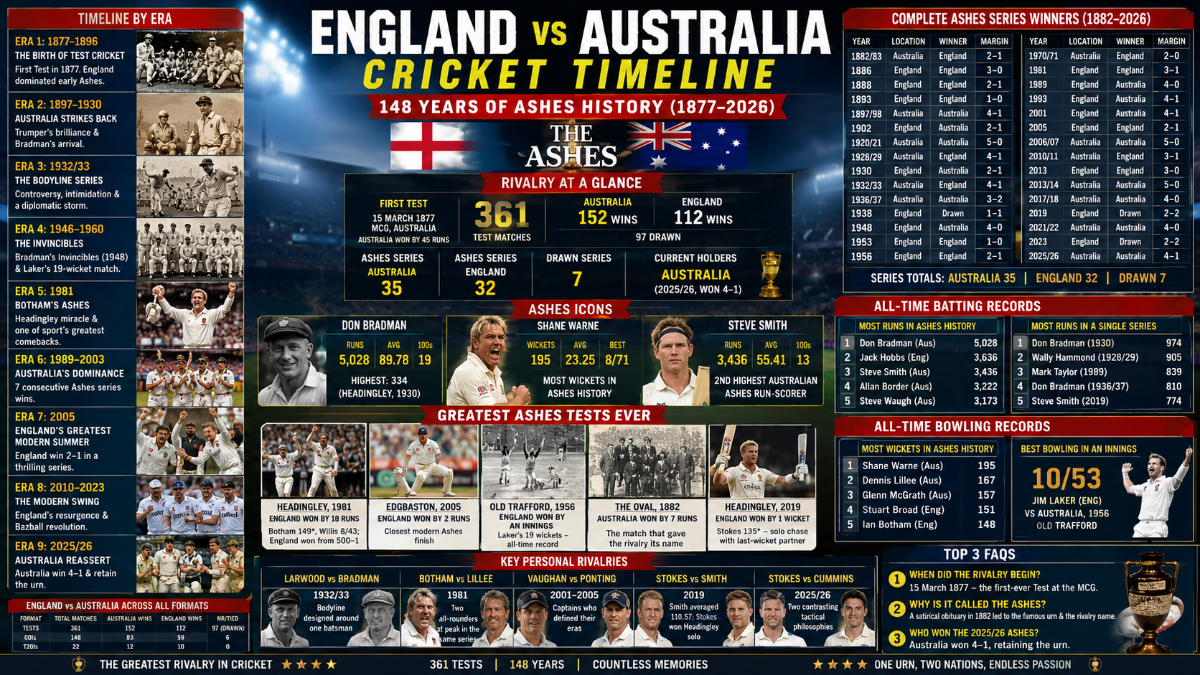
The England Cricket Team vs Australian Men’s Cricket Team Timeline stretches back almost 150 years, making it the oldest continuous rivalry in international cricket, and Australia currently holds a narrow historical edge in Ashes series wins after their 4-1 triumph in the 2025-26 series. This complete guide breaks down every era, match result, and record that defines the contest, with data tables built for quick scanning and easy reference.
How the Rivalry Began
The very first Test match between the two nations was played at the Melbourne Cricket Ground in March 1877, when an Australian XI defeated James Lilly white’s touring English side. At the time, nobody called it a “Test match”-that label came later, applied retroactively once the format’s significance became clear. This single fixture is now recognized as the founding match of the entire England Cricket Team vs Australian Men’s Cricket Team Timeline, and it set a precedent that would repeat for generations: Australian conditions favoring pace and bounce would consistently challenge visiting English batting line-ups.
The Birth of “The Ashes”
Five years after that first Test, in 1882, Australia stunned English cricket by winning on English soil for the first time, defeating the hosts at The Oval by a mere seven runs. The English press reacted with theatrical despair. A satirical obituary published in a London newspaper mourned the “death” of English cricket, joking that the body would be cremated and “The Ashes taken to Australia.” The phrase stuck instantly. When England’s captain Ivo Bligh led a touring side to Australia the following winter and won the series, a group of Melbourne women presented him with a small terracotta urn as a memento-now widely regarded as the physical symbol of the rivalry, even though it has never officially been the trophy contested on the field. The Ashes name originated from an 1882 satirical obituary published after Australia’s first Test win in England, and the urn was gifted to England’s captain Ivo Bligh the following year.

Why the Early Years Set the Tone
What most casual fans miss about this founding period is how quickly the rivalry became genuinely competitive, rather than one team simply dominating a weaker opponent. Unlike England’s colonial-era matches against other nations, Australia fielded strong, well-drilled sides almost from the outset, partly because domestic first-class cricket in the colonies was already highly organized by the 1870s. This early parity is why the rivalry has stayed remarkably even for nearly 150 years, rather than skewing heavily toward one nation.
Ashes Series Results: A Century of Swings
Understanding the full England Cricket Team vs Australian Men’s Cricket Team Timeline means tracking how dominance has shifted across generations, rather than assuming either side has held a permanent grip. The table below captures the broad eras of control.
Read More: New Zealand National Cricket Team vs United Arab Emirates National Cricket Team Match Scorecard
| Era | Period | Dominant Side | Key Context |
| Founding Years | 1877–1890 | England | Home advantage, established domestic structure |
| First Australian Rise | 1891–1900 | Australia | Emergence of skilled colonial pace bowlers |
| Bradman Era | 1928–1948 | Australia | Don Bradman’s unmatched batting dominance |
| Post-War Balance | 1950–1980 | Evenly split | Series alternated almost every cycle |
| Australian Golden Age | 1989–2005 | Australia | 8 consecutive series wins, near two-decade dominance |
| English Resurgence | 2005–2015 | Split | Frequent alternation, closely fought series |
| Modern Australian Control | 2017–2026 | Australia | 4 series wins out of 5 in this window |
Early Dominance (1877–1900)
England won the majority of series in the contest’s first two decades, largely due to superior fast bowling depth and home-conditions familiarity. Australia broke through more consistently by the 1890s, signaling the start of a genuinely competitive rivalry rather than a one-sided contest. This period established a pattern that has repeated throughout the timeline: whichever nation develops a superior fast-bowling attack at a given moment tends to control the Ashes for that cycle.
The Bradman Era (1928–1948)
No single figure shaped the England vs Australia cricket rivalry more than Don Bradman. His batting average of nearly 100 across his Test career remains statistically unmatched by any player in the sport’s history, and Australia’s Ashes dominance during his playing years reflected his individual influence as much as team strength. The 1948 “Invincibles” tour of England, where Bradman’s Australian side went through the entire tour undefeated, remains one of the most dominant campaigns ever completed by a touring team in any sport, let alone cricket. Bradman’s dominance wasn’t purely a batting story-England’s bowling attacks during this period were forced to experiment with unconventional tactics, including the infamous “Bodyline” series of 1932-33, where England targeted Bradman’s body with short-pitched bowling specifically to neutralize his scoring. This tactical innovation, though controversial and eventually banned in its extreme form, shows how one player’s excellence reshaped opposition strategy for an entire era.
Mid-Century Balance (1950–1980)
Both nations traded Ashes victories through the middle of the 20th century, with series result swings happening almost every cycle rather than any team building sustained dominance. This period is often overlooked in modern retrospectives, but it produced some of the most technically admired cricket in the rivalry’s history, with fewer blowout results and more tightly fought contests decided by individual moments rather than team-wide superiority.
The Modern Era (2000–2026)
This period has produced the most dramatic momentum shifts in the entire timeline, and it’s the era most current fans reference when discussing Ashes history.
| Series | Winner | Margin | Notable Context |
| 2001 (England) | Australia | 4-1 | Australia’s dominant era continued |
| 2002-03 (Australia) | Australia | 4-1 | Glenn McGrath, Shane Warne at peak form |
| 2005 (England) | England | 2-1 | Ended Australia’s near two-decade stranglehold |
| 2006-07 (Australia) | Australia | 5-0 | Ruthless revenge whitewash |
| 2009 (England) | England | 2-1 | Andrew Strauss captaincy debut series |
| 2010-11 (Australia) | England | 3-1 | England’s first series win in Australia since 1986-87 |
| 2013 (England) | England | 3-0 | Alastair Cook-led dominance |
| 2013-14 (Australia) | Australia | 5-0 | Mitchell Johnson’s fearsome pace spell |
| 2015 (England) | England | 3-2 | Fluctuating momentum throughout |
| 2017-18 (Australia) | Australia | 4-0 | Steve Smith’s prolific batting form |
| 2019 (England) | Drawn | 2-2 | Australia retained the urn |
| 2021-22 (Australia) | Australia | 4-0 | Pat Cummins’ first series as captain |
| 2023 (England) | Drawn | 2-2 | Bazball era’s fierce, entertaining cricket |
| 2025-26 (Australia) | Australia | 4-1 | Series retained with a match to spare |
Why 2005 and 2013-14 Still Get Referenced Constantly
Two series from this modern window get disproportionate attention in cricket media, and understanding why adds context most surface-level timelines skip. The 2005 series is remembered as arguably the greatest Ashes contest ever played, decided by margins as small as two runs in one Test, and it ended Australia’s 16-year unbeaten Ashes run. The 2013-14 series, by contrast, is remembered for the opposite reason: Mitchell Johnson’s pace and aggression completely dismantled England’s batting line-up, producing a 5-0 whitewash that effectively ended several English players’ international careers within months.
The 2025-26 Ashes: Complete Match-by-Match Breakdown
The most recent chapter of the England Cricket Team vs Australian Men’s Cricket Team Timeline saw Australia dominate from the opening Test, winning the five-match series 4-1.
| Test | Venue | Dates | Result |
| 1st Test | Perth Stadium | 21–25 Nov 2025 | Australia won by 8 wickets |
| 2nd Test | The Gabba, Brisbane | 4 Dec 2025 | Australia won by 8 wickets |
| 3rd Test | Adelaide Oval | 17–21 Dec 2025 | Australia won, series retained |
| 4th Test | MCG, Melbourne | 26–27 Dec 2025 | England won by 4 wickets |
| 5th Test | SCG, Sydney | 4–8 Jan 2026 | Australia won by 5 wickets |
Series Summary Comparison to “England Cricket Team vs Australian Men’s Cricket Team Timeline”
| Metric | Australia | England |
| Tests Won | 4 | 1 |
| Tests Lost | 1 | 4 |
| Ashes Retained | Yes | No |
| WTC Points Earned | 48 | 12 |
| Series Duration | 18 days | 18 days |
| Tests Completed in ≤2 Days | 2 | – |
Key Turning Points of the Series: England Cricket Team vs Australian Men’s Cricket Team Timeline
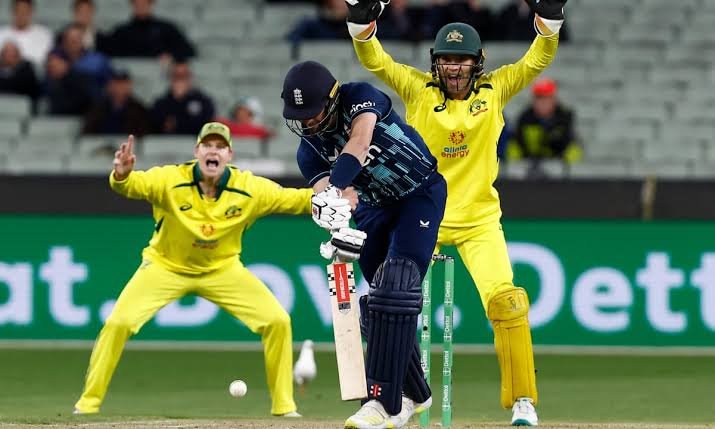
Mitchell Starc‘s fiery new-ball spell at Perth set the tone for the entire tour, dismantling England’s top order before Travis Head’s blistering century sealed the opener for Australia. By the third Test in Adelaide, Australia had already wrapped up the series with two matches still to play, a rare feat of dominance in modern Ashes cricket that hadn’t been achieved since the 2013-14 whitewash. England’s only bright spot came at Melbourne, where a disciplined chase produced their sole win of the tour-but it wasn’t enough to prevent a lopsided 4-1 series score line. Australia won the 2025-26 Ashes 4-1, sealing the series with a match to spare in Adelaide, while England’s only victory came in the fourth Test at Melbourne.
What Went Wrong for England
Beyond the score line, England’s tour was defined by a batting order that struggled consistently against Australian pace on bouncier home pitches. Their historical struggle in Australia extended further, with commentary noting it as their closest loss in a stretch of 16 defeats in Australia across their last 18 Tests down under without a win. This statistic matters because it highlights a structural issue rather than a one-off bad series-England’s away record in Australia has been in decline for nearly a decade, regardless of which players are selected.
Also Read: England Cricket Team vs Zimbabwe National Cricket Team Match Scorecard
Beyond the Ashes: White-Ball Clashes
The full England Cricket Team vs Australian Men’s Cricket Team Timeline isn’t limited to Test matches. The two teams have also produced some of the most memorable white-ball encounters in recent ICC tournaments, and these results matter for tournament seedings even when public attention gravitates toward the Ashes.
T20 World Cup and Champions Trophy Meetings
- ICC T20 World Cup 2024: Australia won by 36 runs, dominating the defending champions
- ICC Champions Trophy 2025: Australia won a high-scoring chase by 5 wickets, with Josh Inglis scoring a maiden ODI century
- Bilateral T20I Series 2024: Results were split, with England winning one match by 3 wickets in Cardiff and Australia winning another by 28 runs in Southampton
Why White-Ball Form Doesn’t Always Predict Test Results
One counterintuitive pattern in this rivalry: strong white-ball form for either team rarely translates directly into Ashes success. Several England squads that performed well in T20 World Cups arrived at subsequent Ashes series and struggled against the longer format’s demands on technique and patience. This split-format inconsistency is a genuine strategic challenge for both cricket boards, since player workload management often means first-choice Test players and white-ball specialists are entirely different squads.
Head-to-Head Records at a Glance
| Format | Total Matches (approx.) | Australia Wins | England Wins |
| Test Matches | 361+ | 152 | 112 |
| Ashes Series | 73 | Narrow lead | Close second |
| T20 World Cup meetings | Multiple | Recent dominance | Occasional wins |
| ODI meetings (all-time) | 150+ | Slight lead | Competitive |
Venue-by-Venue Ashes History to England Cricket Team vs Australian Men’s Cricket Team Timeline
Certain grounds have become synonymous with specific outcomes in this rivalry, which adds useful context for anyone tracking venue-based trends.
| Venue | Country | Historical Trend |
| Melbourne Cricket Ground | Australia | Host of first-ever Test, historically strong for Australia |
| The Oval | England | Site of the original 1882 Ashes-defining match |
| Perth Stadium/WACA | Australia | Traditionally pace-friendly, favors Australian bowlers |
| Edgbaston | England | Strong recent home record for England |
| Sydney Cricket Ground | Australia | Frequently hosts series-deciding final Tests |
What’s Next in the Rivalry
Looking ahead, the England Cricket Team vs Australian Men’s Cricket Team Timeline calendar already has a landmark fixture locked in. A special one-off Test is scheduled for March 2027 at the MCG to mark the 150th anniversary of men’s Test cricket, played as a day-night pink-ball match to mirror the historic 1877 fixture at the same venue. England’s white-ball tour of Australia is also slated to begin in November 2026, keeping the rivalry active outside the traditional Ashes cycle.
Why the 150th Anniversary Match Matters
This isn’t just a ceremonial fixture. Cricket administrators on both sides have treated it as an opportunity to reintroduce day-night Test cricket to a marquee audience, following the format’s mixed reception since its introduction in 2015. A successful pink-ball anniversary Test could influence whether more Ashes fixtures shift to day-night scheduling in future series, which would materially change how broadcasters and fans in both hemispheres experience the rivalry going forward.
Why This Timeline Still Matters to Fans
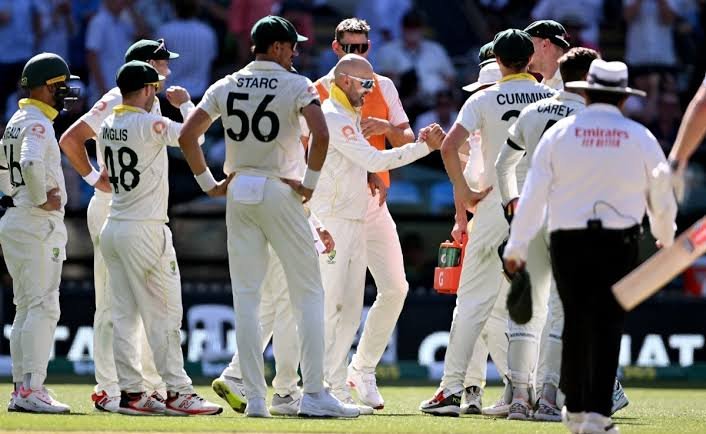
Unlike many modern rivalries shaped mainly by rankings or ICC events, the England-Australia contest carries generational weight-fathers and sons on both sides have grown up associating certain years (2005, 2013-14, 2025-26) with either euphoria or heartbreak. This emotional continuity is part of why the Ashes remains cricket’s most-watched bilateral series, regardless of either team’s current global ranking. Broadcasters in both countries continue to treat Ashes series as their single biggest cricket property, often outperforming World Cup matches in domestic viewership figures.
Frequently Asked Questions:
When did the England vs Australia cricket rivalry start?
The rivalry began in March 1877 with the first-ever Test match, played at the Melbourne Cricket Ground.
Why is the series called “the Ashes”?
The name comes from an 1882 satirical obituary published after Australia’s first Test win in England, joking that English cricket had “died” and its ashes would be taken to Australia.
Who won the 2025-26 Ashes series?
Australia won the series 4-1, retaining the Ashes with victories in four of the five Tests.
How many Ashes series has each team won overall?
Australia holds a slim historical lead over England in total series wins, with the margin remaining close for more than 140 years.
What is the Ashes urn actually made of?
The urn is a small terracotta trophy, traditionally believed to contain the remains of a burnt cricket bail, presented to England’s captain in 1882-83.
Has the Ashes ever ended in a draw?
Yes, several series have finished drawn, most recently in 2019 and 2023, with Australia retaining the urn on both occasions as the previous holders.
Where was the fourth Test of the 2025-26 series played?
The fourth Test was held at the Melbourne Cricket Ground and was England’s only win of the series, secured by 4 wickets.
How many total Test matches have England and Australia played?
The two nations have played over 360 Test matches against each other since 1877, the highest total of any Test rivalry.
When is the next major England vs Australia Test fixture?
A special 150th-anniversary Test is scheduled for March 2027 at the MCG, played under day-night pink-ball conditions.
Do England and Australia only compete in Test cricket?
No, the rivalry extends to ODIs and T20Is, including recent meetings at the 2024 T20 World Cup and 2025 Champions Trophy.

Related Posts
Bangladesh Women vs Australia Women’s National Cricket Team Timeline: Every Match, Every Record

Oman National Cricket Team vs Namibia National Cricket Team Timeline: Complete Head-to-Head History, Stats & Records (2019-2026)