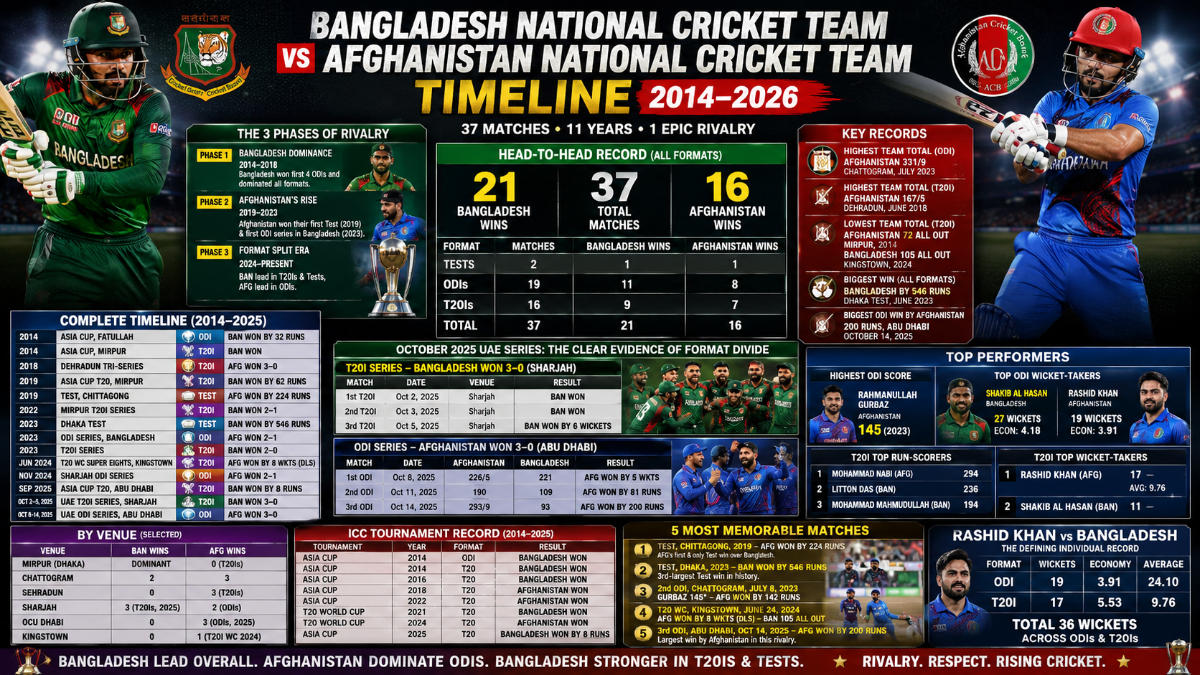
Bangladesh National Cricket Team vs Afghanistan National Cricket Team Timeline: Complete Head-to-Head History (2014–2026)
The Bangladesh National Cricket Team vs Afghanistan National Cricket Team timeline spans more than a decade of cricket, evolving from a lopsided contest into one of the most competitive rivalries in Asian cricket today. As of 2026, Bangladesh leads bilateral ODIs 9-6, holds a perfect 2-0 record in ODI World Cups, the Test series stands level at 1-1, and Afghanistan leads the overall T20I head-to-head with stronger recent form since 2018. This guide breaks down every phase of the rivalry, format-by-format records, key players, tactical patterns, and the story behind Afghanistan’s dramatic rise against a once-dominant Bangladesh side.
Few modern cricket rivalries have compressed as much drama into such a short window. What began as a routine fixture between an established Test nation and a cricketing newcomer has turned into genuinely unpredictable cricket, where reputation counts for very little once the toss happens. Understanding this rivalry properly means looking beyond headline scorelines and into the venue patterns, personnel battles, and tactical shifts that actually decide these matches.
What Is the Bangladesh vs Afghanistan Cricket Rivalry?
The Bangladesh vs Afghanistan cricket rivalry began in 2014 and has grown into a near-even contest across Tests, ODIs, and T20Is, driven largely by Afghanistan’s rapid rise as a cricketing nation and Bangladesh’s home-conditions dominance. Unlike older subcontinental rivalries built on decades of shared cricketing history, this one compressed an entire power shift into just over ten years. Afghanistan entered international cricket as an ICC Associate member in 2009 and achieved Full Member Test status only in 2017, yet by 2019 they had already beaten Bangladesh in a Test match-a result that reshaped how both boards and fans viewed the fixture. Bangladesh, by contrast, had been playing Test cricket since 2000 and carried a natural experience advantage in the early years of this rivalry. That gap has narrowed sharply, and the Bangladesh National Cricket Team vs Afghanistan National Cricket Team timeline now reads less like a mismatch and more like a genuinely unpredictable contest, especially in white-ball formats where conditions and spin quality matter more than institutional pedigree.
Key Facts at a Glance
| Category | Detail |
| First meeting | March 16, 2014, T20I at Mirpur-Bangladesh won by 9 wickets |
| Total meetings | 33+ matches across Tests, ODIs, and T20Is (through 2025/26) |
| Bangladesh captains (2026) | Najmul Hossain Shanto (Test), Mehidy Hasan Miraz (ODI), Litton Das (T20I) |
| Afghanistan captains (2026) | Hashmatullah Shahidi (Test/ODI), Ibrahim Zadran (T20I) |
| Biggest turning point | 2018 Dehradun T20I sweep, followed by 2019 maiden Test win for Afghanistan |
| Most dominant individual | Rashid Khan, whose spin has defined the last decade of this fixture |
Why This Rivalry Matters Beyond the Numbers
Cricket fans often underestimate how much this fixture reflects broader shifts in the Associate-to-Full-Member pathway. Afghanistan’s success against Bangladesh isn’t an isolated anomaly-it mirrors their rise against Test-playing nations more generally, and Bangladesh remains one of the clearest measuring sticks for that progress because both teams occupy similar positions in ICC rankings across formats. Every new series adds another data point to a rivalry that genuinely could go either way, which is precisely why it draws such consistent viewership across South Asia and the UAE.
Read More: South Africa National Cricket Team vs Canada National Cricket Team Match Scorecard
How Did the Bangladesh vs Afghanistan Rivalry Begin?
The rivalry started in 2014 with a T20I in Mirpur, followed quickly by an ODI meeting at that year’s Asia Cup where Afghanistan pulled off a surprise win over the hosts. That early Asia Cup upset, built around a gritty innings from veteran all-rounder Asghar Afghan, was the first sign that Afghanistan wouldn’t be an easy fixture despite their newcomer status. Bangladesh answered by winning the next two ODI meetings, establishing an early pattern of alternating dominance that has defined the Bangladesh National Cricket Team vs Afghanistan National Cricket Team timeline ever since.
The Early Years (2014-2017): Bangladesh’s Initial Edge
During this phase, Bangladesh’s greater experience in international cricket translated into more consistent results. Afghanistan was still building domestic infrastructure and had not yet unlocked the spin-bowling depth that would later define their identity. Bangladesh’s home conditions in Mirpur and Chattogram gave them a further edge, as Afghanistan had limited exposure to Bangladeshi pitches during this period, and their squad was still short of the international match experience that breeds composure in tight finishes.
This early period also saw Bangladesh benefit from a settled core of senior players-Mushfiqur Rahim, Shakib Al Hasan, and Tamim Iqbal among them-who had already navigated multiple ICC tournaments together. Afghanistan’s side, while talented, hadn’t yet developed the same collective experience of high-pressure cricket, and it showed in tight run-chases and close finishes during this window.
What Changed for Afghanistan After 2015
Afghanistan’s 2015 World Cup appearance, though it ended in defeat to Bangladesh, proved to be a pivotal exposure point. Playing at that level against established opposition accelerated the development of their core group, several of whom would go on to become the backbone of the side that dominated Bangladesh in 2018. This is a pattern often overlooked in casual analysis of the rivalry: Afghanistan’s losses in the early years were, in hindsight, part of a deliberate development curve that paid off within just three years.
The 2018 Turning Point: Afghanistan’s Breakthrough
Afghanistan’s 3-0 T20I series sweep over Bangladesh in Dehradun in 2018 marked the single biggest turning point in this rivalry, announcing them as a legitimate white-ball threat rather than a developing side. This wasn’t a narrow series win-Afghanistan controlled all three matches, with their spin-heavy bowling attack repeatedly restricting Bangladesh’s middle order. The series exposed a structural weakness that would resurface throughout the rest of the Bangladesh vs Afghanistan Test and T20I history: Bangladesh’s batting struggles against high-quality wrist-spin on turning tracks.
Why Dehradun 2018 Mattered So Much
- Afghanistan had never previously won a bilateral T20I series against a Test-playing nation by such a margin.
- The result forced Bangladesh’s team management to reassess their approach against spin bowling in white-ball cricket.
- It set the template for future Afghanistan wins: tight bowling, disciplined fielding, and a spin trio built around emerging talent.
- The neutral Dehradun venue-used because of Afghanistan’s limited home infrastructure at the time-turned out to favor Afghanistan’s bowlers more than anyone anticipated.
The Ripple Effect Across Formats
What’s often missed in surface-level coverage of this rivalry is how the Dehradun result changed perceptions beyond just T20I cricket. Afghanistan’s board and coaching staff used the momentum from that series to push for more fixtures against Full Member nations, arguing that their side was ready for Test cricket. Within a year, that argument was validated in the most emphatic way possible-with a Test win over the very team they had just swept in the shorter format.
Bangladesh vs Afghanistan Test Match History
Bangladesh National Cricket Team vs Afghanistan National Cricket Team timeline have played only two Test matches, and remarkably, both ended in dominant one-sided victories for different sides-a 1-1 score line that makes Tests the most evenly balanced format in this rivalry when measured purely by results, even though the sample size remains small.
Afghanistan’s Historic 2019 Chattogram Win
Afghanistan’s Test debut against Bangladesh came in September 2019 at Chattogram, and the result stunned the cricketing world. Afghanistan won by 224 runs, doing so in only their third Test match ever-one of the fastest away Test wins recorded by any new Full Member nation against an established Test side. The victory was built on disciplined seam and spin bowling, with the tourists exploiting a Bangladesh batting lineup that simply had no answer for turning conditions on a wicket that deteriorated quickly as the match progressed.
Afghanistan had barely established a domestic red-ball structure at the time, and several of their players were transitioning from limited-overs specialists into genuine Test cricketers mid-career. The fact that they could execute a disciplined four-day performance against a side with nearly two decades of Test experience spoke volumes about the depth of talent Afghanistan had quietly assembled.
Bangladesh’s Response: The 2023 Mirpur Rout
Bangladesh waited nearly four years for their response, and when it came, it was emphatic. In June 2023, Bangladesh crushed Afghanistan by 546 runs in Mirpur-one of the largest Test victory margins ever recorded between two nations, and a clear statement that Bangladesh had closed the gap exposed in 2019. Litton Das led the side in that match, marking a significant leadership milestone in his career and signaling a generational shift in Bangladesh’s Test captaincy setup.
The scale of that win is worth dwelling on. A 546-run margin isn’t just a comfortable win-it’s a statement result that ranks among the most one-sided Test outcomes in the sport’s modern history involving two Full Member nations. Bangladesh’s batters dominated across all four innings, while their bowling attack found enough support from Mirpur’s conditions to bowl Afghanistan out twice within the match’s timeframe.
| Test Match | Date | Venue | Result | Margin |
| 1st Test | Sep 5-9, 2019 | Chattogram | Afghanistan won | 224 runs |
| 2nd Test | Jun 14-17, 2023 | Mirpur | Bangladesh won | 546 runs |
What the Test Rivalry Tells Us
With only two matches played, drawing sweeping conclusions from the Test record is risky, but one pattern is clear: home advantage has been decisive in both matches. Afghanistan won away from home in familiar subcontinental conditions in 2019, while Bangladesh’s response came firmly on home turf in 2023. If the two sides schedule a longer Test series in the coming years, this small sample will finally get the context it needs.
Bangladesh vs Afghanistan ODI Head-to-Head Record
Bangladesh holds a clear 9-6 lead in bilateral ODIs and remains unbeaten against Afghanistan in ODI World Cup competition, winning both meetings in 2015 and 2019. This is the format where Bangladesh’s historical advantage is most visible, largely due to superior batting depth and greater tournament experience in 50-over cricket.
World Cup Meetings: Bangladesh’s Perfect Record
Bangladesh’s two ODI World Cup victories over Afghanistan remain the most-remembered results in this rivalry among casual fans, even though they represent only a small fraction of total meetings.
| World Cup | Venue | Result | Key Performer |
| 2015 World Cup | Canberra | Bangladesh won by 105 runs | Mushfiqur Rahim (71) |
| 2019 World Cup | Southampton | Bangladesh won by 62 runs | Mushfiqur Rahim (83) |
The 2025/26 ODI Series: Afghanistan’s Statement
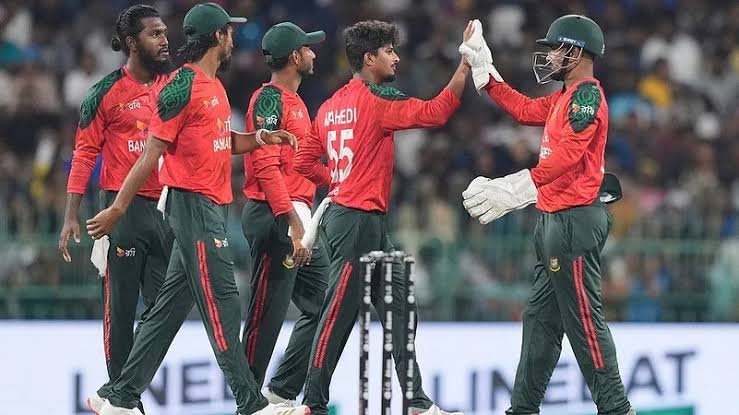
The most recent bilateral ODI series, played in the UAE in late 2025 and early 2026, marked one of Afghanistan’s most dominant white-ball performances against Bangladesh in years. Rashid Khan took 11 wickets across three matches at an average of just 6.09 and an economy rate of 2.73, single-handedly dismantling Bangladesh’s batting order. In the second ODI of that series, Bangladesh collapsed to just 109 all out, prompting Bangladesh’s coaching staff to publicly acknowledge deep concerns about the batting unit’s ability to counter high-class spin. That series result matters beyond the score line. It confirmed that Bangladesh’s spin-vulnerability, first exposed in Dehradun in 2018, has never actually been resolved-it has simply been masked by strong performances in other conditions.
Bangladesh vs Afghanistan T20I Head-to-Head Record
Afghanistan currently leads the T20I rivalry with stronger recent form, even though Bangladesh holds a narrow 9-7 edge across all completed matches since 2014. T20Is have produced the most volatile results of any format in this rivalry, swinging back and forth almost every series.
Complete T20I Match Results Timeline
| Date | Venue | Winner | Margin |
| Mar 16, 2014 | Mirpur | Bangladesh | 9 wickets |
| Jun 3, 2018 | Dehradun | Afghanistan | 45 runs |
| Jun 5, 2018 | Dehradun | Afghanistan | 6 wickets |
| Jun 7, 2018 | Dehradun | Afghanistan | 1 run |
| Sep 15, 2019 | Mirpur | Afghanistan | 25 runs |
| Sep 21, 2019 | Chattogram | Bangladesh | 4 wickets |
| Mar 3, 2022 | Mirpur | Bangladesh | 61 runs |
| Mar 5, 2022 | Mirpur | Afghanistan | 8 wickets |
| Aug 30, 2022 | Sharjah (Asia Cup) | Afghanistan | 7 wickets |
| Jul 14, 2023 | Sylhet | Bangladesh | 2 wickets |
| Jul 16, 2023 | Sylhet | Bangladesh | 6 wickets |
| Jun 24, 2024 | Kingstown (T20 World Cup) | Afghanistan | 8 runs |
| Sep 16, 2025 | Abu Dhabi (Asia Cup) | Bangladesh | 8 runs |
| Oct 5, 2025 | Sharjah | Bangladesh | 6 wickets |
The 2024 T20 World Cup Shock
Afghanistan’s win in Kingstown during the 2024 T20 World Cup deserves special mention. Bangladesh was bowled out for a mere 105, a collapse that highlighted the recurring vulnerability against Afghanistan’s spin-heavy attack on neutral, low-scoring surfaces. That result contributed to Afghanistan’s historic run to the Super Eight stage of that tournament, a campaign that reshaped their global standing overnight.
Asia Cup History: Afghanistan’s Strongest Tournament
Afghanistan has won three of their four Asia Cup meetings against Bangladesh, making the continental tournament their most successful competition against this opponent. This is a striking contrast to the ODI World Cup, where Bangladesh has never lost to Afghanistan. The 2022 Asia Cup meeting in Sharjah, won by Afghanistan by seven wickets, extended a pattern of strong Afghan performances in UAE conditions, where dry, slower pitches favor their spin bowlers.
| Asia Cup Meeting | Format | Winner | Margin |
| 2014 | ODI | Afghanistan | Narrow win |
| 2018 | T20I/ODI | Afghanistan | 136 runs |
| 2022 | T20I | Afghanistan | 7 wickets |
| 2025 | T20I | Bangladesh | 8 runs |
Leading Run Scorers and Wicket-Takers
Mushfiqur Rahim leads all-time ODI run-scoring in this rivalry with 457 runs, while Rashid Khan dominates the bowling charts with 35 ODI wickets at an economy rate of just 3.77. These numbers explain the tactical core of the rivalry: Bangladesh’s batting has generally been strong enough to win regularly in 50-over cricket, but Afghanistan’s spin quality has consistently created problems in tighter, shorter formats.
| Category | Player | Record |
| Most ODI runs | Mushfiqur Rahim (BAN) | 457 runs, average 35.15 |
| Most ODI wickets | Shakib Al Hasan (BAN) | 27 wickets, average 19.51 |
| Most T20I wickets | Rashid Khan (AFG) | 22-24 wickets, economy under 5.6 |
| Most T20I runs (current squads) | Litton Das (BAN) | 227 runs, strike rate 109.66 |
| Highest ODI team total | Afghanistan | 331/9 in 50 overs |
Rashid Khan’s Dominance Over Bangladesh: A Closer Look
Rashid Khan’s numbers against Bangladesh rank among the best of his career against any opponent, with a career economy rate of 3.77 in ODIs and an average near 10.5 in T20Is. No single player has shaped the recent trajectory of this rivalry more than Afghanistan’s premier spinner. His ability to control middle overs and strike at crucial moments has repeatedly turned matches that Bangladesh appeared to be winning on paper.
| Format | Matches | Wickets | Average | Economy |
| ODI | 19 | 35 | 19.22 | 3.77 |
| T20I | 11-12 | 22-24 | ~10.5 | ~5.5 |
Bangladesh holds a comfortable historical edge over Afghanistan, largely because of memorable ODI World Cup wins in 2015 and 2019-but since 2018, Afghanistan has actually won more T20Is, split the Test series, and taken the most recent bilateral ODI series. This perception gap is worth addressing directly, because it shapes how fans and pundits frame every new series between the two sides. The rivalry has been essentially even rather than Bangladesh-dominated. Afghanistan’s rise from ICC Associate status in 2009 to a top-10 ranked T20I and ODI nation by the mid-2020s represents one of the fastest development curves in modern cricket history.
Venue-Based Performance Patterns
Bangladesh performs significantly better at home venues like Mirpur and Sylhet, while Afghanistan has a stronger record in UAE venues such as Sharjah and Abu Dhabi, where dry, spin-friendly conditions suit their bowling attack. This venue split is one of the most useful predictive factors for anyone trying to forecast future results in this fixture.
| Venue Type | Advantage | Evidence |
| Bangladesh home (Mirpur, Sylhet) | Bangladesh | 546-run Test win, T20I sweeps in 2023 |
| UAE (Sharjah, Abu Dhabi) | Afghanistan | 2025/26 ODI series dominance, multiple Asia Cup wins |
| Neutral venues (World Cups) | Slight Afghanistan edge since 2022 | 2024 T20 World Cup upset |
Current Squads and Leadership (2026)
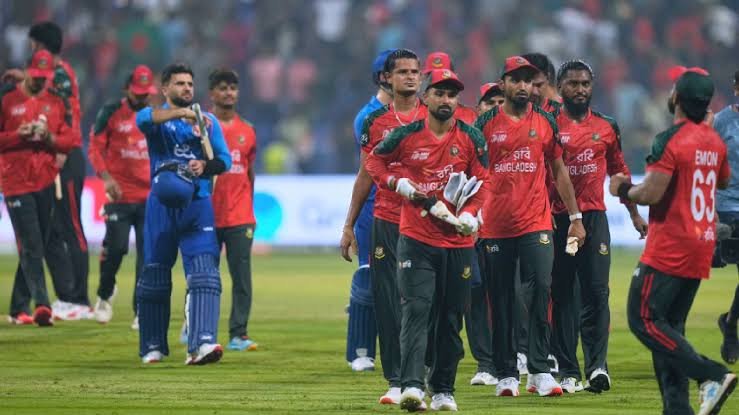
Bangladesh’s current leadership group splits captaincy duties across formats-Najmul Hossain Shanto leads in Tests, Mehidy Hasan Miraz captains the ODI side, and Litton Das leads the T20I team. Afghanistan has recently undergone a leadership transition of its own: Ibrahim Zadran took over as T20I captain from Rashid Khan in March 2026 following Afghanistan’s group-stage exit at the 2026 T20 World Cup, while Hashmatullah Shahidi continues to lead the Test and ODI sides.
What’s Next for This Rivalry?
Both nations are scheduled to meet again as part of the regular Future Tours Programme cycle, with Bangladesh set to host the 2027 Asia Cup ODI tournament, giving Afghanistan another opportunity to add to their growing tally of continental wins on Bangladeshi soil. Given the trajectory of the last eight years, expect this fixture to remain unpredictable, with format and venue continuing to matter more than reputation.
Frequently Asked Questions:
Who leads the Bangladesh vs Afghanistan head-to-head record?
It depends on the format. Bangladesh leads bilateral ODIs 9-6 and is unbeaten 2-0 in ODI World Cups. The Test record is level at 1-1, and Afghanistan holds the stronger recent form in T20Is despite trailing 7-9 all-time.
When did Bangladesh and Afghanistan first play each other in international cricket?
Their first meeting was a T20I in Mirpur on March 16, 2014, which Bangladesh won by nine wickets.
Has Afghanistan ever beaten Bangladesh in a Test match?
Yes. Afghanistan won by 224 runs in Chattogram in September 2019, in only their third-ever Test match as a nation.
What was Bangladesh’s biggest win margin against Afghanistan?
Bangladesh’s 546-run Test victory in Mirpur in June 2023 remains the largest win margin recorded between the two teams in any format.
Why does Afghanistan perform so well against Bangladesh in white-ball cricket?
Afghanistan’s spin-heavy attack, led by Rashid Khan, has consistently exploited Bangladesh’s struggles against quality wrist-spin, especially on UAE and neutral pitches.
Who has the best individual bowling record in this rivalry?
Rashid Khan, with 35 ODI wickets at an average of 19.22 and an economy rate of 3.77, plus over 20 T20I wickets against Bangladesh.
Who is the leading run-scorer between Bangladesh and Afghanistan?
Mushfiqur Rahim leads all-time ODI scoring with 457 runs across 14 matches at an average of 35.15.
Has Bangladesh ever lost to Afghanistan in the ODI World Cup?
No. Bangladesh has a perfect 2-0 record against Afghanistan in ODI World Cup meetings, in 2015 and 2019.
How has Afghanistan performed against Bangladesh in the Asia Cup?
Afghanistan has won three of four Asia Cup meetings against Bangladesh, making it their most successful tournament against this opponent.
Who currently captains Bangladesh and Afghanistan across formats?
Bangladesh splits captaincy between Najmul Hossain Shanto (Tests), Mehidy Hasan Miraz (ODIs), and Litton Das (T20Is), while Afghanistan is led by Hashmatullah Shahidi (Tests, ODIs) and Ibrahim Zadran (T20Is).

Related Posts
Bangladesh Women vs Australia Women’s National Cricket Team Timeline: Every Match, Every Record
Oman National Cricket Team vs Namibia National Cricket Team Timeline: Complete Head-to-Head History, Stats & Records (2019-2026)