New Zealand National Cricket Team vs Sri Lanka National Cricket Team Timeline: Complete Rivalry History, Stats and Key Turning Points (1979–2026)
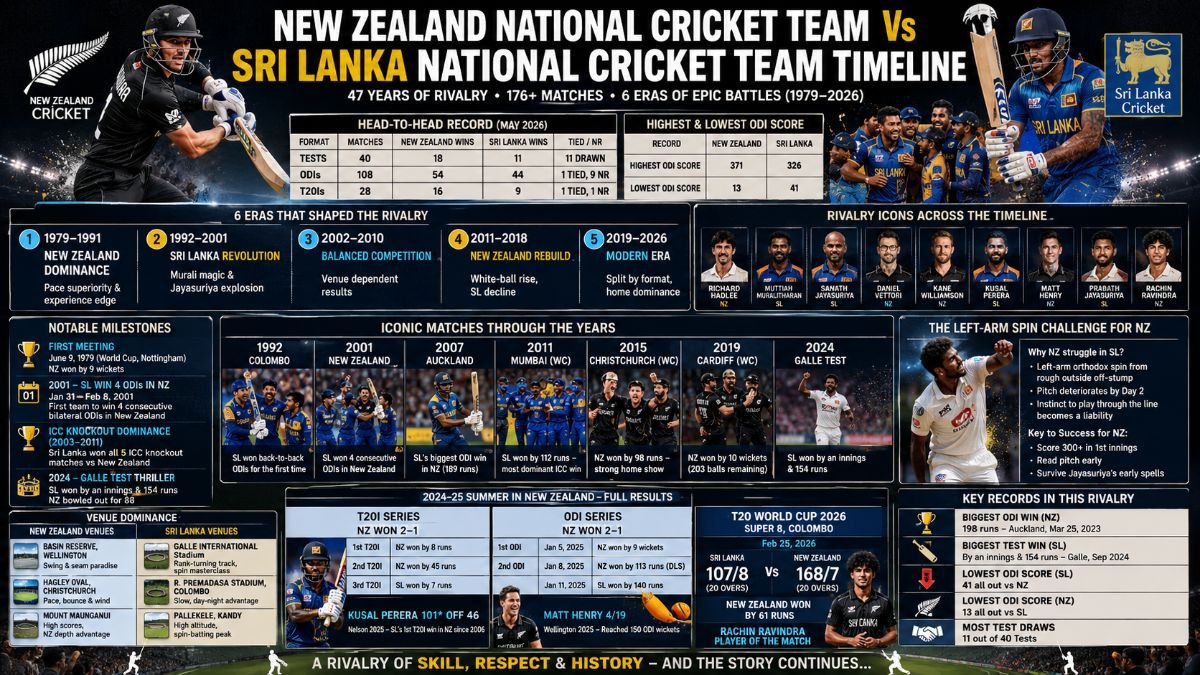
The New Zealand national cricket team vs Sri Lanka national cricket team timeline is one of the most tactically rich rivalries in world cricket- 47 years, 176+ international matches, and six distinct phases of dominance that have shifted with almost every decade. New Zealand lead the head-to-head in all three formats: 54 wins from 108 ODIs, 18 wins from 40 Tests (11 drawn), and 16 wins from 28 T20Is and CricketSky records updated through May 2026. But the overall ledger does not tell the real story. Sri Lanka won four consecutive ODIs on New Zealand soil in 2001. They swept every major ICC knockout match against New Zealand between 2003 and 2011. They bowled New Zealand out for 88 in a Test in 2024 and won by an innings and 154 runs. This rivalry has never been one-sided- it has been format-specific, venue-dependent, and built around a tactical battle that repeats in every era: New Zealand’s seam swing at home versus Sri Lanka’s spin dominance in Asia.
Full Head-to-Head Record
New Zealand hold a statistical lead across all formats in the NZ vs SL rivalry, but the margins are closer than most fans realise.
| Format | Matches | NZ Wins | SL Wins | Tied / NR |
| Tests | 40 | 18 | 11 | 11 drawn |
| ODIs | 108 | 54 | 44 | 1 tied, 9 NR |
| T20Is | 28 | 16 | 9 | 1 tied, 1 NR |
| Record | New Zealand | Sri Lanka |
| Highest ODI Score | 371 | 326 |
| Lowest ODI Score | 13 | 41 |
Rivalry by Format- Where Each Team Holds the Edge
| Format | Edge | Key Reason |
| Tests | New Zealand (overall) | Home seam conditions, SL dominates at Galle and Colombo |
| ODIs | New Zealand | Consistent home wins, SL stronger in Asian bilateral series |
| T20Is | New Zealand | Batting depth, SL dependent on Perera / Asalanka form |
Decade-by-Decade Timeline: How Dominance Shifted
The New Zealand national cricket team vs Sri Lanka national cricket team timeline spans six competitive eras, each defined by a different tactical and personnel advantage.
| Era | Dominant Team | Key Driver |
| 1979–1991 | New Zealand | NZ pace superiority, SL in development years |
| 1992–2001 | Sri Lanka | Muralitharan spin revolution, Jayasuriya batting explosion |
| 2002–2010 | Even | Venue-dependent results, both teams in transition |
| 2011–2018 | New Zealand | SL white-ball decline, NZ rebuild complete |
| 2019–2026 | Split (by format) | NZ white-ball edge, SL home Test resurgence in WTC era |
Phase One: New Zealand’s Early Dominance (1979–1991)
New Zealand dominated the early years of this rivalry through pace bowling and experience advantage. Sri Lanka had gained Test status only in 1981, and the gap in infrastructure and match exposure was significant throughout this decade.
First Meeting- 1979 World Cup, Nottingham
The sides first met at Trent Bridge, Nottingham on June 9, 1979, in the Cricket World Cup. New Zealand won by 9 wickets– a result that reflected the gap between an established cricketing nation and a side still finding its footing. Sri Lanka had not yet played a single Test match.
Bilateral Dominance Through the 1980s
New Zealand swept bilateral ODI series throughout this era with consistent, large margins:
- March 1983, New Zealand: NZ won by 116 runs (Auckland), 7 wickets (Napier), 65 runs (Dunedin)
- March 1984, Colombo: NZ won by 104 runs, then 86 runs
- January–February 1991, New Zealand: NZ won all three matches- by 5 wickets, 41 runs, and 107 runs
Richard Hadlee’s seam bowling on New Zealand’s pitches was the decisive weapon. Sri Lanka’s top order had no reliable answer for accurate late swing in overcast conditions.
Phase Two: Sri Lanka’s Revolution (1992–2001)
Sri Lanka’s rise in the 1990s completely reversed the power dynamic in this rivalry, driven by the emergence of Muttiah Muralitharan and the batting revolution led by Sanath Jayasuriya.
December 1992- The First Breakthrough
On December 12 and 13, 1992, in Colombo, Sri Lanka beat New Zealand by 8 wickets and 31 runs in back-to-back ODIs. These were the first consecutive bilateral wins Sri Lanka had recorded against New Zealand in history- a clear early signal that the balance was shifting.
2001- Sri Lanka Win Four Consecutive ODIs in New Zealand
Between January 31 and February 8, 2001, Sri Lanka won four straight ODIs on New Zealand soil:
- January 31, Napier: SL won by 61 runs
- February 3, Wellington: SL won by 3 wickets
- February 6, Auckland: SL won by 9 wickets
- February 8, Hamilton: SL won by 3 runs (DLS)
This remains Sri Lanka’s most complete away ODI series performance in the history of the New Zealand vs Sri Lanka timeline. No team had won four consecutive bilateral ODIs in New Zealand against a home side with that margin combination.
The ICC Knockout Dominance: 2003–2011
Between 2003 and 2011, Sri Lanka won every major ICC tournament match against New Zealand:
| Year | Tournament | Venue | Result |
| 2003 | ODI World Cup | Bloemfontein | SL won by 47 runs |
| 2007 | ODI World Cup | St George’s | SL won by 6 wickets |
| 2007 | ODI World Cup | Kingston | SL won by 81 runs |
| 2011 | ODI World Cup | Mumbai | SL won by 112 runs |
| 2011 | ODI World Cup | Colombo | SL won by 5 wickets |
Sri Lanka’s 112-run win at Mumbai in 2011 was the most decisive result in the rivalry’s ICC history- it eliminated New Zealand’s semi-final hopes and exposed a clear composure gap under big-match pressure.
Phase Three: Balanced Competition and Transition (2002–2010)
The mid-period of the New Zealand national cricket team vs Sri Lanka national cricket team timeline produced the most unpredictable results, with both teams winning and losing based almost entirely on venue.
2006–2007- Sri Lanka’s Largest Win in New Zealand
In January 2007 at Auckland, Sri Lanka won by 189 runs– their largest ODI victory margin in New Zealand across this entire rivalry. Sri Lanka’s batting fired on a flat Auckland surface, New Zealand’s bowling had no answers.
2009–2010- Champions Trophy and Asia Results
- September 2009, Johannesburg (Champions Trophy): NZ won by 38 runs
- September 2009, Colombo: SL won by 97 runs
- August 2010, Dambulla: SL won by 3 wickets
The pattern was clear: the home-conditions team almost always won. Neither side had yet developed the adaptability to consistently succeed on unfamiliar surfaces.
Phase Four: New Zealand’s White-Ball Rebuild (2011–2018)
New Zealand’s restructured white-ball programme, led by Brendon McCullum and then Kane Williamson, rebuilt their bilateral superiority in ODIs and T20Is– while Sri Lanka began a gradual decline in limited-overs cricket.
Read More: Scotland National Cricket Team Vs England Cricket Team Timeline
2015 World Cup, Christchurch
February 14, 2015, Hagley Oval, Christchurch. New Zealand beat Sri Lanka by 98 runs at their home World Cup- one of six ODI wins New Zealand recorded against Sri Lanka across the 2015 home season. New Zealand’s bowling attack that summer, led by Trent Boult and Tim Southee, was operating at its most cohesive.
2019 World Cup, Cardiff- The Most Dominant Single Result
June 1, 2019. Cardiff. New Zealand beat Sri Lanka by 10 wickets with 203 balls remaining. Sri Lanka were dismissed for 136, New Zealand overhauled the target inside 17 overs. This is the most one-sided World Cup result between these two sides- and it effectively ended Sri Lanka’s semi-final hopes in the 2019 tournament.
Phase Five: The Modern Era (2019–2026)
The latest phase of the New Zealand national cricket team vs Sri Lanka national cricket team timeline is defined by a format split: New Zealand dominate white-ball cricket in home conditions, Sri Lanka have re-established themselves as one of the world’s toughest teams in home Tests- particularly at Galle.
2023- New Zealand’s Largest Win on Record
- March 25, 2023, Auckland: NZ won by 198 runs– New Zealand’s largest ODI victory margin against Sri Lanka
- March 31, 2023, Hamilton: NZ won by 6 wickets
September 2024- Sri Lanka’s Most Dominant Test Win
Galle, September 2024. This series produced the most lopsided Test result in this rivalry’s history:
- First Test: Sri Lanka won by 63 runs. Prabath Jayasuriya was the decisive bowler.
- Second Test: New Zealand were bowled out for 88 in their first innings. Sri Lanka declared on 602/5d. New Zealand were dismissed again for 360 in the second innings. Sri Lanka won by an innings and 154 runs.
This result exposed a structural weakness: New Zealand’s batting has no reliable answer for left-arm orthodox spin from rough outside off-stump on deteriorating Galle surfaces– a problem that has persisted across multiple touring squads.
2024-25 Summer in New Zealand: Full Verified Results
T20I Series- New Zealand won 2-1
| Match | Date | Venue | Winner | Key Performer |
| T20I 1 | Dec 28, 2024 | Mount Maunganui | NZ won by 8 runs | Pathum Nissanka 90 off 60 (SL) |
| T20I 2 | Dec 30, 2024 | Mount Maunganui | NZ won by 45 runs | Jacob Duffy 4/15 |
| T20I 3 | Jan 2, 2025 | Nelson | SL won by 7 runs | Kusal Perera 101 off 46 |
Kusal Perera’s 101 off 46 balls at Nelson was the standout individual performance of the entire summer series- his maiden T20I century, and Sri Lanka’s first T20I win in New Zealand since 2006.
ODI Series- New Zealand won 2-1
| Match | Date | Venue | Winner | Key Performer |
| ODI 1 | Jan 5, 2025 | Wellington | NZ won by 9 wickets | Matt Henry 4/19 |
| ODI 2 | Jan 8, 2025 | Hamilton | NZ won by 113 runs (DLS) | Rachin Ravindra 79 off 63 |
| ODI 3 | Jan 11, 2025 | Auckland | SL won by 140 runs | Asitha Fernando 3/26 |
Matt Henry reached 150 ODI wickets in the third ODI at Auckland. Sri Lanka’s 140-run win at Auckland- their largest bilateral ODI win in New Zealand since 2006- showed their ability to exploit flat surfaces when their batting fires without restriction.
T20 World Cup 2026- Super 8, Colombo
February 25, 2026. R. Premadasa Stadium, Colombo.
Sri Lanka 107/8 (20 overs) vs New Zealand 168/7 (20 overs)
New Zealand won by 61 runs. Rachin Ravindra: Player of the Match. Winning by 61 runs at R. Premadasa- one of Sri Lanka’s most defended home venues- is among New Zealand’s most significant results in subcontinental white-ball cricket. It reflects a genuine improvement in New Zealand’s ability to bat in Asian T20 conditions, a gap this rivalry had exposed for years.
The Left-Arm Spin Problem: New Zealand’s Most Persistent Tactical Weakness
This is the single most consistent pattern in the modern NZ vs SL rivalry, and understanding it explains almost every Test series result when New Zealand toured Sri Lanka.
Why It Keeps Happening
Left-arm orthodox spin, bowled from around the wicket into rough outside right-handers’ off stump, is the hardest delivery for New Zealand’s batting lineup to neutralise on turning surfaces. Prabath Jayasuriya exploits this angle at Galle- where rough develops by session two on day one and sustains for the full five days. New Zealand’s domestic first-class pitches do not deteriorate at the same pace or in the same way. The instinct to play through the line- effective against seam- becomes a liability when the ball turns sharply and bounces unevenly.
What Changes the Equation
When New Zealand post above 300 in the first innings of a Test in Sri Lanka, they force Sri Lanka to bat under a run-chase situation that restricts the spinner’s attacking fields. In their two most recent Tests at Galle, New Zealand failed to pass 280 in any single innings– which gave Jayasuriya and Ramesh Mendis complete freedom to attack with 7-2 and 8-1 field settings. The 2026 New Zealand A tour of Sri Lanka is directly targeted at addressing this preparation gap.
Venue Intelligence: Where Each Team Dominates
New Zealand’s Strongest Home Venues vs Sri Lanka
| Venue | Why NZ Dominate |
| Basin Reserve, Wellington | Morning swing, cold conditions, seam-friendly surface, Matt Henry is almost unplayable here in first 10 overs |
| Hagley Oval, Christchurch | Pace and bounce, exposed to wind, challenges Sri Lanka’s lower-order technique |
| Mount Maunganui | High-scoring but NZ batting depth historically superior, Jacob Duffy effective in powerplay conditions |
Sri Lanka’s Strongest Home Venues vs New Zealand
| Venue | Why SL Dominate |
| Galle International Stadium | Rank-turning surfaces by day two, Jayasuriya and Ramesh Mendis unplayable in tandem |
| R. Premadasa Stadium, Colombo | Slow surface, day-night conditions favour slow bowling and batting in second half of innings |
| Pallekele, Kandy | High altitude, SL spin-batting combination peaks here in longer formats |
Key Players Across the Full Timeline
| Player | Team | Era | Verified Standout |
| Richard Hadlee | New Zealand | 1979–1991 | Pace dominance, series wins across early bilateral era |
| Muttiah Muralitharan | Sri Lanka | 1992–2011 | 7/68 Test figures, ODI wicket machine across 1997–2007 |
| Sanath Jayasuriya | Sri Lanka | 1996–2007 | Opening aggression, transformed bilateral ODI tempo |
| Daniel Vettori | New Zealand | 2000–2012 | Left-arm spin counterpoint, tactical captaincy |
| Kane Williamson | New Zealand | 2012–2024 | Test batting backbone, anchoring chases |
| Kusal Perera | Sri Lanka | 2019–present | 101 off 46, Nelson 2025, first SL T20I century in NZ since 2006 |
| Matt Henry | New Zealand | 2019–present | 4/19, Wellington 2025, reached 150 ODI wickets vs SL |
| Rachin Ravindra | New Zealand | 2023–present | T20 WC 2026 Player of the Match, emerging No. 1 match-winner |
| Prabath Jayasuriya | Sri Lanka | 2022–present | Galle Test destroyer, decisive in 2024 innings win |
| Jacob Duffy | New Zealand | 2024–present | 4/15 and 3/21 in successive T20Is, December 2024 |
Match Reading Guide: What to Watch in Any NZ vs SL Match
Understanding these signals helps fans, analysts, and fantasy players assess any fixture in the New Zealand vs Sri Lanka cricket timeline before the toss is even taken.
If the match is in New Zealand:
- Sri Lanka’s top-3 survival in the first 15 overs is the most reliable in-match signal- if they lose two wickets before over 15, they rarely build a competitive total
- Matt Henry’s swing availability in the first 10 overs is decisive, on overcast Wellington mornings, he generates movement that Sri Lanka’s top order has historically struggled to handle
- Sri Lanka’s best counter: survive the new ball, build a 100+ partnership in the middle overs, then attack in overs 35–50
If the match is a Test in Sri Lanka:
- First-innings total is the decisive variable– teams reaching 300+ have a substantially stronger chance of avoiding defeat
- Watch New Zealand’s ability to read pitch deterioration in sessions 2 and 3 on day one
- If Jayasuriya takes two wickets before lunch on day one, New Zealand historically do not recover
In T20Is (any venue):
- Kusal Perera in form is the single greatest individual variable– when he is set, he scores at above 200 strike rate and changes target-setting for any side
- The middle overs (7–14) have historically produced the highest wicket concentration in this fixture, the team that controls this phase wins the majority of T20Is in this rivalry
- For fantasy: Jacob Duffy in powerplay conditions on New Zealand pitches is consistently the highest wicket-taking option in T20Is
The Most Memorable Collapses
Collapses define this rivalry as much as centuries do– and both teams have produced historic low-scores against each other.
New Zealand’s Worst Test Collapse
Second Test, Galle, September 2024- New Zealand bowled out for 88. Sri Lanka declared on 602/5d. New Zealand were bowled out again for 360 in the second innings. Sri Lanka won by an innings and 154 runs. This is the largest winning margin in this rivalry’s Test history- and the 88 all out remains New Zealand’s joint-lowest total in Tests in Sri Lanka.
Sri Lanka’s Lowest ODI Total vs New Zealand
41 all out– Sri Lanka’s lowest ODI score against New Zealand on record, per CricketSky match archives.
New Zealand’s Lowest ODI Total vs Sri Lanka
13– New Zealand’s lowest ODI total against Sri Lanka. Both records represent the extreme variance that seam and spin conditions can create in this fixture.
World Test Championship Context
The WTC era has elevated the stakes of every Test between these sides. Sri Lanka’s home-conditions dominance- against England, Australia, and New Zealand since 2022- has placed them consistently in the top-three Test teams in Asian conditions. New Zealand, despite being WTC 2021 champions, have accumulated series losses in Asia. New Zealand’s 0-2 loss in Sri Lanka in September 2024 had direct WTC points implications, reducing their chances of qualifying for the WTC 2023-25 final. Any future bilateral Test series between New Zealand and Sri Lanka now carries combined stakes of pride, rankings, and WTC qualification- making each of the five days more consequential than at any point in the earlier timeline.
FAQs: New Zealand National Cricket Team vs Sri Lanka National Cricket Team
Q1. Who leads the overall head-to-head in the NZ vs SL rivalry?
A1. New Zealand lead in all three formats (May 2026): ODIs 54-44 (108 matches), Tests 18-11 (40 matches), T20Is 16-9 (28 matches).
Q2. When did New Zealand and Sri Lanka play their first international match?
A2. June 9, 1979, at Trent Bridge, Nottingham in the Cricket World Cup. New Zealand won by 9 wickets.
Q3. What is Sri Lanka’s lowest ODI score against New Zealand?
A3. 41 all out– Sri Lanka’s lowest ODI total against New Zealand on record.
Q4. What is the biggest Test win in the New Zealand vs Sri Lanka cricket timeline?
A4. Sri Lanka’s win by an innings and 154 runs in the second Test at Galle, September 2024. New Zealand were dismissed for 88 in their first innings, Sri Lanka declared on 602/5d.
Q5. What was the result of the NZ vs SL T20 World Cup 2026 match?
A5. New Zealand beat Sri Lanka by 61 runs at R. Premadasa Stadium, Colombo, on February 25, 2026, in the Super 8 stage. Rachin Ravindra was named Player of the Match.
Q6. Who is the best bowler in New Zealand vs Sri Lanka history?
A6. Muttiah Muralitharan– best figures of 7/68 in Tests and the highest sustained wicket-taking rate across both formats from 1992 to 2007.
Q7. Has Sri Lanka ever won a T20I series in New Zealand?
A7. Sri Lanka won the third T20I at Nelson (January 2, 2025)- their first T20I win in New Zealand since 2006- but lost the series 2-1 to New Zealand.
Q8. What was New Zealand’s biggest ODI victory margin against Sri Lanka?
A8. 198 runs– Auckland, March 25, 2023.
Q9. How many Tests have been drawn between New Zealand and Sri Lanka?
A9. 11 Tests have ended in draws from 40 played, reflecting the difficulty both teams face in forcing results against each other, particularly in away conditions.
Q10. Which venue gives Sri Lanka the best chance against New Zealand in Tests?
A10. Galle International Stadium– Sri Lanka’s most dominant venue. The turning surface, sustained rough outside off-stump, and two-spinner combination (Jayasuriya + Mendis) make it the most difficult ground in this rivalry for any New Zealand batting lineup.

Related Posts
Bangladesh Women vs Australia Women’s National Cricket Team Timeline: Every Match, Every Record
Oman National Cricket Team vs Namibia National Cricket Team Timeline: Complete Head-to-Head History, Stats & Records (2019-2026)