Royal Challengers Bengaluru vs Punjab Kings Match Scorecard: RCB Seal Playoff Spot With 23-Run Win
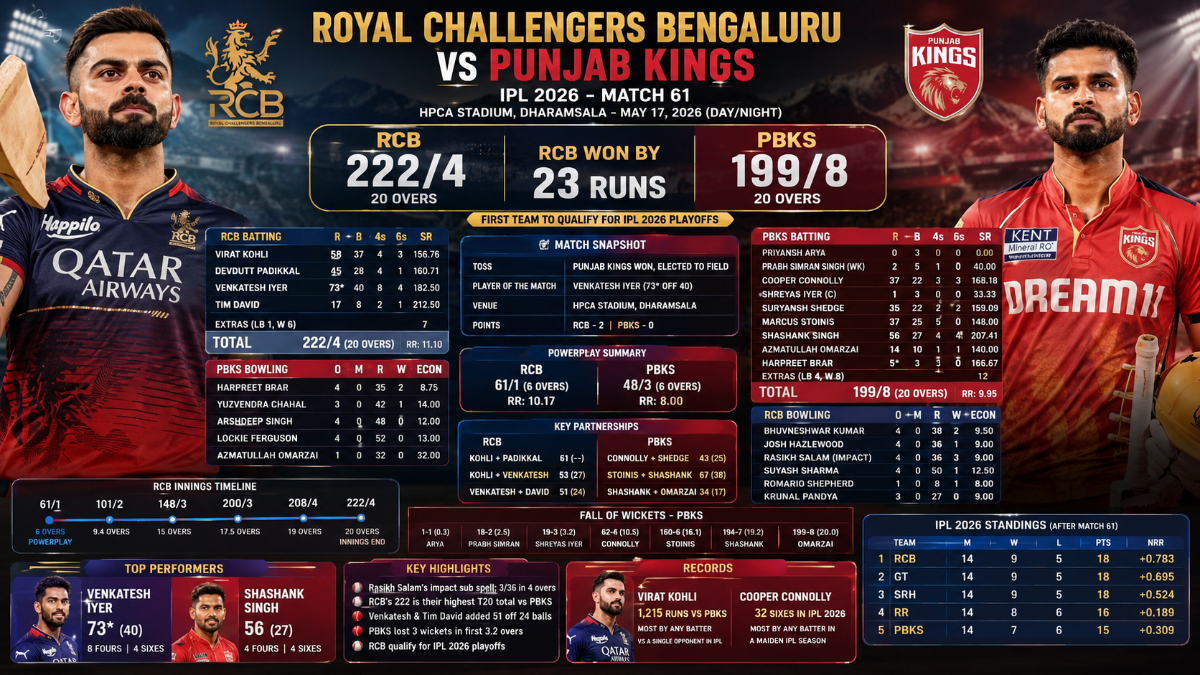
Royal Challengers Bengaluru beat Punjab Kings by 23 runs in IPL 2026 Match 61, posting 222/4 before restricting the Kings to 199/8 at the HPCA Stadium, Dharamsala, and this Royal Challengers Bengaluru vs Punjab Kings match scorecard breaks down every batting figure, bowling spell, and turning point from the contest. The result made RCB the first franchise to confirm a top-four finish in IPL 2026, while a sixth straight defeat left Punjab Kings staring at elimination. This wasn’t just another league game. Both sides had contested the IPL 2025 final months earlier, adding a layer of rivalry tension to what was already a must-win fixture for RCB and a virtual knockout for a struggling Punjab side. What followed was a T20 innings built on calculated risk-taking, a batting collapse that decided the match inside the first four overs of the chase, and an individual performance that instantly became the story of the night.
Quick Match Summary
RCB 222/4 (20 overs) beat PBKS 199/8 (20 overs) by 23 runs. Punjab Kings won the toss and chose to field first at the HPCA Stadium, Dharamsala, on May 17, 2026, but that decision backfired as RCB posted their highest total of the season against this opponent.
- Venue: HPCA Stadium, Dharamsala
- Toss: Punjab Kings won, elected to field
- Result: Royal Challengers Bengaluru won by 23 runs
- Impact: RCB became the first team to qualify for IPL 2026 playoffs
Why This Match Mattered
The scoreline alone undersells the stakes. RCB needed one more win to guarantee a top-four finish, and a below-par chasing performance from Punjab meant the equation was settled far quicker than most fans expected. For Punjab Kings, already reeling from five straight defeats, this was effectively a season-defining fixture -and losing it pushed their campaign to the brink. There’s also a bigger tactical subplot here that most match reports gloss over. RCB went into this game without regular captain Rajat Patidar, forcing a reshuffle that tested the depth of their batting order under real pressure -not against a weak attack, but against a Punjab bowling unit featuring Yuzvendra Chahal, Arshdeep Singh, and Harpreet Brar, all proven performers in these conditions.
Player of the Match: Venkatesh Iyer’s Career-Defining Knock
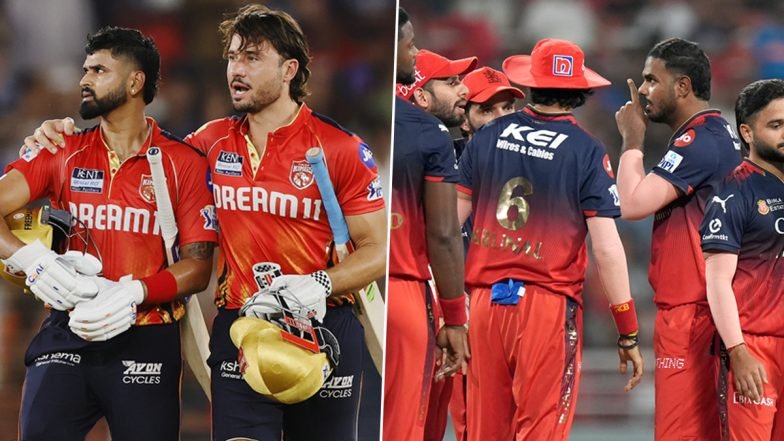
Venkatesh Iyer was named Player of the Match for his unbeaten 73 off 40 balls, a performance built on 8 fours and 4 sixes at a strike rate of 182.50. Used mainly as an Impact Player substitute through most of the season, Iyer got his first real opportunity to bat through an innings after captain Rajat Patidar’s absence opened a spot at No.4 -and he made it count with the calmest head in a chase-defining total. What makes this innings notable isn’t just the runs, it’s the situation in which they came. Iyer walked in with RCB still rebuilding after an early wicket, and rather than playing cautiously to protect his spot, he accelerated from the very first over he faced. That decision -to attack immediately rather than settle -set the tone for RCB’s final six overs, during which the score jumped from 157 to 222.
Read More: Ireland Cricket Team vs Zimbabwe National Cricket Team Timeline
The Tactical Read Behind His Promotion
RCB’s team management took a calculated risk moving Iyer up the order against a Punjab attack that includes Chahal‘s wrist-spin and Arshdeep’s left-arm pace, both bowlers who typically trouble batters new to the crease. His control percentage stayed above 68% even in the death overs, which meant RCB never lost momentum despite losing wickets at regular intervals through the middle overs. This is the kind of tactical nuance that separates a genuine analytical breakdown from a basic recap. Most casual viewers see “73 not out” and assume a straightforward big-hitting innings. In reality, Iyer’s knock was built on shot selection -targeting Chahal’s flatter deliveries for boundaries while working Arshdeep’s yorker-length balls into gaps rather than trying to muscle them out of the ground. That balance of risk and control is exactly why RCB’s middle-overs run rate held steady even as wickets fell around him.
Royal Challengers Bengaluru Innings Breakdown (222/4)
RCB posted 222/4 in 20 overs at a run rate of 11.10, built on three distinct phases: an aggressive powerplay, a rebuilding middle, and an explosive finish. The innings had contributions from four different batters passing 25 runs, giving it a balanced look rather than a one-man show. This phase-by-phase structure is worth dwelling on because it explains why RCB’s total felt so difficult to chase down. A team that scores 220+ off one blistering powerplay often leaves bowlers room to adjust lengths in the middle overs. RCB avoided that trap by staying above a run rate of 9 throughout the middle phase, denying Punjab’s bowlers any real recovery period.
Batting Scorecard
| Batter | Dismissal | Runs | Balls | 4s | 6s | Strike Rate |
| Jacob Bethell | b Harpreet Brar | 11 | 7 | 2 | 0 | 157.14 |
| Virat Kohli | c Priyansh Arya b Yuzvendra Chahal | 58 | 37 | 4 | 3 | 156.76 |
| Devdutt Padikkal | c Shreyas Iyer b Harpreet Brar | 45 | 25 | 4 | 3 | 180.00 |
| Venkatesh Iyer | not out | 73 | 40 | 8 | 4 | 182.50 |
| Tim David | c Harpreet Brar b Arshdeep Singh | 28 | 12 | 2 | 2 | 233.33 |
Extras: 7 (bye 1, wide 5, no-ball 1). Total: 222/4 in 20 overs.
Look closely at the strike rates and a clear pattern emerges: every single specialist batter in RCB’s top five finished above 150. That kind of collective intent, rather than one standout hitter carrying the innings alone, is what separates a genuinely strong T20 batting performance from a lucky one.
Powerplay and Partnership Analysis
RCB raced to 61/1 in the powerplay, setting up the platform for the eventual 222-run total. Kohli and Padikkal then built a crucial 76-run stand across 41 balls before Venkatesh Iyer and Kohli added another 60 off 35 -the middle-overs consolidation that let RCB attack freely at the death, where Iyer and David combined for 65 runs off just 30 balls. Breaking that down further: the Kohli-Padikkal stand wasn’t about slogging boundaries every ball. It was built on running hard between the wickets and picking off Punjab’s fielding gaps, converting ones into twos consistently enough that the required boundary percentage for the final overs stayed manageable. That’s a subtle but crucial difference from teams that rely purely on six-hitting to compensate for a slow middle phase.
Fall of Wickets
| Wicket | Score | Over | Batter Out |
| 1st | 21 | 2.2 | Jacob Bethell |
| 2nd | 97 | 9.1 | Devdutt Padikkal |
| 3rd | 157 | 14.6 | Virat Kohli |
| 4th | 222 | 19.6 | Tim David |
Notice the spacing between these dismissals. RCB never lost more than one wicket inside a five-over window, which is precisely why Punjab’s bowlers could never string together consecutive overs of pressure. Every time a wicket fell, the next partnership had already had time to settle.
Punjab Kings Bowling Figures
Harpreet Brar was Punjab’s standout bowler with figures of 4-0-35-2, the best economy rate among the home attack, while Arshdeep Singh leaked 43 runs in his 4 overs despite taking the crucial Tim David wicket in the final over.
| Bowler | Overs | Runs | Wickets | Economy |
| Arshdeep Singh | 4 | 43 | 1 | 10.80 |
| Azmatullah Omarzai | 4 | 38 | 0 | 9.50 |
| Harpreet Brar | 4 | 35 | 2 | 8.80 |
| Lockie Ferguson | 3 | 43 | 0 | 14.30 |
| Yuzvendra Chahal | 3 | 42 | 1 | 14.00 |
| Shashank Singh | 2 | 20 | 0 | 10.00 |
Punjab’s over-allocation here tells its own story. Skipper Shreyas Iyer used six different bowling options but never found a spell that genuinely slowed RCB down for more than two consecutive overs. Chahal, usually Punjab’s most economical option against a settled batting lineup, went for over 14 an over -a sign that RCB’s batters had done their homework on his variations.
Punjab Kings Chase: A Powerplay Collapse That Decided the Match
Punjab Kings were reduced to 19/3 after just 3.2 overs, a collapse from which IPL chasing sides historically win fewer than 10% of matches when defending a target above 220. This early damage from Bhuvneshwar Kumar and Rasikh Salam effectively decided the contest before the halfway mark of the innings. This statistic deserves more attention than it usually gets in match reports. A 19/3 start chasing 223 isn’t just a bad beginning -it’s a mathematical death sentence in most T20 contexts, because it forces the remaining batters to take risks far earlier than they’d otherwise want to, which in turn makes them more susceptible to further dismissals. Punjab’s middle order never fully escaped that trap for the rest of the innings.
Batting Scorecard
| Batter | Dismissal | Runs | Balls |
| Priyansh Arya | run out | 0 | 3 |
| Prabhsimran Singh | caught | 5 | – |
| Shreyas Iyer | caught (wk) | 1 | 3 |
| Cooper Connolly | caught | 37 | 22 |
| Suryansh Shedge | caught | 35 | 22 |
| Marcus Stoinis | lbw | 37 | 25 |
| Shashank Singh | not out | 56 | 27 |
| Azmatullah Omarzai | caught | 14 | 10 |
| Harpreet Brar | not out | 5 | 3 |
Extras: 12 (leg bye 4, wide 8). Total: 199/8 in 20 overs.
Fight back That Fell Short
Shashank Singh’s unbeaten 56 off 27 balls, built on a 22-ball fifty, was the innings’ standout individual effort, but Punjab needed 40 runs off the final two overs and never got close. Cooper Connolly and Suryansh Shedge had earlier added useful contributions of 37 and 35 respectively, briefly threatening to bring the chase back into contention before RCB’s death bowlers reasserted control. Shashank Singh’s innings actually was in isolation -a strike rate above 200 in a genuine rescue effort. The problem for Punjab wasn’t the quality of the fightback, it was the arithmetic that the powerplay collapse had already created. Even a near-flawless finish couldn’t fully close a gap that opened in the first four overs.
RCB Bowling Figures (Second Innings)
Rasikh Salam was the standout bowler with 3/36 across his 4 overs, backed by Bhuvneshwar Kumar’s disciplined new-ball spell of 2/38 that triggered Punjab’s early collapse.
| Bowler | Overs | Runs | Wickets | Economy |
| Bhuvneshwar Kumar | 4 | 38 | 2 | 9.50 |
| Josh Hazlewood | 4 | 36 | 1 | 9.00 |
| Rasikh Salam | 4 | 36 | 3 | 9.00 |
| Suyash Sharma | 4 | 50 | 1 | 12.50 |
| Romario Shepherd | 1 | 8 | 1 | 8.00 |
| Krunal Pandya | 3 | 27 | 0 | 9.00 |
The most telling number in this table is Suyash Sharma’s economy of 12.50 -the one spell where Punjab’s late fightback found boundaries. Everywhere else, RCB’s bowlers kept the containment tight enough that Punjab never got a genuine platform to launch a serious chase from.
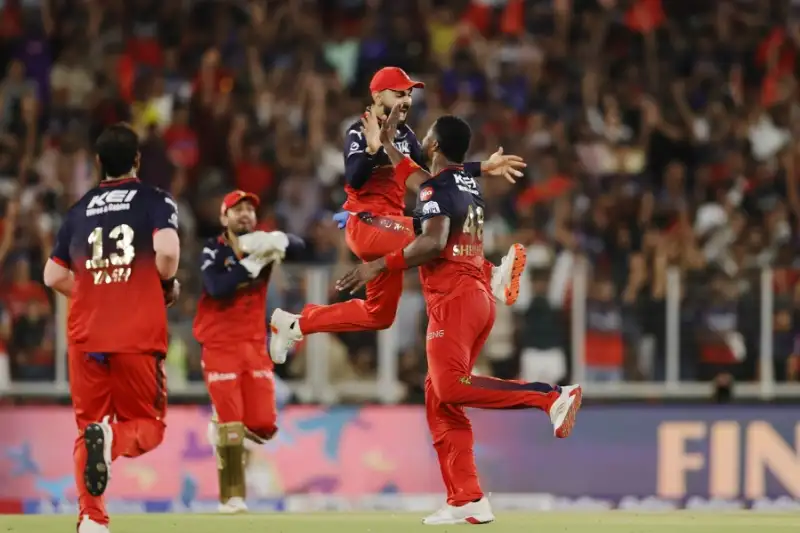
Fall of Wickets
| Wicket | Score | Over |
| 1st | 1 | 0.3 |
| 2nd | 18 | 2.5 |
| 3rd | 19 | 3.2 |
| 4th | 62 | 7.3 |
| 5th | 93 | 10.5 |
| 6th | 160 | 16.1 |
| 7th | 194 | 19.2 |
| 8th | 199 | 19.6 |
Key Moments Timeline
The 3.2-over mark, not any single big over later in the innings, was the statistically provable turning point of this match. Once Punjab slipped to 19/3, they needed a required rate above 11 runs per over for the remaining 16 overs -a rate they never sustained beyond three consecutive overs.
| Over | Event |
| 2.2 | Jacob Bethell dismissed for 11, RCB 21/1 |
| 3.2 | PBKS collapse to 19/3, chase effectively lost |
| 9.1 | Padikkal falls for 45, RCB 97/2 |
| 14.6 | Kohli dismissed for 58, RCB 157/3 |
| 19.6 | Tim David out, RCB innings closes at 222/4 |
| 19.6 (chase) | Rasikh Salam removes Azmatullah Omarzai, sealing RCB’s win |
Every subsequent Punjab wicket after the 3.2-over mark simply confirmed a result that had already been mathematically settled. This is why raw win-margin numbers like “23 runs” can sometimes undersell how comprehensive a victory actually was -the game was effectively over well before the scoreboard reflected it.
Match Statistics at a Glance
RCB’s top five batters combined for 20 fours and 12 sixes, a boundary-heavy total that reflects the aggressive intent both openers showed from the first over.
- Highest scorer: Venkatesh Iyer, 73* off 40 balls
- Best bowler: Rasikh Salam, 3/36 in 4 overs
- Powerplay score, RCB: 61/1
- Powerplay score, PBKS: 19/3
- Total match sixes: 9 across both innings
- RCB total fours: 20
The powerplay comparison alone tells you almost everything about how this match unfolded -RCB were 42 runs ahead of Punjab at the same stage, a gap that, once established, was never seriously threatened.
Royal Challengers Bengaluru vs Punjab Kings match scorecard Head-to-Head Record
RCB now lead the overall IPL rivalry 20-18 across 38 meetings, extending their edge after a strong recent run that includes the IPL 2025 final, which they won by just 6 runs.
| Metric | Record |
| Total IPL matches | 38 |
| RCB wins | 20 |
| PBKS wins | 18 |
This isn’t a rivalry defined by one-sided dominance, it’s genuinely one of the more evenly matched contests in IPL history, which is part of why this fixture always draws heightened attention regardless of league standing. The 2025 final loss would have still stung Punjab’s dressing room heading into this game, adding an extra psychological dimension to an already high-stakes match.

Playoff Standings Impact
This win pushed RCB to 9 victories from 13 matches, mathematically confirming a top-four finish -the first team to achieve this in IPL 2026. Punjab Kings, meanwhile, extended their losing streak to six games, leaving their playoff campaign hanging by a thread with one league fixture remaining.
For RCB, securing playoff qualification this early in the season carries a strategic advantage beyond bragging rights -it allows the management to rest key players, manage workloads ahead of the knockouts, and experiment with combinations in remaining league games without the pressure of must-win scenarios. For Punjab, the opposite is true: every remaining fixture now carries knockout-stage intensity, with almost no margin left for further slip-ups.
Frequently Asked Questions:
Who won the RCB vs PBKS match in IPL 2026?
Royal Challengers Bengaluru won by 23 runs, scoring 222/4 against Punjab Kings’ 199/8 in their IPL 2026 encounter at Dharamsala.
Who was named Player of the Match?
Venkatesh Iyer earned Player of the Match honors for his unbeaten 73 off 40 balls, which anchored RCB’s innings.
What was Punjab Kings’ score at the fall of the third wicket?
Punjab Kings collapsed to 19/3 after just 3.2 overs, the moment that effectively decided the match.
What is the current Royal Challengers Bengaluru vs Punjab Kings match scorecard head-to-head record?
Royal Challengers Bengaluru lead 20-18 across 38 IPL meetings between the two franchises.
Who took the most wickets in this match?
Rasikh Salam of RCB claimed 3 wickets for 36 runs in his 4 overs, the best bowling figures on either side.
Did this result confirm RCB’s playoff qualification?
Yes, this victory made Royal Challengers Bengaluru the first team to secure a playoff spot in IPL 2026.
What was RCB’s Power Play score in this match?
RCB reached 61/1 in the first six overs, setting up their eventual 222-run total.
How many boundaries were hit in the RCB innings?
RCB’s top five batters combined for 20 fours and 12 sixes during their 222/4 total.
Which bowler had the best economy rate for Punjab Kings?
Harpreet Brar was the most economical Punjab bowler, finishing with figures of 4-0-35-2 and an economy of 8.80.
What does this defeat mean for Punjab Kings’ playoff hopes?
The loss extended Punjab Kings’ losing streak to six consecutive matches, leaving their playoff qualification in serious doubt with only one game left.

Related Posts
Profilbau Victoria United vs Powergen Penal SC Match Scorecard: PPS Win by 4 Runs
India Legends vs West Indies Legends Match Scorecard: Binny 50, Pollard 74 Decide WCL 2025 Thriller