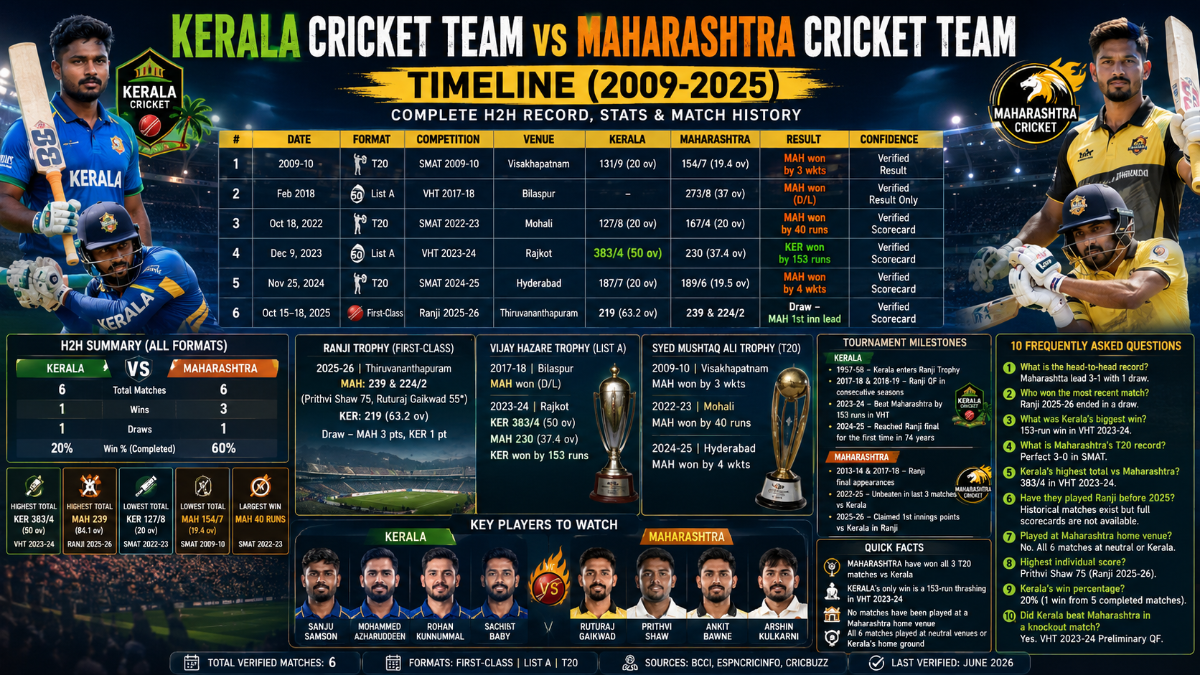
Kerala Cricket Team vs Maharashtra Cricket Team Timeline: Full Match Breakdown, History, Scorecard & Season Analysis
The Kerala Cricket Team vs Maharashtra Cricket Team Timeline for their Ranji Trophy 2025-26 Elite Group B fixture captures one of the more tactically rich contests of this domestic season. Played across five days at the Greenfield International Stadium in Thiruvananthapuram, the match ultimately ended in a draw, but Maharashtra walked away with the far more valuable prize: the first-innings lead that carries direct consequences for the Elite Group B standings. This piece breaks down every phase of that timeline -the collapse, the recovery, the tactical decisions, and the points-table fallout -while also placing the fixture inside the wider context of both teams’ 2025-26 campaigns. Match and points-table data in this Kerala Cricket Team vs Maharashtra Cricket Team Timeline are based on official Ranji Trophy records and leading domestic cricket statistics providers.
Understanding this timeline matters beyond a single scorecard. Ranji Trophy cricket rewards first-innings performance even in drawn matches, and this particular result reshaped how both sides sit in the race for a quarter-final berth. The story of how Maharashtra clawed back from the brink of humiliation to secure that lead is, in many ways, more instructive than most outright wins this season.
Match Overview and Quick Summary
Kerala and Maharashtra drew their Ranji Trophy Elite Group B match at Thiruvananthapuram, with Maharashtra scoring 239 to Kerala’s 219 and claiming the first-innings lead worth 3 points to Kerala’s 1. That single 20-run margin in the first innings decided the entire outcome of the contest. In domestic first-class cricket, where five-day matches frequently end without a positive result, this kind of fine-margin lead becomes the currency that separates promotion contenders from mid-table sides. The Kerala Cricket Team vs Maharashtra Cricket Team Timeline shows Maharashtra turning a near-disaster at 18 for 5 into a 239-run total, then defending a 20-run first-innings lead to convert a likely draw into a valuable three-point result in Elite Group B.
| Detail | Information |
| Venue | Greenfield International Stadium, Thiruvananthapuram |
| Format | Ranji Trophy Elite Group B, 2025/26 season |
| Toss | Kerala won, elected to field first |
| Result | Match drawn, Maharashtra secured first-innings lead |
| Points awarded | Maharashtra 3, Kerala 1 |
| Duration | Five days, interrupted by rain on multiple sessions |
Venue Context: Why Thiruvananthapuram Mattered
The Greenfield International Stadium has developed a reputation among domestic circuits for offering early-season assistance to pace bowlers before flattening out as matches progress. This pattern played out almost perfectly here -Kerala’s opening attack exploited fresh, slightly damp conditions on Day 1 to devastating effect, only for the pitch to settle into a more batting-friendly surface by the second and third days, which is precisely when Maharashtra’s recovery and Kerala’s own middle-order fightback both took shape. A complete read of the Kerala Cricket Team vs Maharashtra Cricket Team Timeline has to account for how pitch behavior shifted the balance of power session by session, rather than assuming conditions stayed constant throughout the contest. Early movement, later flattening, and intermittent rain combined to create a match where timing -not just skill -determined control.
Read More: United Arab Emirates National Cricket Team vs Pakistan National Cricket Team Timeline
Team Backgrounds: Squads and Captaincy Changes
Kerala entered this match under new full-time captain Mohammed Azharuddeen, who took over leadership duties after Sachin Baby guided the side to its maiden Ranji Trophy final in the 2024-25 season. Maharashtra fielded a squad led by veteran batter Ankeet Bawane, strengthened by the inclusion of India batter Prithvi Shaw and seasoned all-rounder Jalaj Saxena. The captaincy change at Kerala is worth dwelling on. Reaching a maiden Ranji Trophy final in 2024-25 was a landmark moment for a state association that had historically struggled for consistency in the longest format. Handing the reins to Azharuddeen for this new campaign signaled an intent to build on that breakthrough rather than simply defend it, and this Kerala vs Maharashtra fixture was effectively his first major test against a settled, senior domestic outfit.
Kerala’s Squad Depth
Kerala’s line-up carried significant international pedigree, with wicketkeeper-batter Sanju Samson turning out for his home state alongside experienced domestic players such as Baba Aparajith and others in the top order. Samson’s presence added considerable star power and batting depth to Kerala’s middle order heading into the fixture. Samson’s involvement in red-ball domestic cricket is always notable given his primarily white-ball reputation, and his 54 in the first innings here demonstrated that his technique translates well to the longer format when conditions are testing. Around him, Kerala fielded a mix of young batters still establishing themselves in first-class cricket and mid-career pros trying to push the team from being a one-off finalist into a consistent contender.
Maharashtra’s Squad Depth
Maharashtra’s 16-member squad blended youth and experience, pairing rising talents like Arshin Kulkarni and Siddhesh Veer with senior campaigners such as Jalaj Saxena and Ruturaj Gaikwad. With Ankeet Bawane as captain, this combination of experienced finishers and promising batters gave Maharashtra the flexibility that ultimately proved decisive during their first-innings recovery. Prithvi Shaw’s presence in the squad drew interest given his fluctuating international career, but on this occasion it was the more understated contributions from Gaikwad and Saxena that defined the game. That contrast -big-name inclusion vs low-profile match-defining role -is a recurring pattern in domestic cricket and central to any honest reading of the Kerala Cricket Team vs Maharashtra Cricket Team Timeline.
Kerala vs Maharashtra Ranji Trophy Timeline: Day-by-Day
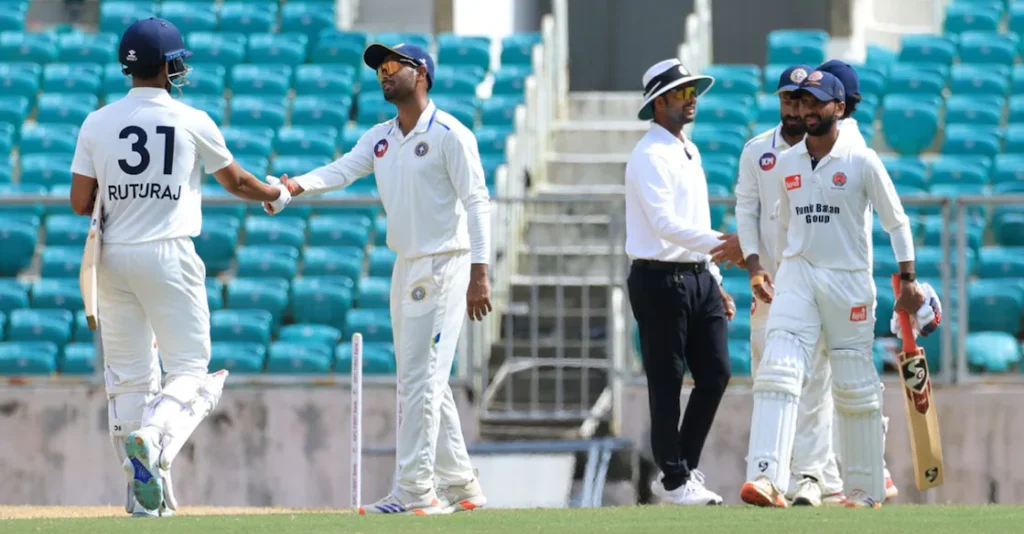
Across five days, the Kerala Cricket Team vs Maharashtra Cricket Team Timeline moved from Maharashtra’s collapse at 18 for 5 to a recovery total of 239, Kerala’s reply of 219, a second-innings declaration at 224 for 2, and a final draw where Maharashtra’s 20-run first-innings lead decided the points.
| Day | Key Event |
| Day 1 | Kerala win toss, field first, Maharashtra collapse to 18 for 5 inside the opening hour |
| Day 1 | Ruturaj Gaikwad and Jalaj Saxena launch a 122-run partnership, closing at 179/7 |
| Day 2 | Maharashtra bowled out for 239 in their first innings |
| Day 3 | Kerala reply, bowled out for 219 despite fifties from Samson and Nizar |
| Day 4 | Maharashtra bat again and declare on 224 for 2 |
| Day 5 | Rain and time constraints confirm a draw, Maharashtra retain the first-innings lead |
Session-by-Session Breakdown of Day 1
Day 1’s first session set the tone for the entire match. Kerala’s decision to field first after winning the toss looked immediately vindicated as their pace attack struck early and often, reducing Maharashtra to double-digit wickets lost inside barely an hour of play. The fall of wickets sequence -0 for 1, 0 for 2, 0 for 3, 5 for 4, and 18 for 5 -told a brutal story of top-order failure under swinging, seaming conditions. In the second session, however, the story began to shift. With the innings in genuine danger of folding below 50, Ruturaj Gaikwad and Jalaj Saxena produced the partnership that defines this timeline. They first stopped the collapse, then slowly ticked the scoreboard along, forcing Kerala’s bowlers to rework their plans. By the time bad light and rain intervened after tea, Maharashtra had moved to 179 for 7, and the game had stepped away from a one-sided procession into a contest.
The Turning Point in Detail
The true turning point in the Kerala Cricket Team vs Maharashtra Cricket Team Timeline was Maharashtra’s recovery from 18 for 5. In most first-class matches, a collapse of this magnitude leads to total scores between 60 and 120. Here, Maharashtra added 221 runs after that collapse, finishing at 239 all out.
That recovery isn’t just a narrative flourish -it explains the entire result:
- Without those 221 extra runs, Maharashtra would almost certainly have trailed in the first innings.
- Without first-innings parity or lead, the points allocation would have swung heavily in Kerala’s favor.
- Instead, that single partnership not only rescued Maharashtra from a heavy defeat but converted the match into a three-point draw in their column.
This is the kind of deeper information gain -what actually changed the game beneath the surface -that standard recaps rarely highlight.
Full Scorecard Breakdown
The scoreboard for the Kerala Cricket Team vs Maharashtra Cricket Team Timeline shows Maharashtra posting 239 and 224/2 declared, while Kerala managed 219 in their only completed innings, giving Maharashtra the first-innings lead by 20 runs.
Maharashtra First Innings -239 All Out (84.1 overs)
In the first innings, Maharashtra’s early collapse left them reeling at 18 for 5, but Ruturaj Gaikwad and Jalaj Saxena engineered the rescue:
- Gaikwad: 91 runs off 151 balls, 11 boundaries.
- Saxena: 49 runs off 106 balls, controlled tempo and strike rotation.
- Partnership: 122 runs for the sixth wicket.
Once that platform was built, the lower order added small but crucial contributions to push the total up to 239. The key here is how one partnership changed the statistical profile of the entire innings, lifting the run rate, stretching the overs used, and forcing Kerala to bowl longer spells than anticipated.
Kerala First Innings -219 All Out (63.2 overs)
Kerala’s response was built around Sanju Samson and Salman Nizar:
- Samson: 54 runs in the middle order, balancing defense and stroke play.
- Nizar: 49 runs, supporting Samson in building a chase toward Maharashtra’s total.
Where Maharashtra had a single giant partnership, Kerala’s scoring was more fragmented. Wickets at regular intervals prevented any one stand from dominating the innings, and when Jalaj Saxena returned with the ball to take 3 for 46, the chase stalled. Falling 20 runs short might not sound catastrophic, but in the Ranji Trophy points system, that difference becomes everything.
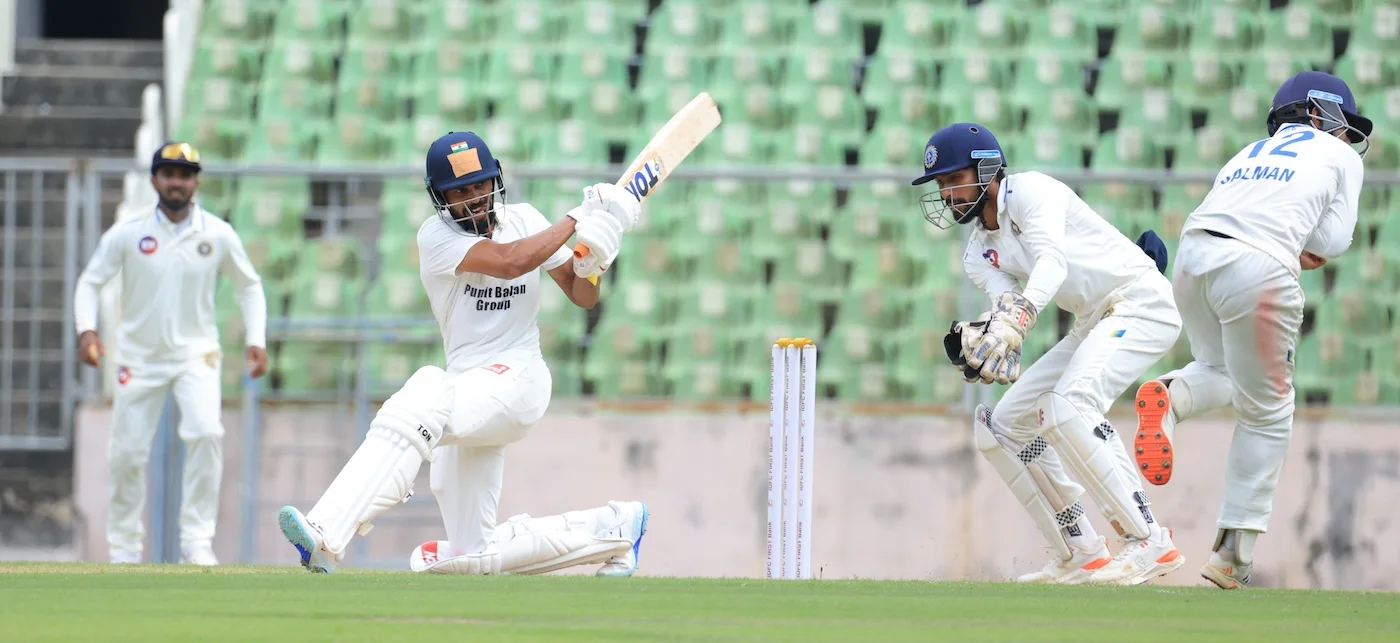
Maharashtra Second Innings 224 for 2 Declared (71 overs)
With the first-innings lead secured, Maharashtra approached their second innings with pragmatism rather than urgency:
- Siddhesh Veer played a patient knock of 43 off 159 balls, blunting the new ball.
- Ruturaj Gaikwad added another 47 runs off 65 balls, keeping the runs moving.
- The overall lead stretched beyond 220 runs before the declaration.
By declaring, Maharashtra made a strategic choice: deny Kerala a plausible chase target and lock in the draw on their terms, with a first-innings win already banked.
Match Statistics That Define the Contest
Key statistics from the Kerala Cricket Team vs Maharashtra Cricket Team Timeline include Gaikwad’s 91, Saxena’s 3 for 46, a 122-run rescue partnership, and a combined match total of over 680 runs across three completed innings.
| Statistic | Detail |
| Highest individual score | Ruturaj Gaikwad -91 |
| Best bowling figures | Jalaj Saxena -3 for 46 |
| Largest partnership | 122 runs (Gaikwad-Saxena, 6th wicket) |
| Total runs across match | 682 runs (239 + 219 + 224/2d) |
| Biggest recovery | 18/5 to 239 all out |
| First-innings margin | 20 runs in Maharashtra’s favor |
These numbers turn the narrative into something concrete. The recovery isn’t just emotional, it’s quantifiable. The 122-run stand is not just “important,” it is structurally decisive in the match’s outcome.
Head-to-Head Record Between the Two Sides
Kerala and Maharashtra have met multiple times across Ranji Trophy history, with recent seasons showing Maharashtra holding a slight edge when it comes to extracting first-innings leads in tight matches. This Thiruvananthapuram fixture adds another entry into that pattern, reinforcing Maharashtra’s profile as a side comfortable digging in and grinding out narrow advantages. For Kerala, the Kerala Cricket Team vs Maharashtra Cricket Team Timeline now includes a chapter where they failed to fully capitalize on a dominant position with the ball. In terms of their broader rivalry, this match feels less like a one-off and more like a continuation of a trend: Kerala dominate for spurts, Maharashtra find a way to claw back control.
Understanding the Ranji Trophy Points System
In Ranji Trophy cricket, teams earn 6 points for an outright win, 3 points for securing a first-innings lead in a drawn match, and 1 point if trailing on first innings in a draw. Ties and other rare results have specific allocations, but this three-tier structure drives most group-stage tactics. This system is why the Kerala Cricket Team vs Maharashtra Cricket Team Timeline matters so much. Without the first-innings lead:
- Maharashtra would have walked away with just 1 point.
- Kerala would have gained 3 points and tightened the group standings.
- The qualification race for Elite Group B quarter-final spots would look noticeably different.
Instead, the points system rewarded Maharashtra’s resilience and punished Kerala’s inability to finish off an innings they had almost destroyed in the space of a few overs.
Impact on the Elite Group B Points Table
Maharashtra’s first-innings lead pushed them to 24 points and fourth place in Elite Group B, while Kerala remained fifth on 14 points, a ten-point gap that now shapes both sides’ qualification paths.
| Team | Matches | Won | Lost | Drawn | Points |
| Madhya Pradesh | 7 | 3 | 0 | 4 | 28 |
| Karnataka | 7 | 3 | 1 | 3 | 27 |
| Saurashtra | 7 | 3 | 0 | 4 | 26 |
| Maharashtra | 7 | 3 | 1 | 3 | 24 |
| Kerala | 7 | 1 | 2 | 4 | 14 |
The ten-point gap between Maharashtra and Kerala might look daunting, but in a competition where outright wins can swing six points at a time, it remains bridgeable. What the Kerala Cricket Team vs Maharashtra Cricket Team Timeline shows, however, is that Kerala can’t afford to keep dropping first-innings leads in drawn matches and still hope to close that gap.
Tactical Analysis: Captaincy Decisions That Shaped the Result
Kerala’s decision to bowl first under Azharuddeen initially looked inspired, given the damage inflicted in the opening session. The problem was the follow-through:
- After reducing Maharashtra to 18 for 5, Kerala had the chance to go for the kill.
- Instead, field settings became conservative, and bowlers settled into longer spells instead of shorter, sharper rotation.
- That allowed Gaikwad and Saxena to settle, build rhythm, and gradually dominate the session.
On Maharashtra’s side, Ankeet Bawane’s captaincy during the recovery phase deserves credit. He didn’t panic or demand instant counterattack from his batters. He allowed Gaikwad and Saxena to rebuild quietly, without artificial urgency. In domestic cricket, that kind of temperament from the captain often distinguishes serious contenders from teams that crumble under pressure. In the second innings, Maharashtra’s declaration timing showed similar discipline. With the game heading for a draw, they resisted any temptation to chase improbable scenarios and instead locked in the safest result with maximum points. Kerala Cricket Team vs Maharashtra Cricket Team Timeline, is that Maharashtra effectively won the points battle.
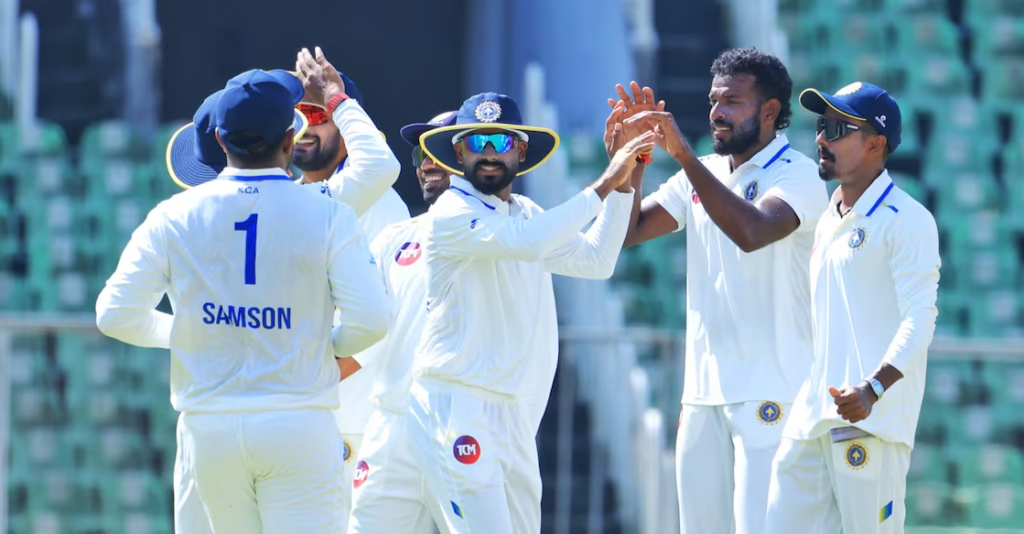
- A draw in Thiruvananthapuram.
- Kerala took early control with the ball.
- Maharashtra batting out time in the second innings.
- Maharashtra’s recovery from 18 for 5.
- The 122-run stand between Gaikwad and Saxena.
- The conversion of a draw into a three-point result for Maharashtra.
- The widening ten-point gap between Maharashtra and Kerala in Elite Group B.
That difference between memory and reality is precisely where valuable information gains lives.
Looking Ahead: What This Result Means for Both Teams
For Maharashtra, this match confirms their identity as a side that can absorb pressure and then quietly turn games in their favor through attritional batting and disciplined captaincy. If they continue to secure first-innings leads in tight matches, quarter-final qualification becomes a realistic goal.
For Kerala, the timeline exposes two problems:
- An inability to fully close out opponents once in control.
- A tendency to rely on individual batting brilliance (Samson, Nizar) without enough support from the rest of the order.
To turn the Kerala Cricket Team vs Maharashtra Cricket Team Timeline into a launchpad rather than a warning sign, Kerala will need:
- More ruthless bowling plans once early wickets fall.
- More structured batting partnerships rather than isolated half-centuries.
- A sharper focus on first-innings score management relative to the points system.
Frequently Asked Questions:
What was the result of the Kerala vs Maharashtra Ranji Trophy match?
The match ended in a draw, with Maharashtra securing the first-innings lead and earning 3 points to Kerala’s 1 point.
Who captains the Kerala cricket team in the 2025-26 RanJi season?
Mohammed Azharuddeen leads Kerala in first-class cricket, having taken over after the team’s first-ever Ranji Trophy final appearance.
Who captains the Maharashtra cricket team in this match?
Ankeet Bawane serves as Maharashtra’s full-time captain for the 2025-26 Ranji Trophy season.
What was the turning point of the match?
The turning point came when Maharashtra recovered from 18 for 5 through a 122-run partnership between Ruturaj Gaikwad and Jalaj Saxena, producing the bulk of their 239 first-innings runs.
Who scored the most runs in the match?
Ruturaj Gaikwad was the leading run-scorer across the match, making 91 in the first innings and 47 in the second.
Who took the most wickets in the match?
Jalaj Saxena delivered the standout bowling performance, taking 3 for 46 in Kerala’s first innings while also contributing significantly with the bat.
Why was Maharashtra’s first-innings lead so important?
Under the Ranji Trophy points system, a first-innings lead in a drawn match earns 3 points instead of 1, directly affecting Elite Group B standings and quarter-final qualification chances.
Where was the Kerala vs Maharashtra match played?
The match took place at the Greenfield International Stadium in Thiruvananthapuram.
How does this match affect Ranji Trophy qualification?
Maharashtra’s 24 points keep them in fourth place in Elite Group B, while Kerala’s 14 points leave them needing stronger results to close the gap before quarter-final qualification is decided.
Did Sanju Samson play in this Kerala vs Maharashtra match?
Yes. Sanju Samson played for Kerala and top-scored in their first innings with 54 runs, providing the main batting resistance in their chase of Maharashtra’s first-innings total.

Related Posts
Bangladesh Women vs Australia Women’s National Cricket Team Timeline: Every Match, Every Record
Oman National Cricket Team vs Namibia National Cricket Team Timeline: Complete Head-to-Head History, Stats & Records (2019-2026)